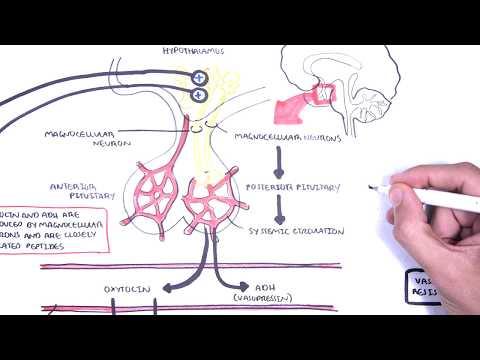
Oxytocin | The Love Hormone | Endocrinology 🩺
A short classroom-style lecture where Dr. Najeeb explains oxytocin as a bonding hormone and contrasts it with the dopamine-driven early phase of love.
With Dr. Najeeb
Key moments
Tap a moment to play the video from there.
- 0:00Do males have oxytocin?Najeeb quizzes his audience on whether males produce oxytocin and what it might do in them.
- 0:32Oxytocin as the bonding hormoneHe calls it a cuddle and loving hormone, released with touch, hugging, kissing and especially orgasm, acting on neurons to build emotional bonds.
- 1:04Sex differences in bondingHe says females usually release more oxytocin and so bond more strongly, while men bond more weakly and can drift away.
- 2:04Early love runs on other chemicalsHe says the first stage of love depends on dopamine and norepinephrine, not oxytocin, and that these suppress analytical brain areas.
- 3:05Why bonding follows the excitementHe argues oxytocin rises over time so that a couple stays bonded long enough to raise a child.
- 4:06Chasing the early phaseHe describes some men as addicted to the early excitement and seeking it repeatedly, while oxytocin keeps family bonds in place.
- 5:37Why the spell breaksHe says the excitatory phase lasts about 6 months to two years, then fades so that life is not disrupted.
- 7:10Passionate to affectionate loveHe closes by saying passionate love turns into affectionate love as passion fades and affection continues.
What the video says
This is a 7 minute lecture from Dr. Najeeb Lectures, an endocrinology series. It is a conversational teaching clip rather than a research talk, and it covers oxytocin only from a social and emotional angle. It does not discuss oxytocin as a medicine, a dose, or a product.
Najeeb opens by asking his audience whether males also have oxytocin. He says they do, and describes it as a bonding or cuddle hormone. According to him, touch between two people, hugging, kissing and especially orgasm release oxytocin, which acts on neurons in the central nervous system to build emotional bonding. He adds that females usually release more oxytocin than males, and offers this as the reason women bond more strongly while men bond more weakly and can drift away more easily.
He then separates oxytocin from the early, intense stage of love. In his account, that early phase depends on dopamine, norepinephrine and serotonin, which keep the brain in a heightened state, dampen analytical areas and boost emotional ones. He says this phase lasts roughly 6 months to two years, and that nature designs it to fade so that people can get back to other parts of life.
Najeeb says that as the excitement fades, rising oxytocin holds a couple together, which he links to caring for a child over many years. He describes passionate love, driven by dopamine and norepinephrine, turning into affectionate love over time. He also makes several broad claims about how men and women behave in relationships. These are his opinions in a teaching setting, not findings he cites from studies.
On each compound
Oxytocin0:32
Najeeb describes oxytocin as a bonding, cuddle and loving hormone that is released with touch and orgasm and acts on neurons in the central nervous system to create emotional bonding. He says females release more of it than males.
See how your DNA reads Oxytocin“oxytocin is a bonding hormone. It's a cuddle hormone.”
What this video doesn’t settle
- The video gives no studies or data, so the claims about oxytocin and sex differences in bonding are the lecturer's statements only.
- It does not cover oxytocin as a supplement, injection or nasal product, or any dosing, effects or safety of taking it.
- The comparisons between men's and women's relationship behavior are broad generalizations from one speaker, not established in the video.
Questions this video answers
What does oxytocin do according to Dr. Najeeb?
Najeeb says oxytocin is a bonding hormone that acts on neurons in the central nervous system to build emotional attachment between people. He says it is released with touch, hugging, kissing and especially orgasm.
Do men have oxytocin?
Najeeb says males also have oxytocin, and that it helps them bond. He adds that females usually release more of it, which he links to women bonding more strongly.
Is oxytocin responsible for the early rush of falling in love?
According to Najeeb, no. He says the early phase of love depends on dopamine and norepinephrine, with serotonin also mentioned, and that oxytocin takes over as that phase fades.
How long does the early phase of love last in this video?
Najeeb says it usually lasts 6 months to two years, depending on the couple. He then describes oxytocin holding the couple together and passionate love turning into affectionate love.
Video by Dr. Najeeb Lectures on YouTube, embedded as published. The summary is written by PeptidesDNA from the video; every claim in it is the speaker’s. Not affiliated with or endorsed by the creator. Not medical advice.