Sample report: synthetic genetic data for demonstration only
This report has not been evaluated by the FDA. It is for educational and informational purposes only. It is not intended to diagnose, treat, cure, or prevent any disease. Not a substitute for professional medical advice. PeptidesDNA is not a medical practice, pharmacy, or healthcare provider. Consult a qualified healthcare provider before making any health-related decisions.
● Your report
John Doe · August 13, 2026
Your genomic peptide report is ready.
We read every variant in your file and scored the peptide compounds against your biology. Below is your whole genome, with the genes behind your matches lit up where they sit.
0
Variants read
0
Genes lit
0.0%
No-calls
Raw genotype
Source
Each bar is a chromosome; brighter = denser coverage. Glowing pins are your scored genes. Tap to zoom.
0
Markers found
of 144 targets
0
Peptides scored
compounds
0%
Top match
of its genetic case
0%
Data coverage
35 missing
● What your DNA says
Your biological systems
Here are the 13 parts of your biology your file had something to say about. The number beside each one is simply how much of what we read there turned into a real finding. A low number means we found little, not that something is wrong.
Cagrilintide leads at 73% of its genetic case, built from three findings that reinforce each other: two MC4R appetite-risk copies that raise hunger and food intake, two -receptor copies that mute the fullness signal coming back from fat tissue, and one FTO appetite copy pushing the same way. CagriSema at 67%, at 64% and MariTide at 64% draw on largely the same markers, while Melanotan II and PT-141, both at 67%, reach the MC4R receptor itself from the pigment and desire side rather than the appetite side. Your Appetite & Weight domain reads 48 of 100, with 5 of its 11 markers producing findings, and those findings sit on the melanocortin and leptin arms these compounds act through.
Recovery & Tissue Repair
COL5A1COL5A1 rs12722 CCchr 9Strength
100%
6 of 6
Tendons and joints read strong
Sturdy
SturdyFragile
You carry versions of two genes, COL5A1 and , that build tougher tendon and ligament tissue, the pattern that tracks with fewer ruptures and fewer tendon injuries. You also make more of GDF5, a factor that builds and maintains joint cartilage, which goes with less knee and hip osteoarthritis. Pulling the other way, your version breaks tissue down more actively as it remodels it and has been tied in some groups to greater tendon wear, while your HIF1A and TGFB1 results add small effects that sit in the middle.
Upside: Your COL5A1 result is linked to a lower risk of tendon injury.
Trade-off: The same result may come with slightly less flexibility.
COL5A1C/CCOL1A1T/TGDF5C/CMMP3G/GHIF1AC/TTGFB1A/G
What it means for you
Nothing here asks you to act. Your connective tissue is already on your side, so the repair peptides in your list, and , are tools for treating a real injury rather than something your DNA is asking for. Warming up properly and working on range of movement will do more for you than either of them.
You carry one copy of the BDNF change that lowers the on-demand release of the protein your brain uses to lock in something new, so a fresh memory can fade a little faster overnight. Your serotonin transporter at SLC6A4 runs at the quietest of the common settings, which tracks with greater stress reactivity, and one copy at ANKK1/DRD2 leaves you with fewer of the dopamine receptors that register reward. On the other side, your main OXTR result points to stronger empathy and better social buffering against stress and your GABRA2 result leans toward less anxious impulsiveness, while a second OXTR site, DBH, HTR2A and TPH2 add small or weakly supported leans and COMT was read here without adding a finding.
Upside: You tend toward stronger empathy and social stress-buffering, and your brain appears more responsive to oxytocin.
Trade-off: It costs you nothing on its own, and it does nothing for the memory and stress-reactivity findings that make up the rest of this area.
Expect to handle people and social pressure well, and expect new material to need a second pass rather than one. Semax in the morning is the compound aimed at the memory side and Selank at the stress side, kept for hard stretches rather than taken daily. Keep them in separate parts of the day, because one is stimulating and the other is calming.
Inflammation & Immune
TNFrs1800629 TNF -308 GA (A-allele carrier)chr 6Watch
75%
7 of 9
Inflammatory tone leans warm
Balanced
CoolWarm
You carry a version of TNF that pushes one of your main inflammatory signals a little higher than average, plus two separate NLRP3 results that make the alarm system inside your immune cells trip more readily, and an IL6 result that may add to that tone on mixed evidence. Working against all of it, you make plenty of IL-10, your body's own calming signal, and one of your PTGS2 copies may soften how hard the inflammation enzyme COX-2 ramps up when tissue is stressed. Your ADA result is a rare one that points toward slower breakdown of adenosine and stronger sleep pressure, though almost nobody with this exact pattern has been studied; CRP and IL1B were read here and had nothing to add.
Upside: The TNF finding is one modest nudge in a single signal rather than a broad problem with your immune system.
Trade-off: That version can drive the signal a bit higher than average.
TNFG/AIL6G/GNLRP3C/AIL10G/GPTGS2C/GADAA/ACRPIL1B
What it means for you
If you notice you inflame easily after training or illness, that is consistent with what your file shows, and sleep, training load and food do more about it than any compound. Two peptides in your list meet these findings at different levels: KPV, which calms inflammation in the gut lining, and Thymosin Alpha-1, which adjusts the immune system's broader tone. They do not overlap, so using them together is reasonable with a doctor involved.
Your tissues answer insulin well: the IRS1 result you carry is the one linked to better insulin sensitivity, and your SLC30A8 result goes with a stronger first burst of insulin after a meal. The release side carries more weight here, though, because IGF2BP2 and KCNQ1 both lean toward putting out less insulin, one ADCY5 copy ties to weaker glucose-driven release, and one TCF7L2 copy sits in the pathway that turns post-meal gut signals into insulin. You also carry a quieter GIPR copy, a GLP1R change that may subtly shift how you answer medicines without predicting it, and a PNPLA3 result tied to the liver holding on to fat rather than releasing it; KCNJ11, GIP, PPARG, ADIPOQ and DIO2 were read here and stayed quiet.
Upside: Your IRS1 result is associated with better insulin sensitivity, so your tissues answer the insulin you do release.
Trade-off: It says nothing about how much insulin you release, which is where the rest of this area leans.
Meal composition and carbohydrate timing are worth real attention for you, and it is worth asking your doctor for a fasting glucose and HbA1c so you have a baseline instead of a guess. The appetite drugs at the top of your report, and tirzepatide, work on exactly the insulin-release step these results thin out. The liver finding is a conversation for a clinician, not something a gene result settles on its own.
Growth Hormone & Muscle
ACTN3ACTN3 rs1815739 CC (R577/R577)chr 11Strength
69%
5 of 8
Growth-hormone genetics look favourable
Responsive
ResponsiveBlunted
You make full alpha-actinin-3 in your fast-twitch muscle fibres, the pattern that turns up more often in sprint and power athletes. You also carry the standard full-length growth-hormone receptor, the reference against which any growth-hormone-raising approach is judged, and an IGFBP3 result that tracks with the highest levels of IGF-1's main carrier protein, a helpful background for those approaches. Your IGF1R may run slightly quieter in a way loosely tied to longer life, your GDF15 result mainly skews some laboratory measurements rather than predicting anything about you, and GHRHR, GHSR and ACE were read here without adding a finding.
Upside: You make full alpha-actinin-3 in fast-twitch muscle, the pattern that favours power and sprint performance.
Trade-off: It describes fibre type only, so it says nothing about how much muscle you carry or how quickly you recover.
Sprint and power work suits how you are built, and the receiving end of the growth-hormone system looks capable of answering if it were ever raised. In your list, paired with at bedtime is the combination that fits this background, and Tesamorelin is the swap if fat around the organs is the specific target. None of that is a reason to start; it is a reason these would suit you if you and a doctor decided to.
You carry two copies of a PPARGC1A change tied to less mitochondrial energy capacity, so the parts of your cells that generate energy are built up and run at a slightly lower level than average. Against that, your KLOTHO result is the version several studies link to better aging and cognition, and your NRF1 result leans toward stronger signalling to build new mitochondria, though that evidence is thin. FOXO3 was read here and came back as the common version, without the longevity-linked change.
Upside: The finding names one specific step, how much energy capacity your cells build, rather than making a broad claim about how you age.
Trade-off: Two copies of the change are linked to reduced mitochondrial energy capacity.
PPARGC1AA/AKLOTHOT/GNRF1A/AFOXO3
What it means for you
Endurance training is the strongest lever anyone has on this, and it costs nothing. If you want a compound aimed at the same target, MOTS-c and SS-31 both work on mitochondria, though neither has been tested properly in people. Epithalon rests almost entirely on the aging-related result here and comes from a single research group, so treat its case as weak.
Stress & Cortisol
FAAHrs324420 AA (low FAAH / high anandamide)chr 1Strength
67%
2 of 3
Naturally calm, cortisol lingers
You keep the calming natural cannabinoid anandamide at the top of the usual range, thanks to your FAAH result, and that pattern goes with lower anxiety and faster recovery after a fright. One FKBP5 copy pulls the other way, stretching out how long cortisol stays raised after a stressful event, an effect that matters most in people who also had a hard early life. CRHR1 was read here and stayed quiet.
Upside: You keep the highest levels of anandamide, the calming cannabinoid, which is linked to lower anxiety and quicker recovery from fear.
Trade-off: Nothing attaches to this one on the cost side, and it does not shorten the drawn-out cortisol response the other finding describes.
FKBP5C/TFAAHA/ACRHR1
What it means for you
Your baseline calming chemistry is generous, so you likely need less help here than most people do. Selank is the compound in your list aimed at this, and it fits as an occasional tool for demanding weeks rather than something daily. Protecting wind-down time after stressful days is worth the effort, since your cortisol takes longer than average to settle.
You carry the low-function version of SLCO1B1, the transporter that pulls statin drugs into your liver; with it working poorly, statin levels in your blood run higher and the risk of muscle side effects rises with them. You also carry a VKORC1 result that makes you moderately more sensitive to warfarin, so a lower than standard dose would be needed. Both findings concern prescription medicines rather than peptides, and was read here without producing anything peptide-relevant.
Upside: Knowing both of these before a prescription is written is exactly the kind of thing a doctor can act on.
Trade-off: The low-function transporter sharply raises statin levels and muscle side-effect risk.
SLCO1B1C/CVKORC1G/ACYP2C9
What it means for you
Tell any doctor who is about to put you on a cholesterol drug or a blood thinner about these two results, because they change which drug and which dose makes sense. Nothing in your peptide list changes dose because of them, since peptides are broken down by entirely different enzymes. Do not stop or adjust any medicine you are already taking on the strength of this report.
Vitamins & Nutrients
GCrs2282679 TT (GC) vitamin-D binding protein favorablechr 4Strength
62%
4 of 7
Vitamin D status looks favourable
Lower range
Lower rangeHigher range
Two separate results in GC, the gene behind vitamin D's carrier protein in your blood, both track with higher total vitamin D on a lab panel. Your BCO1 result converts the beta-carotene in foods like carrots and leafy greens into usable vitamin A at a normal rate. Your VDR sits in the middle with an uncertain effect on bone density, and LCT was read here as well.
Upside: Your GC pattern supports higher vitamin D levels, a favourable vitamin D status.
Trade-off: Sun exposure, body composition and diet still set most of where your level lands, so the gene alone does not guarantee it.
VDRG/AGCG/GBCO1A/ALCT
What it means for you
You are less likely than average to be running low on vitamin D, though a blood test is the only way to know and it is a cheap one. That favourable background also weakens the main argument for LL-37, the antimicrobial peptide in your list, which is part of why it sits near the bottom of your ranking.
One of your two MC1R copies is a red-hair version that weakens the receptor tanning peptides use to darken skin, so any tanning from them may be patchy while the flushing and nausea arrive anyway. Your SHBG result sits at the lower end of its range, which tends to leave a slightly larger share of your sex hormones circulating unbound, though many other factors set the actual level. FSHR and FSHB were read here and neither is used for anything in this report.
Upside: One working MC1R copy remains, so the pigment receptor is weakened rather than switched off.
Trade-off: Melanocortin peptides may tan you unpredictably while still causing flushing and nausea.
MC1RC/TSHBGG/GFSHRFSHB
What it means for you
If a tanning peptide ever comes up, expect less colour than other people report and do not answer that by raising the dose, because the nausea and flushing scale with dose while the tanning may not. That applies to Melanotan II most directly, and to the pigment side of PT-141 as well. Neither is something to start without a doctor, and Melanotan II is not legally sold for human use in most countries.
You carry two copies of the MC4R change that raises hunger and how much you eat, the strongest single finding in this area, though a second MC4R site adds one copy leaning subtly the other way. You also carry two copies of a LEPR change that weakens the fullness message sends from your fat tissue back to your brain, a pattern that tracks with higher body fat. Your UCP2 reads ordinary, so heat production looks typical, your PCSK1 is the common form of the enzyme that cuts hormone precursors into active hormones like , and ADRB2, UCP1, ADRB3, GHRL and one FTO site were read here too.
Upside: The finding names one specific mechanism, melanocortin appetite signalling, and that mechanism is what several compounds in your report act on.
Trade-off: Two copies of the appetite-risk version tend to raise your hunger and how much you eat.
Feeling hungrier than the people around you is not a failure of willpower in your case; the signal really does run louder. Protein at every meal, a predictable meal structure and enough sleep are the levers that work without a prescription. This cluster is also what puts cagrilintide at the top of your ranking and makes the approved way onto the same biology, both of which need a doctor.
One of your two NQO1 copies works poorly, which leaves you less able to neutralise certain reactive compounds and to recycle antioxidants back into usable form. You also carry the weakest version of NFE2L2, the master switch that turns on your cells' stress defences, so the two compound each other: less capacity sitting behind a weaker signal to build more of it. , GPX1 and ALDH2 were read here without pointing clearly in either direction.
Upside: Your second NQO1 copy still works, so this reads as reduced capacity rather than a missing enzyme.
Trade-off: The poorly working copy leaves less capacity in reserve for clearing reactive compounds and recycling antioxidants.
NQO1C/TNFE2L2A/ASOD2GPX1ALDH2
What it means for you
Vegetables, sleep and staying away from smoke do more for this than any supplement, and there is nothing here that needs treating. If you want compounds aimed at it, SS-31 and MOTS-c both target the same cellular machinery from different directions, though neither has controlled human evidence behind it. High-dose antioxidant pills are not the answer; food and recovery are.
Circadian & Sleep
CLOCKrs1801260 C/C (evening-leaning, both copies)chr 4Watch
33%
1 of 3
Body clock prefers late nights
You carry two copies of the evening-leaning CLOCK version, so your internal clock likely prefers a later bedtime and a later wake time than most people's. That leaves morning light, a fixed wake time and habit as the things that actually set your schedule, and they matter more for you than for most. MTNR1B and PER3 were read here and neither pushed your timing one way or the other.
Upside: Knowing your clock runs late means the fix is a schedule change rather than anything you have to take.
Trade-off: A later natural bedtime fights early starts, and consistent morning light and a fixed wake time matter more for you than for most.
CLOCKC/CMTNR1BPER3
What it means for you
A fixed wake time and bright light in the first hour of the day earn more for you than for most people, because your clock drifts late on its own. If the bedtime growth-hormone pair, with , ever comes into play, that late-running clock suits the timing. DSIP, the sleep peptide in your list, has almost no genetic case in your file and thin evidence behind it generally.
The appetite compounds earn their place on the widest genetic case in your file: Cagrilintide at 73%, CagriSema at 67%, and and MariTide at 64%, all resting on the same MC4R, LEPR and FTO findings. The two ranked above Semaglutide are investigational, so Semaglutide is the approved path, and it is the one here carrying a personalised dose note. Read the 100% figures further down the list, AOD-9604, MK-677 and , with their width in mind: each rests on one or two markers, so a perfect match there tells you far less than Cagrilintide's 73% across four genes. Outside appetite, three domains deserve attention. Recovery & Tissue Repair scores 100, with protective results at COL5A1 and and a joint-building GDF5 result, and only pulling the other way. Inflammation & Immune scores 75, where TNF, both NLRP3 sites and IL6 lean toward easier activation and your high-producing IL10 form supplies the counterweight. Cognitive & Mood at 84 splits down the middle: favourable OXTR and GABRA2 results set against one BDNF Met copy, one ANKK1/DRD2 copy and the lowest-expressing serotonin transporter, which is the gap Semax and Selank are positioned against. Two domains score zero for an honest reason rather than a worrying one: Methylation & B-Vitamins read six markers and Cardiovascular read two, and neither produced a finding that changes a peptide.
In plain English
Your DNA points most strongly toward Cagrilintide, matching 73% of its genetic case. You carry two copies of the FTO variant that dials down fat-cell heat production, so your body tends to store energy rather than burn it. You carry two copies of the MC4R appetite-risk , which tends to raise your hunger and food intake. You carry the IRS1 associated with better insulin sensitivity.
Your peptide matches
Based on your profile, here's what your genetics suggest.
Every compound is measured against your own file, then ranked by how much of its genetic case you match. Tap any one to see the markers behind it.
Two questions, on every row.Can it act on you: the part of your body it works through, usually a receptor. A variant that weakens that part caps the effect, and a bigger dose will not recover it. Do you need it: how many of its genes carry the variant it responds to. The count is always shown, because 2 of 2 and 2 of 10 are different claims.
Withdrawn means the evidence behind it was examined and retracted.
Should you take it
You are low here. You carry variants in the systems this compound acts on, and the ember length is the gap it would have to work in. The greyed systems came back clear.
You carry two copies of the MC4R appetite-risk , which tends to raise your hunger and food intake. You carry two copies of a -receptor variant that weakens the fullness signal coming back from your fat tissue, a pattern linked to higher body fat. You carry one copy of the FTO appetite/fat-storage variant, a mild nudge toward higher appetite that diet, sleep, and activity easily outweigh.
Why it ranks #1
Three of the four markers feeding Cagrilintide's score carry the variant it responds to, which is 73% of its genetic case, the strongest fit in your report.
What the research shows
Emerging
As monotherapy in REDEFINE 1, cagrilintide 2.4 mg produced 11.8% mean weight loss at 68 weeks, and earlier Phase 2 work showed dose-dependent loss up to about 10% over 26 weeks, meaningful for a single-hormone agent. Its greater value emerges in combination: agonism stacks with , and pairing it with (CagriSema) pushes weight loss above 22%, making it a key building block in next-generation combination therapy.
Your dose
0.6–4.5mgper dose
Under the skinOnce weekly
No change from your genetics
Long-acting amylin analogue, SC once weekly, titrated over ~4-6 weeks (trial range ~0.6-4.5 mg); 2.4 mg is the monotherapy dose studied in REDEFINE (~11.8% weight loss). Investigational as monotherapy, not approved on its own.
An amylin analogue on a different axis from the incretins; it is deliberately paired with semaglutide (CagriSema). Do not stack two amylin analogues, and do not assume it substitutes for a GLP-1 agonist.
When you take it
One half-life
Around a week
Every half-life, half of what you took is gone. Dosed once a week, that is 1 week between shots against a half-life of 1 week, so the next dose lands on 50% of the last one. The gap is set by that curve rather than by habit, and it is a property of the compound: nothing in your file changes it.
What to expect
Stomach complaints again, and again mostly while the dose is climbing. People describe it as milder than the GLP-1 drugs at comparable stages.
What most people notice
Nausea
Reduced appetite, which is the point
Constipation
Injection-site reactions
Worth keeping an eye on
Because it slows the stomach, anything else you take by mouth may absorb more slowly than you expect
Nausea tracked the dose and settled once people reached their maintenance level. Phase 2 dose-finding trial, Lancet, 2021.
Your markers6 for this compound
Do you need ityou carry 3 of these 4
CC
rs17782313MC4R
you carry two copies of the MC4R appetite-risk allele, which tends to raise your hunger and food intake.
rs1137101LEPR
rs1137101 LEPR: you carry the variant this compound responds to.
CC
rs9939609FTO
you carry two copies of the FTO variant that dials down fat-cell heat production, so your body tends to store energy rather than burn it.
CC
rs10830963MTNR1B
you carry the common MTNR1B form with no copy of the glucose/melatonin risk variant, so this locus reads typical.
Also in your filerelated findings we hold, which carry no weight for this compound
GG
rs1137101LEPR
you carry two copies of a leptin-receptor variant that weakens the fullness signal coming back from your fat tissue, a pattern linked to higher body fat.
Counted onceinherited together with a marker above, so the two are one signal
AT
rs1421085FTO
you carry one copy of the FTO appetite/fat-storage variant, a mild nudge toward higher appetite that diet, sleep, and activity easily outweigh.
Should you take it
You are low here. You carry variants in the systems this compound acts on, and the ember length is the gap it would have to work in. The greyed systems came back clear.
You carry two copies of a -receptor variant that weakens the fullness signal coming back from your fat tissue, a pattern linked to higher body fat. You carry two copies of the MC4R appetite-risk , which tends to raise your hunger and food intake. You carry one copy of a common variant in the GDF-15 gene. What it is known to change is how some laboratory tests measure GDF-15, and it is not a reliable guide to how you would feel on any medicine.
Why it ranks #2
Four of the five markers feeding CagriSema's score carry the variant it responds to, which is 67% of its genetic case and why it sits at #2 in your list.
What the research shows
Emerging
In the 68-week REDEFINE 1 trial, CagriSema (2.4 mg/2.4 mg) produced 22.7% mean weight loss versus 16.1% for alone, 11.8% for cagrilintide alone, and 2.3% for placebo, with 40% of participants losing 25% or more. The combination clearly beat either component as monotherapy, and REDEFINE 2 confirmed benefit in people with type 2 diabetes alongside broad cardiometabolic improvements.
Your dose
2.4mgper dose
Under the skinOnce weekly
No change from your genetics
Fixed-dose SC once weekly: cagrilintide 2.4 mg + semaglutide 2.4 mg, reached by parallel step-wise titration (0.25 mg-equivalent steps up over ~16 weeks, mirroring semaglutide). Investigational/FDA-filed (REDEFINE trials), not yet approved.
The note excludes a whole class; these are the ones in your report.
Already a GLP-1 plus amylin combination; do not add any other GLP-1/GIP agonist or amylin analogue. Titration follows the semaglutide-style schedule for tolerability.
When you take it
One half-life
About a week for both parts, which is why it is weekly
Every half-life, half of what you took is gone. Dosed once a week, that is 1 week between shots against a half-life of 1 week, so the next dose lands on 50% of the last one. The gap is set by that curve rather than by habit, and it is a property of the compound: nothing in your file changes it.
What to expect
Two appetite hormones at once does not mean twice the side effects, but it does mean the same stomach complaints as semaglutide, and they arrive in the same pattern: during the build-up, easing after.
What most people notice
Nausea
Constipation
Vomiting, more often than with semaglutide alone
Appetite dropping off hard, which is the amylin half doing its job
Reflux
Worth keeping an eye on
Eating so little that protein intake collapses, which costs muscle
Low blood sugar if you also take insulin or a sulfonylurea
Both components are raised together over several weeks, and that period is where nearly all of it lands. REDEFINE Phase 3 programme.
Your markers12 for this compound
Can it act on you1 marker on the part it works through
rs6923761GLP1R
rs6923761 GLP1R: we read this marker and there is no variant here that predicts anything.
Do you need ityou carry 4 of these 5
CC
rs17782313MC4R
you carry two copies of the MC4R appetite-risk allele, which tends to raise your hunger and food intake.
rs1137101LEPR
rs1137101 LEPR: you carry the variant this compound responds to.
CC
rs9939609FTO
you carry two copies of the FTO variant that dials down fat-cell heat production, so your body tends to store energy rather than burn it.
rs7903146TCF7L2
rs7903146 TCF7L2: you carry the variant this compound responds to.
CC
rs10830963MTNR1B
you carry the common MTNR1B form with no copy of the glucose/melatonin risk variant, so this locus reads typical.
Also in your filerelated findings we hold, which carry no weight for this compound
GG
rs1137101LEPR
you carry two copies of a leptin-receptor variant that weakens the fullness signal coming back from your fat tissue, a pattern linked to higher body fat.
CG
rs1058587GDF15
you carry one copy of a common variant in the GDF-15 gene. What it is known to change is how some laboratory tests measure GDF-15, and it is not a reliable guide to how you would feel on any medicine.
GT
rs12255372TCF7L2
You carry one copy of the T allele, which sits in the pathway that helps translate the gut's post-meal signals into insulin release. The effect from a single variant is small, but it's a reasonable reason to pay attention to meal composition and carbohydrate timing.
AA
rs6923761GLP1R
you carry two copies of a GLP-1 receptor variant that may subtly shift how you respond to GLP-1 medicines, though it is not a reliable predictor.
Counted onceinherited together with a marker above, so the two are one signal
AT
rs1421085FTO
you carry one copy of the FTO appetite/fat-storage variant, a mild nudge toward higher appetite that diet, sleep, and activity easily outweigh.
CT
rs12255372TCF7L2
you carry one copy of the TCF7L2 variant, giving a moderate dampening of incretin-driven insulin release.
Should you take it
You are low here. You carry variants in the systems this compound acts on, and the ember length is the gap it would have to work in.
You carry one copy of a red-hair variant that weakens your pigmentation receptor, so melanocortin peptides may tan you unpredictably yet still cause flushing and nausea. You carry one copy of a red-hair variant that weakens your pigmentation receptor, so melanocortin peptides may tan you unpredictably yet still cause flushing and nausea. You have a fully working pigmentation receptor, so melanocortin peptides can drive strong skin-darkening; the main thing to watch for is unwanted hyperpigmentation.
Why it ranks #3
All four markers feeding Melanotan II's score carry the variant it responds to, which is 67% of its genetic case and why it sits at #3 in your list.
What the research shows
Preclinical
Melanotan II demonstrates the melanocortin system's reach in a single molecule: it darkens skin via MC1R and can trigger spontaneous erections via central MC4R, the same arousal pathway later refined into approved PT-141. Its safety profile is the cautionary counterpoint, with documented nausea, flushing, priapism, and darkening or proliferation of moles. Reported melanoma cases in users are confounded by concurrent UV and tanning-bed exposure rather than clearly attributable to the peptide itself.
Your dose
0.25–0.5mgper dose
Under the skinOnce daily
Your genetics adjust this
Blunted pigment response
Start low and titrate slowly; anticipate a reduced tanning response rather than escalating dose.
Why: The T allele is the R160W red-hair variant, which reduces MC1R signalling and eumelanin output, so carriers may respond less to the pigmentary action of Melanotan II. MT-II's non-pigmentary (MC4R) effects are not governed by this variant.
Not FDA-approved (not approved anywhere). Research/anecdotal subcutaneous dosing: ~0.25-0.5 mg/day loading for 1-3 weeks, then ~0.5-1 mg maintenance 1-3x/week; early trials used ~0.025 mg/kg SC. Keep single doses modest (commonly capped near 1 mg). Non-selective melanocortin agonist (MC1R pigment, MC4R appetite/libido).
Sometimes paired with PT-141 to combine tanning with libido effects, but this stacks melanocortin-receptor activation (higher nausea, flushing, blood-pressure and priapism risk) with no safety or efficacy data supporting the combination.
When you take it
One half-life
~33 hours
Every half-life, half of what you took is gone. The gap between doses is set by that curve rather than by habit, and it is a property of the compound: nothing in your file changes it.
What to expect
This one has a lot, they are common rather than rare, and the first dose is usually a memorable experience. Most people who describe the compound fondly are describing it after they lowered the dose.
What most people notice
Nausea, often within an hour of the first doses and strong enough to be memorable
Facial flushing
Spontaneous erections, including at unhelpful moments
Reduced appetite
Tiredness or a heavy feeling after a dose
Worth keeping an eye on
Existing moles and freckles getting darker, and new ones appearing. This is extremely commonly reported
Uneven pigmentation, including patches that darken more than the rest
Darkening that persists long after stopping
The one that matters
Because it changes moles, it can mask or mimic the changes dermatologists look for when checking for skin cancer. Anyone using it should be getting skin checks and telling the doctor they are using it, which people rarely do
Case reports exist of melanoma diagnosed in users. Cause is not established, but the effect on moles is a genuine complicating factor
Nausea and flushing track the dose closely and are worst in the first few days. Most protocols start at a fraction of a full dose for this reason. Reported use and early trial work; there is no approved product to draw formal data from.
Your markers11 for this compound
Can it act on you1 marker on the part it works through
AG
rs2229616MC4R
You carry one copy of the Ile103 form of MC4R, which in lab work responds a little less to the appetite-promoting signal AgRP, and carriers tend to sit slightly leaner on average. The effect from this single change is subtle, so treat it as a mild lean rather than an explanation for your body composition.
Do you need ityou carry 3 of these 3
CC
rs17782313MC4R
you carry two copies of the MC4R appetite-risk allele, which tends to raise your hunger and food intake.
rs1042713ADRB2
rs1042713 ADRB2: you carry the variant this compound responds to.
rs4680COMT
rs4680 COMT: you carry the variant this compound responds to.
Also in your filerelated findings we hold, which carry no weight for this compound
CT
rs1805008MC1R
you carry one copy of a red-hair variant that weakens your pigmentation receptor, so melanocortin peptides may tan you unpredictably yet still cause flushing and nausea.
CT
rs1805008MC1R
you carry one copy of a red-hair variant that weakens your pigmentation receptor, so melanocortin peptides may tan you unpredictably yet still cause flushing and nausea.
CC
rs1805007MC1R
you have a fully working pigmentation receptor, so melanocortin peptides can drive strong skin-darkening; the main thing to watch for is unwanted hyperpigmentation.
AG
rs4680COMT
you sit in the middle for how fast you clear dopamine, giving a balanced mix of focus and stress resilience.
Should you take it
You are low here. You carry variants in the systems this compound acts on, and the ember length is the gap it would have to work in.
You sit in the middle for how fast you clear dopamine, giving a balanced mix of focus and stress resilience. You carry one copy of a red-hair variant that weakens your pigmentation receptor, so melanocortin peptides may tan you unpredictably yet still cause flushing and nausea. You have a fully working pigmentation receptor, so melanocortin peptides can drive strong skin-darkening; the main thing to watch for is unwanted hyperpigmentation.
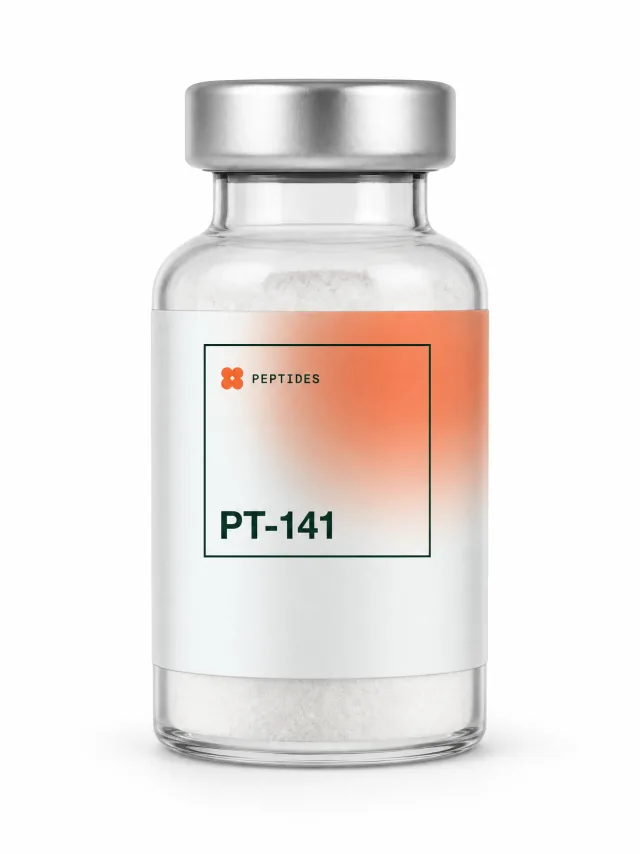
Why it ranks #4
All four markers feeding PT-141's score carry the variant it responds to, which is 67% of its genetic case and why it sits at #4 in your list.
What the research shows
Established
PT-141 is FDA-approved as Vyleesi (June 2019) for acquired, generalized hypoactive sexual desire disorder in premenopausal women, making it the first approved on-demand drug for female low desire and the second HSDD drug overall after flibanserin. Its distinguishing feature is the central melanocortin mechanism: it raises desire through brain pathways, a fundamentally different target from erectile-focused vascular drugs. That central action is also why it is studied off-label for desire in men.
Your dose
1.75mgper dose
Under the skin
Your genetics adjust this
Possible modulation
Standard 1.75 mg SC; response may differ, do not raise dose.
Why: PT-141's pro-sexual effect is mediated chiefly through central MC4R, and the C allele at rs17782313 (near MC4R) alters melanocortin/appetite-axis tone, so it could plausibly shift responsiveness; there is no bremelanotide pharmacogenetic trial, so treat any effect as uncertain and keep to the labeled dose.
FDA-approved as bremelanotide (Vyleesi, 2019) for acquired, generalized HSDD in premenopausal women: 1.75 mg subcutaneous self-injection at least 45 minutes before anticipated sexual activity; no more than one dose per 24 hours and no more than 8 doses per month. Non-selective melanocortin agonist acting mainly via central MC4R (and MC1R).
The label warns against use within 48 hours of oral naltrexone. Enthusiasts sometimes stack it with Melanotan II (its structural parent), but this compounds melanocortin activation and side-effect risk with no safety data.
What to expect
This one has a side effect people genuinely need warning about, because it is common enough to ruin the evening it was meant to improve: nausea. Roughly four in ten people in trials got it.
What most people notice
Nausea, and enough of it that taking a first dose on an important night is a bad plan
Flushing
Headache
Injection-site reactions
A stuffy nose
Worth keeping an eye on
A short-lived rise in blood pressure with a small drop in heart rate, peaking a few hours after a dose
Darkening of skin, freckles, moles or gums with frequent repeated use, since it acts on the same receptors that control pigment
It is meant for occasional use rather than daily, and people who ignore that are the ones who report the pigment changes
Reasons to check first
Uncontrolled high blood pressure or known cardiovascular disease, because of the transient pressure rise
Nausea tracks the dose closely. Most people who tolerate it well got there by using less, not by pushing through. RECONNECT trials for bremelanotide, plus prescribing experience.
Your markers9 for this compound
Can it act on you1 marker on the part it works through
AG
rs2229616MC4R
You carry one copy of the Ile103 form of MC4R, which in lab work responds a little less to the appetite-promoting signal AgRP, and carriers tend to sit slightly leaner on average. The effect from this single change is subtle, so treat it as a mild lean rather than an explanation for your body composition.
Do you need ityou carry 3 of these 3
rs1042713ADRB2
rs1042713 ADRB2: you carry the variant this compound responds to.
CC
rs17782313MC4R
you carry two copies of the MC4R appetite-risk allele, which tends to raise your hunger and food intake.
rs4680COMT
rs4680 COMT: you carry the variant this compound responds to.
Also in your filerelated findings we hold, which carry no weight for this compound
CT
rs1805008MC1R
you carry one copy of a red-hair variant that weakens your pigmentation receptor, so melanocortin peptides may tan you unpredictably yet still cause flushing and nausea.
AG
rs4680COMT
you sit in the middle for how fast you clear dopamine, giving a balanced mix of focus and stress resilience.
CC
rs1805007MC1R
you have a fully working pigmentation receptor, so melanocortin peptides can drive strong skin-darkening; the main thing to watch for is unwanted hyperpigmentation.
CT
rs1800497ANKK1/DRD2
you carry one copy of a variant that leaves fewer dopamine D2 receptors in the brain's reward circuit, nudging reward sensitivity down a notch.
Should you take it
You are low here. You carry variants in the systems this compound acts on, and the ember length is the gap it would have to work in. The greyed systems came back clear.
You carry the IRS1 associated with better insulin sensitivity. You carry two copies of the MC4R appetite-risk , which tends to raise your hunger and food intake. You carry two copies of the IGF2BP2 variant linked to a weaker first-phase insulin response.
Why it ranks #5
Four of the five markers feeding Semaglutide's score carry the variant it responds to, which is 64% of its genetic case and why it sits at #5 in your list.
What the research shows
Established
In the 68-week STEP-1 trial, once-weekly 2.4 mg produced a mean 14.9% weight loss versus 2.4% placebo, and the SELECT trial later showed a 20% reduction in major cardiovascular events in people with obesity and established heart disease, establishing that the benefits extend beyond weight. It is the most extensively studied agonist and the reference point against which newer agents are measured.
Your dose
2.4mgtarget
Under the skin
0.25
0.5
1
1.7
2.4
Step up to target · mg
Your genetics adjust this
Titrate to full
Follow the standard titration but carry it through to the full labelled maintenance dose (2.4 mg) and judge by clinical response rather than stopping at a submaximal step.
Why: The A (Ser168) allele modestly lowers GLP-1 receptor signalling. The largest study of GLP-1 agonist response (n=4,571, six cohorts) associates it with a smaller HbA1c reduction, but the difference is 0.08%, which is not something a person can feel, and the same study found no association with weight response at all. So this changes nothing about the milligrams: it is a reason to carry the standard titration through to the full labelled dose and judge on how you actually respond, rather than a reason to expect less.
The note excludes a whole class; these are the ones in your report.
Do not combine with any other GLP-1 or GLP-1/GIP agonist (tirzepatide, liraglutide, dual/triple agonists): additive GI toxicity with no added benefit. The one deliberate exception is pairing with the amylin analogue cagrilintide, which is the fixed-dose product CagriSema.
When you take it
Dose
Label titration through to 2.4 mg SC, once weekly
Route
Under the skin
Window
7:00-9:00 AM
Morning7:00-9:00 AMFix one injection day and keep it. Your GLP1R Ser168 result is a reason to complete the titration to the full labelled dose and judge on response, not a reason to expect less from the drug.
One half-life
About a week, which is why it is weekly
Every half-life, half of what you took is gone. Dosed once a week, that is 1 week between shots against a half-life of 1 week, so the next dose lands on 50% of the last one. The gap is set by that curve rather than by habit, and it is a property of the compound: nothing in your file changes it.
What to expect
The best-documented side-effect profile of any peptide here, because millions of people take it. Overwhelmingly digestive, and overwhelmingly during the step-up.
What most people notice
Nausea, the most common reason people stop
Constipation
Diarrhoea
Reflux and burping
Food losing its appeal, sometimes including things you used to love
Feeling full very quickly
Worth keeping an eye on
Muscle loss alongside fat, especially without enough protein or any resistance training
Hair shedding around month three or four, usually a response to rapid weight loss rather than the drug
Gallstones when weight comes off quickly
Facial changes people call Ozempic face, which is fat loss rather than anything the drug does to skin
Reasons to call someone
Severe, persistent stomach pain radiating to the back
Vision changes, particularly if you have diabetic eye disease and your blood sugar has dropped fast
Every dose increase tends to bring a few rough days. People who rush the ramp are the ones who quit. STEP and SUSTAIN trial programmes, plus years of prescribing data.
Your markers17 for this compound
Can it act on you1 marker on the part it works through
rs6923761GLP1R
rs6923761 GLP1R: we read this marker and there is no variant here that predicts anything.
Do you need ityou carry 4 of these 5
CC
rs17782313MC4R
you carry two copies of the MC4R appetite-risk allele, which tends to raise your hunger and food intake.
CC
rs2237892KCNQ1
you carry two copies of the KCNQ1 variant linked to lower insulin secretion.
rs7903146TCF7L2
rs7903146 TCF7L2: you carry the variant this compound responds to.
CC
rs9939609FTO
you carry two copies of the FTO variant that dials down fat-cell heat production, so your body tends to store energy rather than burn it.
CC
rs10830963MTNR1B
you carry the common MTNR1B form with no copy of the glucose/melatonin risk variant, so this locus reads typical.
Also in your filerelated findings we hold, which carry no weight for this compound
TT
rs2943641IRS1
you carry the IRS1 genotype associated with better insulin sensitivity.
TT
rs4402960IGF2BP2
you carry two copies of the IGF2BP2 variant linked to a weaker first-phase insulin response.
CC
rs5219KCNJ11
you have the reference KCNJ11 genotype with normal beta-cell channel function.
TT
rs13266634SLC30A8
you carry the SLC30A8 Trp325 genotype, associated with a stronger early insulin response.
Counted onceinherited together with a marker above, so the two are one signal
rs10757278
rs10757278: inherited together with another marker on this compound, so it counts once.
rs1333049
rs1333049: inherited together with another marker on this compound, so it counts once.
AT
rs1421085FTO
you carry one copy of the FTO appetite/fat-storage variant, a mild nudge toward higher appetite that diet, sleep, and activity easily outweigh.
CT
rs12255372TCF7L2
you carry one copy of the TCF7L2 variant, giving a moderate dampening of incretin-driven insulin release.
Should you take it
You are low here. You carry variants in the systems this compound acts on, and the ember length is the gap it would have to work in. The greyed systems came back clear.
You have the common fully-active GIP-receptor , associated with typical response and tolerability to GIP-acting drugs. You carry two copies of a -receptor variant that weakens the fullness signal coming back from your fat tissue, a pattern linked to higher body fat. You carry two copies of the MC4R appetite-risk , which tends to raise your hunger and food intake.
Why it ranks #6
Three of the four markers feeding MariTide's score carry the variant it responds to, which is 64% of its genetic case and why it sits at #6 in your list.
What the research shows
Emerging
In a 592-patient Phase 2 trial, MariTide produced up to ~20% average weight loss in people with obesity without diabetes and ~17% in those with type 2 diabetes (plus up to 2.2% HbA1c reduction), with weight loss not yet plateaued at 52 weeks. The monthly dosing and GIP-antagonist mechanism make it a differentiated bet, testing the counterintuitive finding that blocking GIP can aid weight loss as effectively as activating it.
Your dose
420mgtarget
Under the skinEvery 4 weeks
140
280
420
Step up to target · mg
No change from your genetics
Maridebart cafraglutide, investigational (Amgen, phase 2 MARITIME), not approved. SC once every 4 weeks (monthly); phase 2 used 140, 280 or 420 mg Q4W, with 4- or 12-week dose escalation arms that markedly cut nausea/vomiting versus starting high. Doses are trial protocol.
Stacking
A GLP-1 receptor agonist plus GIP receptor antagonist (peptide-antibody conjugate); do not combine with other incretin agonists. Investigational, with no established combinations.
When you take it
One half-life
Weeks rather than days, which is the whole point of the design
Every half-life, half of what you took is gone. The gap between doses is set by that curve rather than by habit, and it is a property of the compound: nothing in your file changes it.
What to expect
Stomach upset again, but with a twist that comes from the monthly schedule: instead of a mild weekly wave, people describe a heavier few days after each shot.
What most people notice
Nausea concentrated in the days right after an injection
Vomiting
Appetite falling away for most of the month
Worth keeping an eye on
A rougher first week than weekly drugs, because the whole dose lands at once
If a dose disagrees with you, it is a long wait for it to clear
Starting at a full dose rather than building up caused noticeably more of it, which is why later trial arms introduced a ramp. Phase 2 trial, New England Journal of Medicine, 2025.
Your markers11 for this compound
Can it act on you3 markers on the part it works through
rs1800437GIPR
rs1800437 GIPR: you carry the variant this compound responds to.
rs10423928GIPR
rs10423928 GIPR: we read this marker and there is no variant here that predicts anything.
rs6923761GLP1R
rs6923761 GLP1R: we read this marker and there is no variant here that predicts anything.
Do you need ityou carry 2 of these 3
CC
rs17782313MC4R
you carry two copies of the MC4R appetite-risk allele, which tends to raise your hunger and food intake.
CC
rs9939609FTO
you carry two copies of the FTO variant that dials down fat-cell heat production, so your body tends to store energy rather than burn it.
CC
rs10830963MTNR1B
you carry the common MTNR1B form with no copy of the glucose/melatonin risk variant, so this locus reads typical.
Also in your filerelated findings we hold, which carry no weight for this compound
GG
rs1137101LEPR
you carry two copies of a leptin-receptor variant that weakens the fullness signal coming back from your fat tissue, a pattern linked to higher body fat.
GG
rs1800437GIPR
you have the common fully-active GIP-receptor genotype, associated with typical response and tolerability to GIP-acting drugs.
AT
rs10423928GIPR
You carry one copy of the version linked to a somewhat quieter GIP signal after meals, plus a mild lean toward lower body fat; the effect from a single variant is small and easily overshadowed by diet, sleep and activity.
AA
rs6923761GLP1R
you carry two copies of a GLP-1 receptor variant that may subtly shift how you respond to GLP-1 medicines, though it is not a reliable predictor.
Counted onceinherited together with a marker above, so the two are one signal
AT
rs1421085FTO
you carry one copy of the FTO appetite/fat-storage variant, a mild nudge toward higher appetite that diet, sleep, and activity easily outweigh.
You're seeing a preview
This is 6 of your 37 peptide matches. The full report unlocks the rest, and how to use them.
Every section below is built from your own DNA. Here's what you unlock:
All 37 peptides, ranked to your genetics
Your personalized doses, where your DNA shifts the starting point
Daily timing, and which combinations to avoid
A step-by-step protocol built for you
Your whole genome mapped, chromosome by chromosome