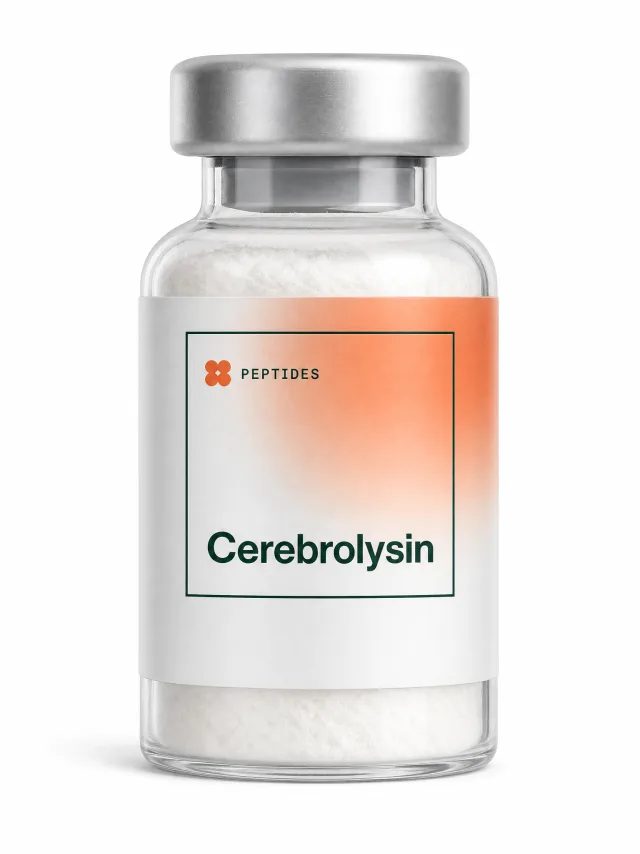
Cerebrolysin
Cerebrolysin (Neuropeptide Preparation)
Also called Cerebrolysin, FPF-1070
The neurorecovery peptide
Cerebrolysin is not a single peptide but a mixture of small peptides and amino acids made from pig brain tissue. It is a genuine prescription medicine across much of Europe and Asia, given by drip or injection in courses, mostly after stroke or for dementia. It has decades of clinical use and never got approved in the US.
A mixture of low-molecular-weight neuropeptides and amino acids derived from pig brain, designed to mimic the action of the body's own neurotrophic factors. It has the strongest human clinical evidence of any compound in the cognitive cluster — but for a specific use: acute neuro-injury and dementia, not general cognitive enhancement. Approved across Russia, Europe and Asia for stroke and dementia; not FDA-approved.
- Route
- Intramuscular
- Typical dose
- 5–10 mL/day
- Availability
- Research-only
Studied in people, and well studied in animals
What people use Cerebrolysin for
Reported uses, roughly in order of how often they are the reason someone goes looking. Whether it works for any of them is a separate question, answered under each one.
- Recovery after stroke
- The main clinical use, given in courses over several weeks and usually started soon after the event. This is where the largest trials sit.
- Dementia and cognitive decline
- Its other approved use in the countries that license it, typically as repeated courses rather than continuously.
- Traumatic brain injury
- Used clinically for this in several countries, with a smaller evidence base than the stroke work.
Mechanism of Action
How Cerebrolysin works
Cerebrolysin acts like the brain's own growth factors:
- Neurotrophic mimicry — its peptide fraction mimics BDNF, GDNF and other neurotrophic factors, supporting neuron survival and synaptic maintenance
- Neuroprotection — reduces excitotoxic and oxidative damage after ischemic/traumatic injury, the basis of its stroke and TBI evidence
- Neuroplasticity support — promotes neurite outgrowth and synaptic remodeling, the mechanism behind its dementia-recovery data
- Indication-specific — the strong RCT base is in acute injury and dementia; for a healthy brain seeking enhancement, the evidence does not transfer directly
Cerebrolysin dosage calculator
Enter what is in your vial, how much water you added, and the dose you are using. It works out where to pull the plunger to.
How much is in the vial?
Printed on the label, in milligrams
How much water did you add?
Bacteriostatic water, in millilitres
What dose are you taking?
The dose you already intend to use
Which syringe?
Barrel size, printed on the wrapper
Draw to
10 units
on a 0.5 mL insulin syringe (0.1 mL)
- Strength once mixed
- 5 mg/mL
- Doses in the vial
- 20
10 mg in 2 mL makes 5 mg/mL. A 500 mcg dose is 0.1 mL of that, which is 10 units.
This is arithmetic, not advice. It converts a dose you already have into a mark on a syringe. It does not tell you what dose to take, and Cerebrolysin is not prescribed by us. Dosing belongs with a qualified clinician.
Cerebrolysin side effects: what people reported
Given by drip in a clinic, so most of what people report relates to the infusion itself and to how fast it is run.
What people report
- Feeling hot or flushed during the infusion
- Dizziness
- Nausea
- Headache
- Injection-site reactions
Worth keeping an eye on
- Agitation or trouble sleeping if a session runs late in the day
- It is derived from pig tissue, which matters for allergy and for anyone whose diet or beliefs exclude it
Reasons to check first
- Epilepsy, since seizures have been reported and prescribers screen for it
- Severe kidney impairment
Dose matters. Running it in too quickly is the usual cause of feeling hot, dizzy or nauseated during a session.
Source: Decades of prescribing experience in Europe and Asia, plus trial data. This is a summary of published findings, not a complete safety profile and not medical advice. Cerebrolysin should only be considered with a qualified clinician who knows your history.
Your Genetics & Cerebrolysin
The genes involved in how Cerebrolysin works
Cerebrolysin works through the receptors these genes build, and the genes vary from person to person. Researchers have linked some of that variation to differences in how people respond. A DNA report tells you which versions you carry.
BDNF · ••
The Val66Met variant sets baseline BDNF activity-dependent secretion. Met carriers have a real neurotrophic deficit that a BDNF-mimicking agent could in principle help rescue; Val/Val (normal) individuals have no such deficit to correct, weakening the rationale for enhancement use.
APOE · ••
APOE status frames neurodegeneration risk and response context. e4 carriers (higher risk) may have more to gain from neuroprotective support; e3/e3 (neutral) carries no e4 synergy.
NTRK2 encodes TrkB, the receptor that neurotrophic signals act through. Variation in receptor function influences how effectively a neurotrophic-mimicking preparation translates into downstream plasticity.
The dots after each gene are where your own result goes. Your report fills them in with the two letters you carry at that position.
Which variants do you carry?
Upload your DNA data, or get tested through our partner, to find out.
Commonly combined with
What Cerebrolysin is most often paired with, and why:
Semax
Neuroprotection StackEmerging EvidenceSemax (ACTH 4-10 Analog with Pro-Gly-Pro)
A synthetic heptapeptide derived from ACTH (4-10) with a C-terminal Pro-Gly-Pro tripeptide extension for stability. Developed in Russia and approved there for stroke recovery and cognitive enhancement. Semax upregulates BDNF, modulates the melanocortin system, and supports neuroplasticity without stimulant-like side effects.
4
Gene variants
40+
Studies
Dihexa
Synaptic StackPreliminary EvidenceDihexa (N-hexanoic-Tyr-Ile-(6) aminohexanoic amide)
An angiotensin-IV-derived peptide built to powerfully promote synapse formation by activating the HGF/c-Met system. The marketing claims are dramatic — orders of magnitude more potent than BDNF at building synapses — but the honest position is that those numbers are from lab models, not humans: dihexa has essentially no human clinical data. Experimental, not approved.
3
Gene variants
8+
Studies
BPC-157
Neuro Recovery StackModerate EvidenceBody Protection Compound 157
BPC-157 is the peptide people reach for when something will not heal. Tendons, ligaments, a gut that has been irritated by painkillers, an injury that has stalled. It is a short chain of amino acids copied from part of a protein your stomach already makes, and the animal research on it is unusually consistent for this category: across a lot of separate rat studies, injured tissue healed faster than it did without it. The gap is that this has largely not been repeated in people, and it is not an approved medicine, so nobody is checking what is in the vial you buy.
3
Gene variants
19+
Studies
Sourcing & access
Where to buy Cerebrolysin
Cerebrolysin is sold as a research compound, not a licensed medicine, so quality and legal status vary widely by country and vendor. If you're sourcing it, treat independent purity testing as non-negotiable.
- Insist on a recent third-party Certificate of Analysis (COA) for the exact batch — labs like Janoshik verify purity and identity.
- Check the legal status where you live before ordering — it differs from country to country.
- Reconstitute correctly with bacteriostatic water and start at a conservative dose.
Before you buy: see whether your DNA actually responds to Cerebrolysin, and at what dose. Analyze my DNA — $99 →
Educational information only, not medical advice. Some outbound links are affiliate links (disclosed, at no extra cost to you). Most peptides are not FDA-approved — consult a qualified professional and check your local laws before purchasing.
Worth knowing before you consider Cerebrolysin
Interactions and situations where there is a specific reason to be careful. Where the honest answer is that nobody has studied something, it says so and says what that leaves open.
- It comes from pig brain
- Worth stating plainly rather than hiding behind a chemical name. That is what porcine-derived means, and it matters to some people for reasons that are not medical.
- Not something you administer yourself
- It is given by drip or intramuscular injection in courses, under supervision, in the countries where it is approved.
Last updated
Frequently Asked Questions
What is cerebrolysin used for?
Cerebrolysin is a neuropeptide preparation approved internationally for stroke recovery and dementia. It mimics the brain's natural neurotrophic factors to protect neurons and support plasticity. Its strongest evidence is for acute neuro-injury and dementia rather than enhancement in healthy brains.
Does genetics affect cerebrolysin response?
Indirectly. BDNF (rs6265) sets whether you have a neurotrophic deficit worth rescuing, and APOE frames neurodegeneration risk and response context. No marker strongly predicts an enhancement response in a healthy brain — its evidence is indication-specific.
Is cerebrolysin legal?
Cerebrolysin is approved and prescribed in Russia, much of Europe and Asia for stroke and dementia, but it is NOT FDA-approved in the US, where access is research/import-only. Regulatory status varies widely by country.
Learn more about Cerebrolysin
Your next move
Two ways forward with Cerebrolysin.
Not sure it's for you?
How does Cerebrolysin relate to your genes?
Your report scores Cerebrolysin against your receptor, pharmacogene and pathway variants and shows the genetic markers relevant to it, with commonly cited dosing information to review with a clinician.
Analyze my DNA — $99