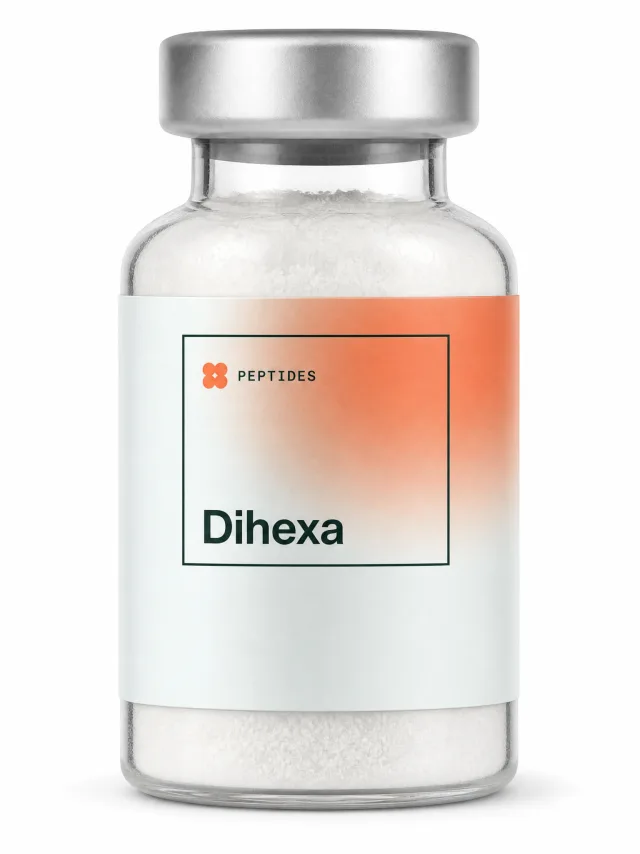
Dihexa
Dihexa (N-hexanoic-Tyr-Ile-(6) aminohexanoic amide)
Also called Dihexa, N-hexanoic-Tyr-Ile-(6) aminohexanoic amide, PNB-0408
The synaptogenic peptide
Dihexa is the most potent thing in this catalogue by a wide margin, and that is the point and the problem. In lab work it forms new connections between brain cells at concentrations millions of times lower than the natural signal it borrows. Almost nothing is known about what it does in people.
An angiotensin-IV-derived peptide built to powerfully promote synapse formation by activating the HGF/c-Met system. The marketing claims are dramatic — orders of magnitude more potent than BDNF at building synapses — but the honest position is that those numbers are from lab models, not humans: dihexa has essentially no human clinical data. Experimental, not approved.
- Half-life
- Not established in humans
- Route
- Usually taken by mouth, unusually for a peptide, because it was designed to cross into the brain
- Typical dose
- No established human dose. Anything quoted is extrapolated from rodents
- Availability
- Research-only
Early research, mostly in the lab so far
What people use Dihexa for
Reported uses, roughly in order of how often they are the reason someone goes looking. Whether it works for any of them is a separate question, answered under each one.
- Memory and learning
- What it was built for. It was designed from a fragment of angiotensin IV to trigger the same growth-factor pathway the brain uses to build new connections, and in rats with damaged memory it restored performance.
- Recovery after brain injury
- The original research direction, aimed at Alzheimer's and traumatic injury. It never made it into people.
Mechanism of Action
How Dihexa works
Dihexa works through a growth-factor pathway distinct from the usual nootropics:
- HGF / c-Met activation — augments hepatocyte growth factor signaling at its c-Met receptor, the pathway it uses to drive synaptogenesis
- Synapse formation — in preclinical models it promotes new dendritic spines and synaptic connections, the basis of its potency claims
- BDNF-independent — unlike most cognitive peptides it does not act through BDNF, so BDNF or catecholamine (COMT) genetics don't bear on its mechanism
- Unvalidated in humans — the striking potency figures come from cell and rodent work; there is no meaningful human trial evidence, so claims should be read with heavy caution
Dihexa dosage calculator
Enter what is in your vial, how much water you added, and the dose you are using. It works out where to pull the plunger to.
How much is in the vial?
Printed on the label, in milligrams
How much water did you add?
Bacteriostatic water, in millilitres
What dose are you taking?
The dose you already intend to use
Which syringe?
Barrel size, printed on the wrapper
Draw to
10 units
on a 0.5 mL insulin syringe (0.1 mL)
- Strength once mixed
- 5 mg/mL
- Doses in the vial
- 20
10 mg in 2 mL makes 5 mg/mL. A 500 mcg dose is 0.1 mL of that, which is 10 units.
This is arithmetic, not advice. It converts a dose you already have into a mark on a syringe. It does not tell you what dose to take, and Dihexa is not prescribed by us. Dosing belongs with a qualified clinician.
Dihexa side effects: what people reported
This is the honest gap. There is essentially no human side-effect data, so anything listed here is either reported anecdotally or predicted from the mechanism, and both deserve scepticism.
What users report
- Headache
- Irritability or a short fuse
- Trouble sleeping
- Feeling mentally overstimulated
The concern that follows from the mechanism
- It powerfully promotes cell growth and new connections, and it does not restrict that to the brain. Growth signals that strong and that unselective are exactly the ones nobody has checked over a long period in a human
Source: Rodent studies and scattered user reports. No human trial. This is a summary of published findings, not a complete safety profile and not medical advice. Dihexa should only be considered with a qualified clinician who knows your history.
Your Genetics & Dihexa
The genes involved in how Dihexa works
Dihexa works through the receptors these genes build, and the genes vary from person to person. Researchers have linked some of that variation to differences in how people respond. A DNA report tells you which versions you carry.
c-Met is the receptor dihexa's HGF-augmenting action runs through. Variation in MET receptor expression is the most mechanism-relevant genetic factor for this peptide — though no human data yet link genotype to response.
HGF is the growth factor dihexa potentiates. Baseline HGF tone set by this gene could influence how much additional synaptogenic signal the peptide can generate.
BDNF · ••
Included to make a point: dihexa is BDNF-independent, so your BDNF (Val66Met) status — which matters for most cognitive peptides — does not predict dihexa response. Its biology runs through HGF/c-Met instead.
The dots after each gene are where your own result goes. Your report fills them in with the two letters you carry at that position.
Which variants do you carry?
Upload your DNA data, or get tested through our partner, to find out.
Commonly combined with
What Dihexa is most often paired with, and why:
Cerebrolysin
Synaptic StackModerate EvidenceCerebrolysin (Neuropeptide Preparation)
A mixture of low-molecular-weight neuropeptides and amino acids derived from pig brain, designed to mimic the action of the body's own neurotrophic factors. It has the strongest human clinical evidence of any compound in the cognitive cluster — but for a specific use: acute neuro-injury and dementia, not general cognitive enhancement. Approved across Russia, Europe and Asia for stroke and dementia; not FDA-approved.
3
Gene variants
60+
Studies
Semax
Neuroprotection StackEmerging EvidenceSemax (ACTH 4-10 Analog with Pro-Gly-Pro)
A synthetic heptapeptide derived from ACTH (4-10) with a C-terminal Pro-Gly-Pro tripeptide extension for stability. Developed in Russia and approved there for stroke recovery and cognitive enhancement. Semax upregulates BDNF, modulates the melanocortin system, and supports neuroplasticity without stimulant-like side effects.
4
Gene variants
40+
Studies
BPC-157
Neuro Recovery StackModerate EvidenceBody Protection Compound 157
BPC-157 is the peptide people reach for when something will not heal. Tendons, ligaments, a gut that has been irritated by painkillers, an injury that has stalled. It is a short chain of amino acids copied from part of a protein your stomach already makes, and the animal research on it is unusually consistent for this category: across a lot of separate rat studies, injured tissue healed faster than it did without it. The gap is that this has largely not been repeated in people, and it is not an approved medicine, so nobody is checking what is in the vial you buy.
3
Gene variants
19+
Studies
Sourcing & access
Where to buy Dihexa
Dihexa is sold as a research compound, not a licensed medicine, so quality and legal status vary widely by country and vendor. If you're sourcing it, treat independent purity testing as non-negotiable.
- Insist on a recent third-party Certificate of Analysis (COA) for the exact batch — labs like Janoshik verify purity and identity.
- Check the legal status where you live before ordering — it differs from country to country.
- Reconstitute correctly with bacteriostatic water and start at a conservative dose.
Before you buy: see whether your DNA actually responds to Dihexa, and at what dose. Analyze my DNA — $99 →
Educational information only, not medical advice. Some outbound links are affiliate links (disclosed, at no extra cost to you). Most peptides are not FDA-approved — consult a qualified professional and check your local laws before purchasing.
Worth knowing before you consider Dihexa
Interactions and situations where there is a specific reason to be careful. Where the honest answer is that nobody has studied something, it says so and says what that leaves open.
- Potency is not the same as safety
- The number people quote, that it is many times stronger than the natural signal, is used as a selling point. It is equally a reason for caution: there is no human data telling you what that potency does over months.
- No human trial has ever been completed
- Not a small trial, not an old one. There is no established dose, no safety window and no long-term follow-up in people.
Last updated
Frequently Asked Questions
What is dihexa used for?
Dihexa is an experimental synaptogenic peptide investigated for cognition and neural repair. It promotes synapse formation via the HGF/c-Met pathway and is best known for dramatic preclinical potency claims — which have not been validated in humans.
Is dihexa really stronger than BDNF?
Those comparisons come from laboratory and animal models, not human trials. Dihexa works through HGF/c-Met rather than BDNF, and its real-world potency in people is essentially unknown. Treat the headline numbers as preclinical, not proven.
Is dihexa legal?
Dihexa is not approved and human clinical data are essentially absent. It exists as a research compound only; access and regulatory status vary by country.
Learn more about Dihexa
11 guides mention Dihexa→peptide guides
In depthDihexa Dosage and Effects: What the Research Actually Shows
13 min read
peptide guides
In depthBest Peptides for Brain Fog and Focus: Semax, BPC-157, and Why Dihexa Doesn't Work
13 min read
stacking
In depthSemax, Selank, Dihexa Stack: 7 Rules for Dosing by Genotype
14 min read
safety
Are Peptides Legal in the US? 9 Things You Need to Know in 2026
14 min read
how it works
Does Selank Increase BDNF? How the Russian Anxiety Peptide Actually Repairs Your Brain
12 min read
genetics
MTHFR Brain Fog Still There? Nootropic Peptides That Work Downstream of the Broken Enzyme
12 min read
Your next move
Two ways forward with Dihexa.
Not sure it's for you?
How does Dihexa relate to your genes?
Your report scores Dihexa against your receptor, pharmacogene and pathway variants and shows the genetic markers relevant to it, with commonly cited dosing information to review with a clinician.
Analyze my DNA — $99Already decided?
Get Dihexa from Swiss Chems.
A US research-chemical supplier with third-party Certificates of Analysis. Sold for research use only — check your local laws before ordering.
Buy at Swiss Chems →Save 10% at checkout with code tcwisiiu