

- Dihexa outperformed BDNF by roughly seven orders of magnitude in a dish, in the test that counts how many new synapses form per unit of compound. That is a cell-culture number, not a clinical one.
- No human clinical trial for Dihexa has ever been completed. All effect data comes from animal models, primarily Alzheimer's mouse studies.
- The HGF/c-Met pathway Dihexa activates is a known tumor promoter in cancer biology. That concern explains why no pharma company has funded a human trial in 14 years of research.
- Animal studies showed Dihexa reversed Alzheimer's-like cognitive impairment in mice at microgram doses after just weeks of treatment.
- How much of your own brain-growth signal you make at baseline is partly inherited, through the BDNF gene. Lower-output versions have, in theory, the most headroom for a compound that amplifies that signal.
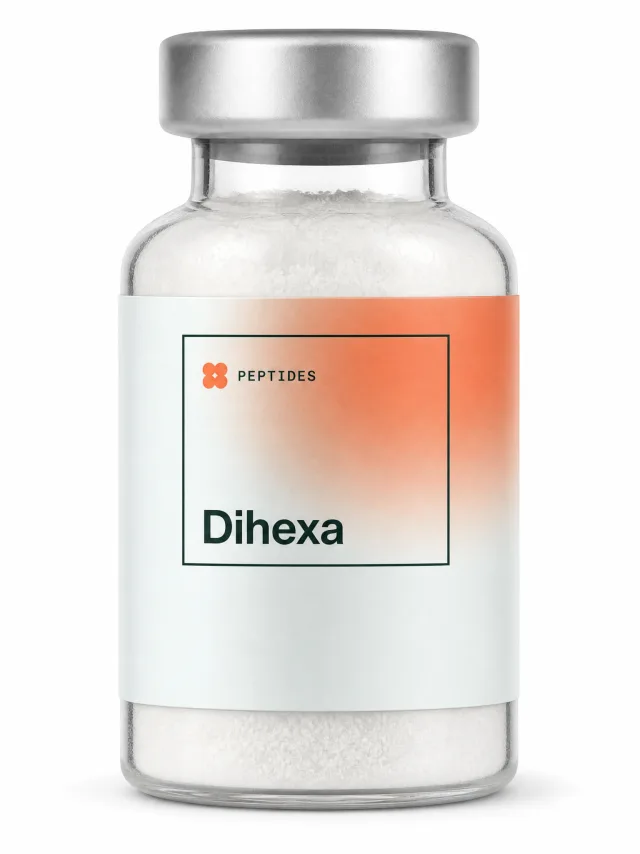
Dihexa is roughly 10 million times more potent than BDNF itself at making neurons grow new connections in a dish. That number comes from the Washington State University group that developed the compound. It is not a marketing claim or a forum exaggeration. It is also the reason zero pharmaceutical companies have completed a human trial of it in the 14 years since it was published.
How much more potent Dihexa is than BDNF (brain-derived neurotrophic factor, the protein your brain uses to build and maintain the connections between neurons) at triggering new connections in cell culture. Dihexa does not replace that signal; it amplifies the one already there. Source: McCoy et al., Journal of Pharmacology and Experimental Therapeutics, 2013 (PMID 23055539).
This is the paradox at the center of the Dihexa story. The peptide amplifies a signal your brain already produces, BDNF, at a potency no natural molecule matches. That same potency is why it has stayed out of human trials while weaker compounds have moved through clinical development.
Here is what the research actually shows, what the animal data proves, and what you need to know before you consider Dihexa as part of a cognitive protocol.
Plain English: Your brain makes BDNF to build and maintain synapses, the connections between neurons. Think of BDNF as the construction crew that keeps your brain wiring strong. Dihexa does not add more workers. It gives every existing worker a megaphone, so the same signal produces dramatically more building activity. Synapses form faster, connections strengthen, memory consolidation improves. That is the mechanism in one sentence.
How Does Dihexa Actually Work in the Brain?
Dihexa is a six-amino-acid peptide built from angiotensin IV, a fragment of the hormone system that controls blood pressure. That same system has a separate, lesser-known role inside the brain. The Washington State University team, led by pharmacologist Joe Harding, was studying angiotensin IV analogs for memory effects when they found that one of their synthesised derivatives, what became Dihexa, had an unexpected and unusually potent mechanism.
It does not bind BDNF receptors directly. Instead, it activates hepatocyte growth factor (HGF) and its receptor c-Met. The HGF/c-Met pathway sits one step upstream and switches on TrkB, the docking point BDNF normally uses to drive synapse formation. By hitting the pathway one step upstream from BDNF itself, Dihexa activates a broader wave of TrkB receptors than BDNF alone can reach. The result is new-synapse formation at a scale natural BDNF cannot produce on its own.
Raising the growth factor directly
Binds TrkB receptor directly. Requires active secretion. Reaches receptors near release sites only. Degrades within minutes in tissue.
Dihexa
Activates HGF/c-Met upstream of TrkB. Creates a broader wave of TrkB activation across the tissue. More stable than BDNF. 10 million times more potent in the new-synapse test.
The potency advantage is specific to one lab test, which counts how many new connections form per unit of compound applied to neurons in a dish. In that test, Dihexa outperformed NGF (nerve growth factor, the standard benchmark for neurotrophic activity) and beat BDNF itself by seven orders of magnitude. That is a cell-culture measurement, not a clinical finding. But it is what made the scientific community pay attention in 2012 and what keeps Dihexa in the conversation today.
What Did the Animal Studies Actually Find?
The headline result from the Washington State lab was reversal of Alzheimer's-like memory loss in rodents. Rats given a drug that impairs memory showed near-complete restoration of their ability to navigate a maze after Dihexa treatment. The effect persisted after the compound had cleared, which points to structural change in the wiring rather than a neurotransmitter boost that fades as the drug leaves.
A later study using the APP/PS1 mouse, an animal bred to carry the human mutations that cause early Alzheimer's, found the same thing in a more demanding model. Treated mice performed better on several memory tasks, including recognising a novel object and navigating a maze. The hippocampus, the brain region that forms new memories, showed measurably more synapses in treated animals. The cell-culture numbers were showing up in living brains.
A companion paper from the same group, Benoist et al. in the Journal of Pharmacology and Experimental Therapeutics in 2014 (PMID 25187433), worked out how the compound moves through the body and reaches the brain, which is the study any dosing discussion should actually be built on.
The animal dose was approximately 1 mg/kg in rodents. Scaling that down to a human by body surface area, the standard way of converting animal doses, gives roughly 0.1 to 0.3 mg/kg, or 7 to 21 mg for a 70 kg person. This is the extrapolation online communities use as a starting point, with all the uncertainty that entails.
What the Animal Data Cannot Tell You
Animal models of Alzheimer's disease are notoriously poor predictors of human outcomes. Over 99% of compounds that show promise in rodent Alzheimer's models have failed to replicate in human trials. This is not a criticism specific to Dihexa. It is the fundamental limitation of the entire field and the reason every compound that looked transformative in mice has so far disappointed in the clinic. The cognitive rescue data in rodents is promising. It is not evidence of a human effect.
| Finding | Evidence Level | Human Applicability |
|---|---|---|
| 10 million times more potent than BDNF | Cell culture assay | Mechanism confirmed; potency in a living human is unknown |
| Reversal of drug-induced memory loss in rats | Rodent pharmacology study | Suggests real biological effect; human dose unknown |
| Cognitive rescue in APP/PS1 Alzheimer's mice | Rodent genetic disease model | Predictive rate for human translation: under 1% |
| Increased hippocampal synaptic density | Rodent tissue slides | Structural finding; human equivalent not measured |
| Human cognitive improvement | No published data | No human trial has ever been completed |
Why Has No Human Trial Ever Been Completed?
Dihexa was first characterized in 2012. It is now 2026. Fourteen years of compelling animal data and zero published human trials. The obstacle is not regulatory friction or lack of interest. It is the mechanism itself.
The HGF/c-Met pathway that Dihexa activates is a known driver of tumor growth. HGF and c-Met are studied extensively in oncology because cancer cells hijack this pathway to proliferate, survive, and metastasize. The oncology field has invested billions developing c-Met inhibitors as cancer treatments. Dihexa activates this pathway. It does the opposite of what those inhibitors do. A compound that activates HGF/c-Met for one therapeutic purpose simultaneously sends the same pro-growth signal that tumors use. No major pharmaceutical company has been willing to take that compound into human safety trials without substantially more preclinical data on cancer risk.
If you are considering Dihexa as part of a cognitive protocol, this trade-off needs to be understood clearly. You are activating a growth-promoting pathway in your central nervous system with no human safety data to define what dose, what duration, or what individual risk factors determine the outcome. The risk is theoretical in the sense that no human adverse event from Dihexa has been documented. It is not theoretical in the sense that the underlying pathway concern is well-established cancer biology.
Dihexa Dosage: What Is Actually Being Used
There is no established human dosage for Dihexa. The animal studies used approximately 1 mg/kg in rodents. Scaling that to a human equivalent dose by body surface area produces a range of roughly 0.1 to 0.3 mg/kg, or 7 to 21 mg for a 70 kg person. This is a rough extrapolation, not a validated clinical dose. Nobody has measured what a human body does with Dihexa by any route.
Dihexa is currently sold only by research chemical vendors under research-use labeling. It is not on the FDA 503A compounding pharmacy bulks list, meaning licensed compounding pharmacies cannot legally prepare it. Routes reported in the research community include oral capsule, sublingual placement, intranasal, and subcutaneous injection. Each route has different bioavailability characteristics that have not been measured in humans for this compound specifically.
| Route | Estimated Bioavailability | Reported Onset | Key Limitation |
|---|---|---|---|
| Oral (capsule/powder) | Unknown, likely low for most peptides | 1 to 3 hours | Digestive enzymes destroy most peptides; Dihexa may have unusual acid stability |
| Sublingual | Unknown, likely higher than oral | 30 to 60 min | Skips the liver on the way in; absorption through the mouth lining not measured for Dihexa |
| Intranasal | Unknown; a direct route to the brain is theorised | 15 to 45 min | No nose-to-brain absorption data for Dihexa specifically |
| Subcutaneous injection | Near-complete for peptide class generally | 20 to 40 min | No absorption data for Dihexa specifically; injection site reactions possible |
The range of doses discussed in research communities spans roughly 5 mg to 25 mg per session. Effects described include improved recall speed, faster verbal processing, and clearer working memory, arriving within 1 to 2 hours and lasting up to 12 hours. These are self-reported observations with no controls. They cannot be separated from expectation, placebo, or the cognitive effects of simply following a careful protocol of any kind.
What we know from broader peptide bioavailability research is that oral peptides survive the digestive tract poorly. Early work suggested Dihexa is unusually stable in acid, a potential advantage over larger peptides, but that has not been confirmed in a human gut. If you are relying on oral dosing, you may be absorbing significantly less than the dose you calculated.
Why the same dose would not land the same way for two people
Dihexa works by amplifying an existing signal. How much amplification you notice depends partly on how loud that signal already is, which is partly inherited. That is true of anything targeting this pathway, but Dihexa's unusual potency makes the starting point matter more than it would for a weaker compound.
The best-studied variant sits in BDNF itself, the gene for the growth factor your neurons release when they fire. It is called Val66Met (rs6265). The Val version releases more of that on-demand signal; the Met version releases less. Roughly a third of people of European descent carry at least one Met copy. Those people run with a quieter baseline signal, particularly in the hippocampus, which is both the memory centre and where Dihexa's animal effects showed up.
Roughly the share of people of European descent carrying at least one Met copy of the BDNF Val66Met variant, which releases less growth factor on demand. How much less has not been pinned to a single reliable number, and no study has tested whether these carriers respond differently to Dihexa. Source for the variant's effect on release: Egan MF et al., Cell, 2003.
The theory is straightforward: an amplifier has more room to work when the underlying signal is quiet. If you already run near your natural ceiling (Val/Val), amplifying adds less at the margin. If you carry Met, the headroom is larger. Nobody has tested this in a person, for this compound, so treat it as a reason to be curious rather than a prediction.
The same logic runs across the focus peptides. If you have read about peptides for brain fog or the Semax vs Selank comparison, you know the dopamine and serotonin systems interact with this one. A slow COMT (the enzyme that clears dopamine from the front of the brain) works through a separate route, so any cognitive effect would add to rather than duplicate what an amplifier does.
Who Should Be Most Cautious
If you carry variants associated with elevated cancer risk, particularly in pathways that overlap with HGF/c-Met signalling, the risk side of the Dihexa equation grows before any benefit does. This is not a blanket contraindication. It is a reason to get a complete genetic picture before considering a compound that tells cells to divide. A conversation with an oncology-informed clinician is the minimum threshold for this genotype.
The Dihexa genetic response profile in the PeptidesDNA report covers BDNF Val66Met and TrkB receptor sensitivity markers, giving you the theoretical response curve before you invest in a research chemical protocol. You can upload your existing DNA data or order a saliva kit to get your full panel.
The Risk That Most Dihexa Articles Skip Over
Most Dihexa content online acknowledges the HGF/c-Met cancer concern in a single sentence and moves on. Here is what it actually means in practice.
HGF activates the c-Met receptor to drive cell proliferation, survival, and migration. In healthy tissue, this is beneficial: wound healing, tissue repair, liver regeneration. In transformed cells or early-stage cancer, the same signal accelerates tumor growth. Elevated HGF/c-Met signalling tracks with higher rates of cancer spreading to other organs in multiple tumour types, which is why pharmaceutical oncology is actively developing c-Met inhibitors as treatments. Dihexa activates this pathway. It does the opposite of what those inhibitors do.
At the doses used in animal studies, microgram-per-kilogram quantities, the absolute size of the HGF/c-Met signal may be small enough that tumor-promotion risk in healthy tissue is negligible. The problem is that nobody has run this experiment in humans at any dose, for any duration, in any population. The absence of documented human harm is not the same as confirmed safety. It means the experiment has not been done.
There is also the question of the scientific record. A small number of papers related to early Dihexa characterization have come under scrutiny in recent years. The core mechanism (HGF/c-Met switching on TrkB indirectly) and the basic potency finding have independent support and have not been formally retracted. But some of the older effect-size numbers should be read with more caution than you will find in typical peptide content. The compound is real. The effect is likely real. The magnitude in humans is unknown.
For context: Selank has 30-plus years of Russian clinical use data and still does not have FDA approval for human use in the United States. Dihexa has no human trial data at all. These are categorically different risk profiles, even if both compounds are technically available through the same research chemical market.
Dihexa vs Other Cognitive Peptides: Where It Actually Sits
Dihexa
Amplifies the pathway upstream of BDNF. Highest potency on record in the new-synapse test. No human trials. Theoretical cancer concern. Research chemical only.
Semax
A fragment of the stress hormone ACTH. Directly increases BDNF production. 30-plus years of Russian clinical use. Nasal spray format. Better-defined safety record than the focus peptides that have no human trial data at all.
Selank
Built from tuftsin, an immune-signalling fragment. Calming, with mild cognitive effect. Modulates BDNF via serotonin pathway. Decades of Russian clinical data. Better suited to anxiety-driven cognitive impairment than pure memory enhancement.
If your goal is sharper working memory and better recall with a more established safety profile, Semax belongs higher in your protocol than Dihexa. Dihexa sits further up the potency curve and further outside the evidence base that any responsible practitioner would recommend for non-experimental use. If you are exploring Dihexa specifically, do it after you understand your BDNF genetics, your cancer-risk genetic profile, and the full gap in the human safety data.
The animal data is genuinely compelling: measurable cognitive rescue in Alzheimer's mouse models, structural synapse formation in the hippocampus, and an upstream mechanism no other focus peptide uses. But the same mechanism activates a tumor-promotion pathway, and that is why no pharmaceutical company has funded a human trial in 14 years of opportunity. If you are exploring cognitive peptides, start with compounds that have human data: Semax, Selank, or the broader BDNF-supporting stack covered in the brain fog peptide guide. Get your BDNF Val66Met genotype before investing in any BDNF-targeting protocol. Order a saliva kit or upload your existing data to see exactly where you sit on the response curve.
Frequently asked questions
What is Dihexa?
Dihexa is a synthetic hexapeptide derived from angiotensin IV, developed by researchers at Washington State University. It amplifies BDNF (brain-derived neurotrophic factor, the protein that builds and maintains the connections between neurons) by switching on the HGF/c-Met pathway one step upstream of the TrkB docking point. In cell culture it is roughly 10 million times more potent than BDNF itself at triggering new connections.
Has Dihexa been tested in humans?
No completed human clinical trial for Dihexa exists. All published efficacy data comes from rodent studies. The lack of human data is primarily due to safety concerns about the HGF/c-Met pathway Dihexa activates: it is a known driver of tumour cell growth in cancer biology, and no pharmaceutical company has moved forward with human trials without more preclinical safety data.
What is the correct Dihexa dosage?
There is no established human dose for Dihexa. Animal studies used approximately 1 mg/kg in rodents, which scales to roughly 0.1 to 0.3 mg/kg in a human, or 7 to 21 mg for a 70 kg person. Online research communities report using 5 to 25 mg per session. These are extrapolations and self-reported observations, not clinically validated doses.
What are the side effects of Dihexa?
No formal human safety data exists for Dihexa. Anecdotal reports describe headaches, mood changes and stomach upset as the most commonly noted effects. The primary theoretical concern is HGF/c-Met pathway activation, which is associated with tumor growth promotion in cancer biology. This risk has not been quantified at any dose in any human study.
Is Dihexa legal to buy?
Dihexa is not a scheduled or controlled substance in the United States. It is also not FDA-approved for human use and is not on the 503A compounding pharmacy bulks list, so licensed compounding pharmacies cannot legally prepare it. It is sold by research chemical vendors under research-use-only labeling. Purchasing it is legal in most jurisdictions; using it as a drug is not legal under US food and drug law.
How does Dihexa compare to Semax for cognitive enhancement?
Both compounds increase BDNF pathway activity but through different mechanisms and with very different evidence bases. Semax directly increases BDNF expression and has decades of clinical use data from Russian medicine. Dihexa works via HGF/c-Met activation and has only rodent data. Semax has a substantially better established safety record. Dihexa is more potent in lab assays but carries far more uncertainty in human use.
Why would two people respond differently to Dihexa?
Part of it is inherited. A variant called Val66Met (rs6265) in the BDNF gene changes how much growth factor your neurons release when they fire, and the Met version releases less. Roughly a third of people of European descent carry at least one copy. Because Dihexa amplifies that signal rather than supplying it, carriers have the largest theoretical gap for it to close. No human study has tested this for Dihexa, so it is a hypothesis, not a prediction.
This article is for informational and educational purposes only. It is not medical advice and does not diagnose, treat, cure, or prevent any disease. Consult a qualified healthcare professional before starting any peptide protocol. Individual results vary. Some outbound links are affiliate links, at no extra cost to you.