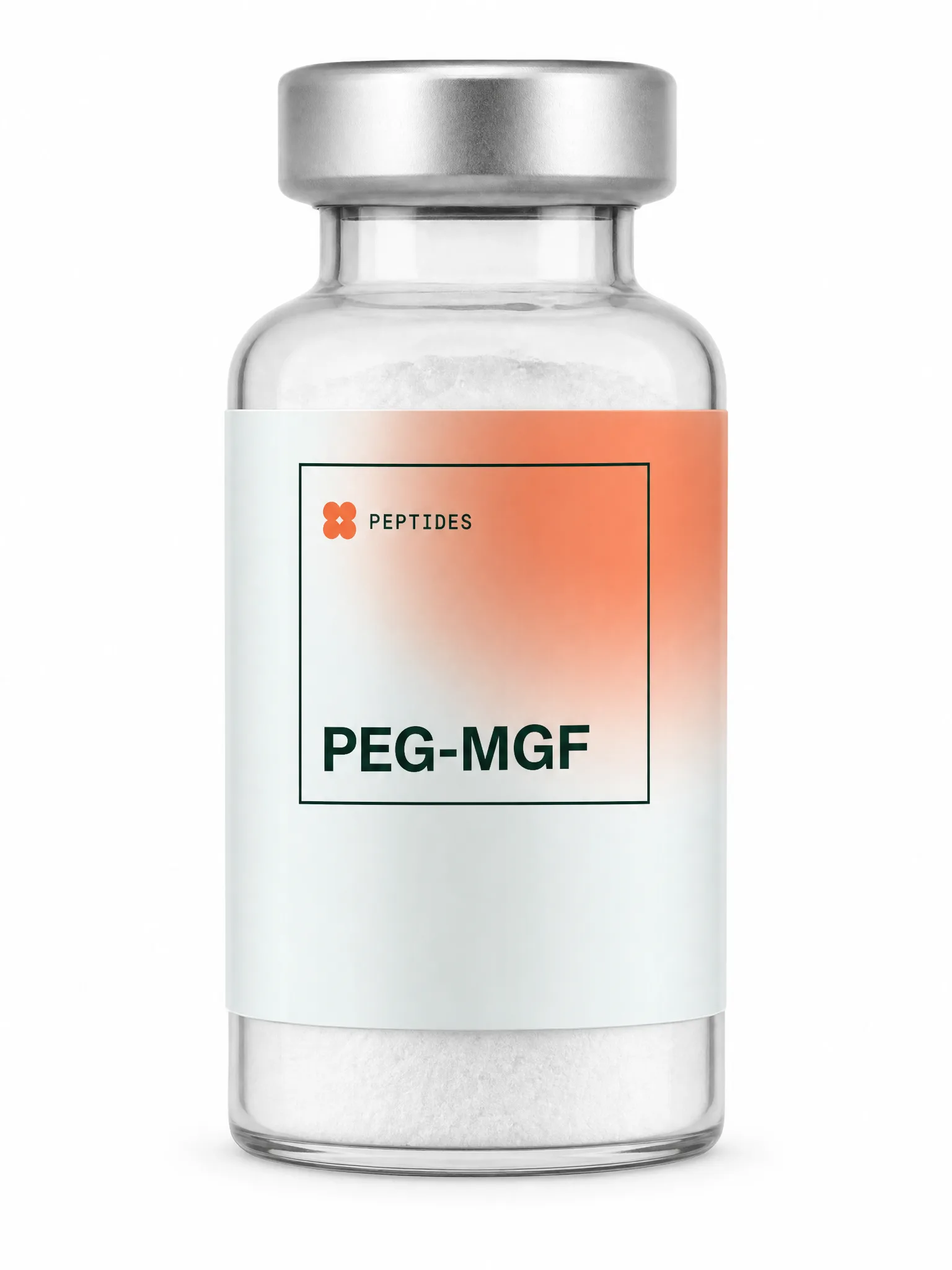
PEG-MGF
PEGylated Mechano Growth Factor
Also called PEG-MGF, pegylated mechano growth factor, IGF-1Ec
The local repair splice variant of IGF-1
MGF is a variant of IGF-1 your muscles produce themselves when you damage them with training. It is the local repair call. Natural MGF lasts minutes, so this version has a chemical tail attached to make it last hours instead, which is what the PEG in the name means.
A pegylated form of Mechano Growth Factor — a splice variant of IGF-1 (IGF-1Ec) produced by muscle in response to mechanical overload and damage. MGF's job is to activate satellite cells and kick off repair locally; the PEGylation extends its otherwise very short half-life so the signal lasts long enough to act systemically.
- Half-life
- ~hours (PEGylated)
- Route
- Subcutaneous injection
- Typical dose
- Research-dependent
- Availability
- Research-only
Human trials published, with more underway
What people use PEG-MGF for
Reported uses, roughly in order of how often they are the reason someone goes looking. Whether it works for any of them is a separate question, answered under each one.
- Muscle repair after hard training
- The whole idea. MGF is released by damaged muscle to wake up the satellite cells that repair and add to muscle fibres, so the theory is that adding more amplifies what training already started.
- Recovery from injury
- Used alongside rehab on the same reasoning. Extrapolated from the mechanism rather than shown in trials.
Mechanism of Action
How PEG-MGF works
PEG-MGF drives the early, satellite-cell phase of muscle repair:
- Satellite-cell activation — the MGF splice variant signals quiescent muscle satellite (stem) cells to proliferate, the critical first step in repairing and growing fibers after damage.
- Distinct from systemic IGF-1 — MGF acts through the early repair pathway rather than the sustained IGF1R growth signal, so it complements (rather than duplicates) IGF-1 LR3.
- PEGylation for half-life — native MGF is degraded within minutes; attaching polyethylene glycol slows clearance so the peptide persists long enough to matter.
- Mechanically gated biology — endogenous MGF is released by training overload, so it's typically used post-workout to amplify the natural repair window.
PEG-MGF dosage calculator
Enter what is in your vial, how much water you added, and the dose you are using. It works out where to pull the plunger to.
How much is in the vial?
Printed on the label, in milligrams
How much water did you add?
Bacteriostatic water, in millilitres
What dose are you taking?
The dose you already intend to use
Which syringe?
Barrel size, printed on the wrapper
Draw to
10 units
on a 0.5 mL insulin syringe (0.1 mL)
- Strength once mixed
- 5 mg/mL
- Doses in the vial
- 20
10 mg in 2 mL makes 5 mg/mL. A 500 mcg dose is 0.1 mL of that, which is 10 units.
This is arithmetic, not advice. It converts a dose you already have into a mark on a syringe. It does not tell you what dose to take, and PEG-MGF is not prescribed by us. Dosing belongs with a qualified clinician.
PEG-MGF side effects: what people reported
Not much reported, and it is genuinely unclear how much of that is a gentle compound and how much is a compound that does less than people hope.
What people report
- Injection-site soreness
- A warm or flushed feeling after a dose
- Tiredness
- Occasional headache
Worth keeping an eye on
- It is related to IGF-1, so low blood sugar is theoretically possible, though it is reported far less than with IGF-1 itself
- It is a growth signal, which carries the same cancer-history caution as the rest of that family
Source: Reported use; there is no human trial of PEG-MGF. This is a summary of published findings, not a complete safety profile and not medical advice. PEG-MGF should only be considered with a qualified clinician who knows your history.
Your Genetics & PEG-MGF
The genes involved in how PEG-MGF works
PEG-MGF works through the receptors these genes build, and the genes vary from person to person. Researchers have linked some of that variation to differences in how people respond. A DNA report tells you which versions you carry.
MGF is a splice variant of the IGF1 gene. Promoter variants that set baseline IGF-1 expression also shape the background on which MGF's local repair signal acts.
ACTN3 · ••
The R577X variant determines fast-twitch fiber composition. Since MGF drives satellite-cell repair of damaged fibers, fiber-type genetics shape how much repair signaling translates to growth.
IGF1R · ••
MGF signaling intersects the IGF-1 receptor pathway. Receptor-sensitivity variants influence how strongly the downstream growth signal fires once satellite cells are activated.
Myostatin restrains satellite-cell activity. Your MSTN tone sets how much resistance MGF's pro-repair signal has to overcome, influencing the net hypertrophy result.
The dots after each gene are where your own result goes. Your report fills them in with the two letters you carry at that position.
Which variants do you carry?
Upload your DNA data, or get tested through our partner, to find out.
Commonly combined with
What PEG-MGF is most often paired with, and why:
IGF-1
Repair + Growth StackModerate EvidenceInsulin-like Growth Factor-1
The primary anabolic mediator of growth hormone. Most of GH's effects on muscle, tissue repair and growth are actually carried out by IGF-1, produced mainly in the liver. Native IGF-1 is short-acting and tightly regulated by binding proteins — making the IGF axis one of the most genetically variable in the body.
4
Gene variants
45+
Studies
CJC-1295
GH Axis StackModerate EvidenceCJC-1295 (Modified GRF 1-29)
A copy of the brain signal that tells the pituitary to release growth hormone, rewritten so the enzyme that normally destroys it in minutes cannot. Before you read any dose, check which version you have: with DAC it keeps growth hormone up for days, without DAC it produces a short pulse, and nearly every blend sold with ipamorelin contains the second one.
4
Gene variants
30+
Studies
BPC-157
Recovery StackModerate EvidenceBody Protection Compound 157
BPC-157 is the peptide people reach for when something will not heal. Tendons, ligaments, a gut that has been irritated by painkillers, an injury that has stalled. It is a short chain of amino acids copied from part of a protein your stomach already makes, and the animal research on it is unusually consistent for this category: across a lot of separate rat studies, injured tissue healed faster than it did without it. The gap is that this has largely not been repeated in people, and it is not an approved medicine, so nobody is checking what is in the vial you buy.
3
Gene variants
19+
Studies
Sourcing & access
Where to buy PEG-MGF
PEG-MGF is sold as a research compound, not a licensed medicine, so quality and legal status vary widely by country and vendor. If you're sourcing it, treat independent purity testing as non-negotiable.
- Insist on a recent third-party Certificate of Analysis (COA) for the exact batch — labs like Janoshik verify purity and identity.
- Check the legal status where you live before ordering — it differs from country to country.
- Reconstitute correctly with bacteriostatic water and start at a conservative dose.
PEG-MGF
The local repair splice variant of IGF-1
Save 10% at checkout with code tcwisiiu
Before you buy: see whether your DNA actually responds to PEG-MGF, and at what dose. Analyze my DNA — $99 →
Educational information only, not medical advice. Some outbound links are affiliate links (disclosed, at no extra cost to you). Most peptides are not FDA-approved — consult a qualified professional and check your local laws before purchasing.
Worth knowing before you consider PEG-MGF
Interactions and situations where there is a specific reason to be careful. Where the honest answer is that nobody has studied something, it says so and says what that leaves open.
- No human trial exists
- The mechanism is real and well described in muscle biology. Whether injecting a long-lasting version does anything useful in a trained human has never been tested.
- It amplifies training rather than replacing it
- The signal it copies is the one damaged muscle sends. Without the damage there is not much for it to amplify.
Last updated
Frequently Asked Questions
What is the difference between PEG-MGF and IGF-1 LR3?
They cover different phases. MGF (the IGF-1Ec splice variant) activates satellite cells to start repair, while IGF-1 LR3 provides the sustained growth signal that builds tissue. PEG-MGF is often used post-workout for the early repair window, with IGF-1 LR3 for the ongoing anabolic phase — they complement rather than duplicate each other.
Why is MGF PEGylated?
Native MGF has an extremely short half-life — it's a local, transient signal in muscle. Attaching polyethylene glycol (PEGylation) slows its breakdown so the peptide stays active long enough to be used practically.
Does genetics affect PEG-MGF response?
Yes. IGF1 background expression, ACTN3 fiber type, IGF1R sensitivity and MSTN (myostatin) tone all shape how well satellite-cell activation converts into actual muscle repair and growth. A genetic peptide report profiles these for you.
Learn more about PEG-MGF
Your next move
Two ways forward with PEG-MGF.
Not sure it's for you?
How does PEG-MGF relate to your genes?
Your report scores PEG-MGF against your receptor, pharmacogene and pathway variants and shows the genetic markers relevant to it, with commonly cited dosing information to review with a clinician.
Analyze my DNA — $99Already decided?
Get PEG-MGF from Swiss Chems.
A US research-chemical supplier with third-party Certificates of Analysis. Sold for research use only — check your local laws before ordering.
Buy at Swiss Chems →Save 10% at checkout with code tcwisiiu