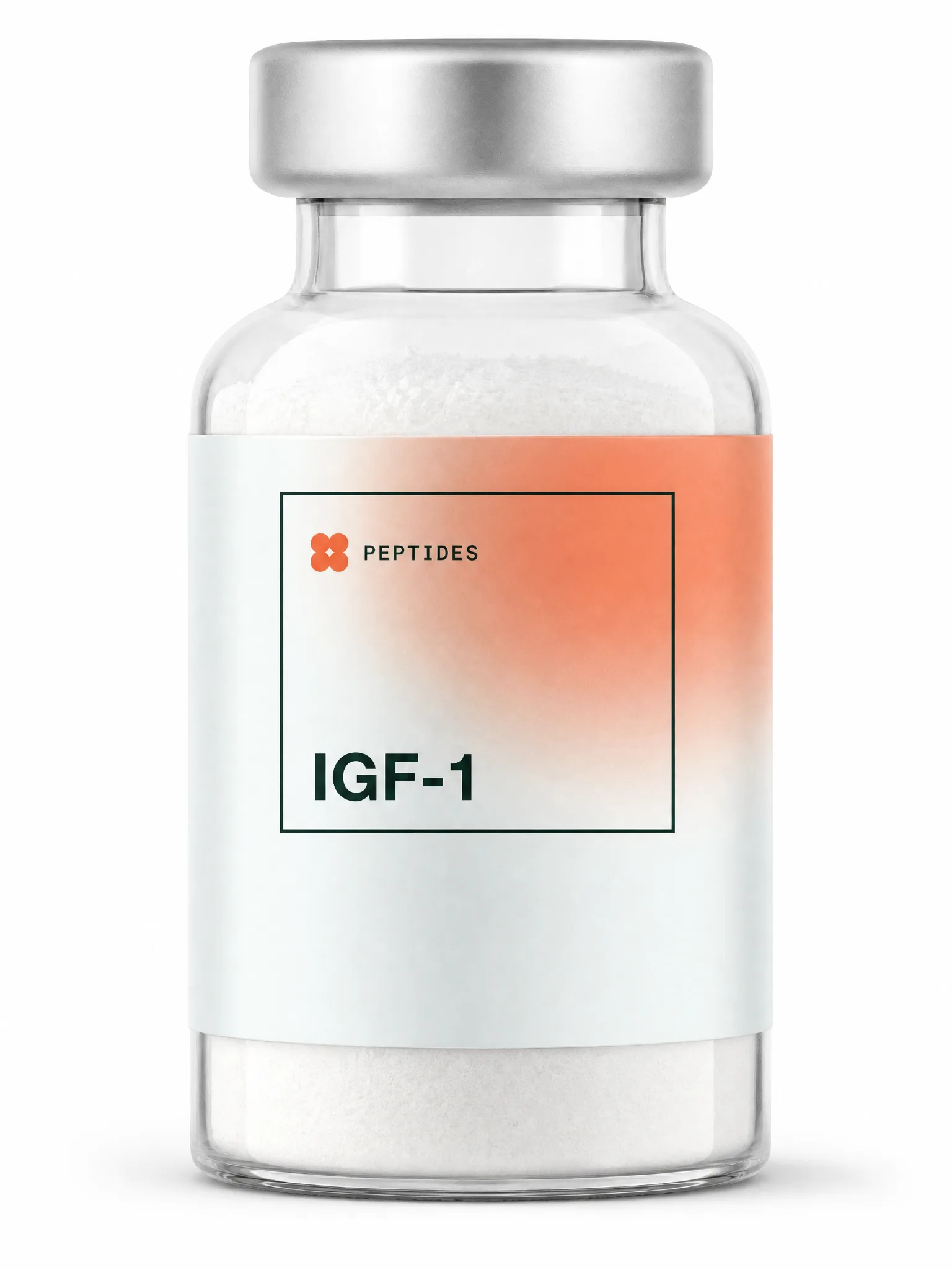
IGF-1
Insulin-like Growth Factor-1
Also called IGF-1, insulin-like growth factor 1, somatomedin C, mecasermin
The hormone GH actually works through
IGF-1 is the hormone that does most of growth hormone's actual work. Growth hormone is largely a messenger: it tells your liver to make IGF-1, and IGF-1 is what tells muscle and other tissue to grow. Taking it directly skips the middleman, which is why it is both more potent and less forgiving than the growth hormone peptides.
The primary anabolic mediator of growth hormone. Most of GH's effects on muscle, tissue repair and growth are actually carried out by IGF-1, produced mainly in the liver. Native IGF-1 is short-acting and tightly regulated by binding proteins — making the IGF axis one of the most genetically variable in the body.
- Half-life
- ~10–12 min (native)
- Route
- Subcutaneous injection
- Typical dose
- Research-dependent
- Availability
- Research-only
Studied in people, and well studied in animals
What people use IGF-1 for
Reported uses, roughly in order of how often they are the reason someone goes looking. Whether it works for any of them is a separate question, answered under each one.
- Muscle growth
- The main reason people use it. It signals muscle cells to grow and to take up nutrients, and unlike the growth hormone secretagogues it does not depend on your pituitary cooperating.
- Recovery from training
- Often used alongside heavy training on the theory that it speeds up repair between sessions.
- Growth hormone insensitivity
- The one genuinely approved use, as a prescription medicine for children whose bodies make growth hormone but cannot respond to it.
Mechanism of Action
How IGF-1 works
IGF-1 is the downstream effector of the growth hormone axis:
- IGF-1 receptor (IGF1R) activation — binds IGF1R to trigger the PI3K/Akt/mTOR pathway that drives protein synthesis, cell growth and repair.
- GH-dependent production — GH signals the liver to produce IGF-1, so most of GH's anabolic effect is really IGF-1's. The GHR d3 genotype sets how efficiently this conversion runs.
- Binding-protein regulation — native IGF-1 is mostly bound to IGFBP-3, with only a small free, active fraction and a short half-life — unlike the engineered LR3 analog.
- Shared insulin signaling — IGF1R overlaps with insulin signaling, giving IGF-1 glucose-lowering effects that depend on individual metabolic genetics.
IGF-1 dosage calculator
Enter what is in your vial, how much water you added, and the dose you are using. It works out where to pull the plunger to.
How much is in the vial?
Printed on the label, in milligrams
How much water did you add?
Bacteriostatic water, in millilitres
What dose are you taking?
The dose you already intend to use
Which syringe?
Barrel size, printed on the wrapper
Draw to
10 units
on a 0.5 mL insulin syringe (0.1 mL)
- Strength once mixed
- 5 mg/mL
- Doses in the vial
- 20
10 mg in 2 mL makes 5 mg/mL. A 500 mcg dose is 0.1 mL of that, which is 10 units.
This is arithmetic, not advice. It converts a dose you already have into a mark on a syringe. It does not tell you what dose to take, and IGF-1 is not prescribed by us. Dosing belongs with a qualified clinician.
IGF-1 side effects: what people reported
This one has a real and predictable side-effect profile, and it comes from the same place as the benefit. IGF-1 shares a receptor with insulin, so it drops blood sugar.
What most people notice
- Low blood sugar: shakiness, sweating, sudden hunger, light-headedness
- Injection-site reactions
- Water retention and puffiness
- Aching joints
Worth keeping an eye on
- Numbness or tingling in the hands, from swelling pressing on the nerve at the wrist
- Headaches
- Jaw and facial aching
The one to take seriously
- Blood sugar can fall far enough to be dangerous, which is why prescription use comes with instructions to eat shortly before or after a dose
- IGF-1 is a growth signal, so anyone with a cancer history should be talking to an oncologist rather than a forum
Dose matters. Low blood sugar tracks the dose closely and is the effect people underestimate most.
Source: Clinical experience with prescription IGF-1 plus widely reported non-medical use. This is a summary of published findings, not a complete safety profile and not medical advice. IGF-1 should only be considered with a qualified clinician who knows your history.
Your Genetics & IGF-1
The genes involved in how IGF-1 works
IGF-1 works through the receptors these genes build, and the genes vary from person to person. Researchers have linked some of that variation to differences in how people respond. A DNA report tells you which versions you carry.
This promoter variant sets your baseline circulating IGF-1. Low-expressers run a lower IGF-1 set point, which shapes both their GH response and how supplemental IGF-1 layers on.
IGF1R · ••
Variants in the IGF-1 receptor gene change signaling efficiency at the direct target. Receptor sensitivity sets how strongly the anabolic cascade fires for a given IGF-1 level.
IGFBP3 · ••
The -202 A/C variant determines IGFBP-3 levels — the main carrier of IGF-1. This sets the bound-versus-free balance and therefore how much active IGF-1 is available.
GHR · ••
The GHR d3 polymorphism governs how efficiently GH is converted to IGF-1 in the liver, setting your endogenous IGF-1 baseline.
The dots after each gene are where your own result goes. Your report fills them in with the two letters you carry at that position.
Which variants do you carry?
Upload your DNA data, or get tested through our partner, to find out.
Commonly combined with
What IGF-1 is most often paired with, and why:
CJC-1295
GH/IGF Axis StackModerate EvidenceCJC-1295 (Modified GRF 1-29)
A copy of the brain signal that tells the pituitary to release growth hormone, rewritten so the enzyme that normally destroys it in minutes cannot. Before you read any dose, check which version you have: with DAC it keeps growth hormone up for days, without DAC it produces a short pulse, and nearly every blend sold with ipamorelin contains the second one.
4
Gene variants
30+
Studies
BPC-157
Recovery StackModerate EvidenceBody Protection Compound 157
BPC-157 is the peptide people reach for when something will not heal. Tendons, ligaments, a gut that has been irritated by painkillers, an injury that has stalled. It is a short chain of amino acids copied from part of a protein your stomach already makes, and the animal research on it is unusually consistent for this category: across a lot of separate rat studies, injured tissue healed faster than it did without it. The gap is that this has largely not been repeated in people, and it is not an approved medicine, so nobody is checking what is in the vial you buy.
3
Gene variants
19+
Studies
Sourcing & access
Where to buy IGF-1
IGF-1 is sold as a research compound, not a licensed medicine, so quality and legal status vary widely by country and vendor. If you're sourcing it, treat independent purity testing as non-negotiable.
- Insist on a recent third-party Certificate of Analysis (COA) for the exact batch — labs like Janoshik verify purity and identity.
- Check the legal status where you live before ordering — it differs from country to country.
- Reconstitute correctly with bacteriostatic water and start at a conservative dose.
Before you buy: see whether your DNA actually responds to IGF-1, and at what dose. Analyze my DNA — $99 →
Educational information only, not medical advice. Some outbound links are affiliate links (disclosed, at no extra cost to you). Most peptides are not FDA-approved — consult a qualified professional and check your local laws before purchasing.
Worth knowing before you consider IGF-1
Interactions and situations where there is a specific reason to be careful. Where the honest answer is that nobody has studied something, it says so and says what that leaves open.
- Eat with it
- The single most practical thing on this page. Prescription IGF-1 is taken shortly before or after food precisely because of the blood-sugar drop. Taking it fasted is how people end up on the floor.
- It is a growth signal, and growth is not selective
- It does not only tell muscle to grow. That is the reason for the cancer caution, and it is not a theoretical one.
Last updated
Frequently Asked Questions
What is the difference between IGF-1 and IGF-1 LR3?
Native IGF-1 is the body's own hormone — short-acting (minutes) and mostly bound to binding proteins. IGF-1 LR3 is an engineered analog that resists those binding proteins and lasts for hours, making it far more potent. Both act on the same IGF-1 receptor; the difference is duration and free-fraction.
Why is IGF-1 tied so closely to growth hormone?
Growth hormone exerts most of its anabolic effects indirectly — by telling the liver to produce IGF-1. So your IGF-1 level is the practical readout of GH activity, and the GHR d3 genotype, which sets GH-to-IGF-1 conversion efficiency, strongly shapes both.
Does genetics affect IGF-1 response?
Yes. IGF1 promoter variants set your baseline, IGF1R variants determine receptor sensitivity, IGFBP3 status sets the free-versus-bound balance, and GHR d3 governs GH-to-IGF conversion. A genetic peptide report profiles the whole axis for you.
Learn more about IGF-1
32 guides mention IGF-1→stacking
Peptide Stacking 101: The Rules, the Risks, and the Science
13 min read
safety
Peptides for Beginners: The Complete Starter Guide (2026)
18 min read
how it works
In depthThe IGF-1 to IGFBP-3 Ratio Explained: What It Actually Tells You About Your Peptide Protocol
12 min read
genetics
In depthWhy Two People on the Same Ipamorelin Protocol Get Completely Different IGF-1 Results
11 min read
genetics
In depthWhy Your IGF-1 Won't Go Up on Ipamorelin: The STAT5B Gene Nobody Talks About
12 min read
safety
In depth9 Signs Your IGF-1 Is Too High (And What to Do Before Your Next Injection)
11 min read
Your next move
Two ways forward with IGF-1.
Not sure it's for you?
How does IGF-1 relate to your genes?
Your report scores IGF-1 against your receptor, pharmacogene and pathway variants and shows the genetic markers relevant to it, with commonly cited dosing information to review with a clinician.
Analyze my DNA — $99Already decided?
Get IGF-1 from Swiss Chems.
A US research-chemical supplier with third-party Certificates of Analysis. Sold for research use only — check your local laws before ordering.
Buy at Swiss Chems →Save 10% at checkout with code tcwisiiu