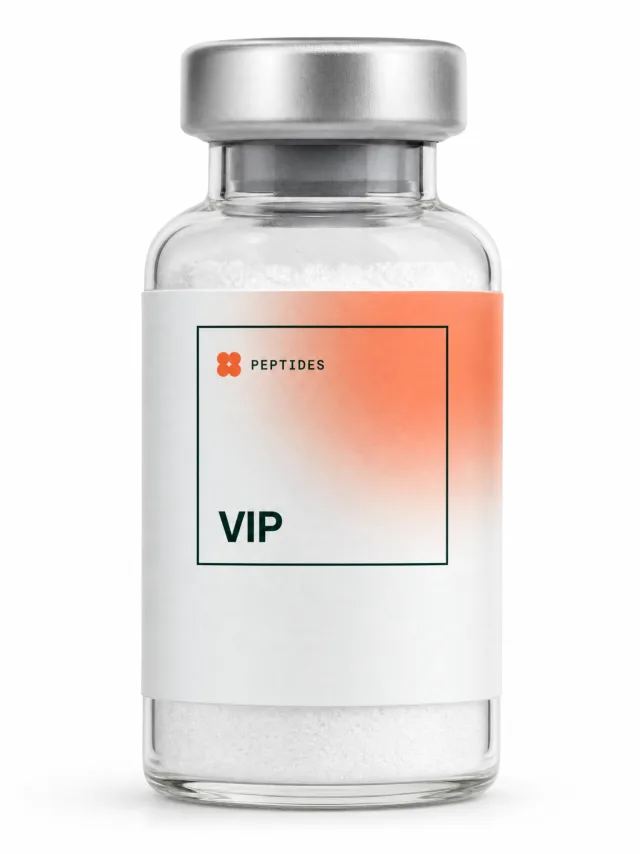
VIP
VIP (Vasoactive Intestinal Peptide)
Also called vasoactive intestinal peptide, aviptadil, VIP peptide
The anti-inflammatory regulator
VIP is a hormone your own body makes, found in the gut, lungs and nervous system, where it widens blood vessels and calms inflammation. As a drug it is called aviptadil and has been trialled in hospital for severe lung failure. The nasal spray sold online for mould illness is a different use with no trial behind it.
A hormone you already make, working in your gut, lungs and nerves, where it widens blood vessels and tells inflammation to settle down. As a hospital drug it is called aviptadil and has been properly trialled for severe lung failure. The nasal spray sold online for mould illness is the same molecule used a completely different way, with no controlled trial behind it.
- Typical dose
- 50 mcg 1–3x daily
- Availability
- Research-only
Early research, mostly in the lab so far
8,369 papers · 111 clinical trials
What people use VIP for
Reported uses, roughly in order of how often they are the reason someone goes looking. Whether it works for any of them is a separate question, answered under each one.
- Severe lung injury
- Where it has actually been trialled, as intravenous aviptadil in hospitalised patients with respiratory failure.
- Mould illness and CIRS
- The reason most people search for it, taken as a nasal spray. This use has no controlled trial behind it.
Mechanism of Action
How VIP works
VIP is not really a peptide product. It is a hormone you already make, working quietly in your gut, lungs and nerves, and its general instruction is to calm things down.
It widens blood vessels. It relaxes the smooth muscle lining your airways. It tells immune cells to ease off rather than escalate, damping the inflammatory signals that drive swelling and damage. It is one of the body's own de-escalation signals.
Why it is difficult to use as a drug
It is destroyed within a couple of minutes of entering the bloodstream. That is fine for a signal meant to act locally and stop, and awkward for anything you want to swallow or inject and have work for hours.
That single fact shapes everything about how it is actually used in medicine. Where it has been given seriously, as a drug called aviptadil for patients in respiratory failure, it went in as a continuous drip in hospital, with monitoring, because a vasodilator that drops blood pressure is not something to administer casually.
The gap you should know about
Most people searching for this are not looking for an intensive care drug. They are looking at a nasal spray sold for mould illness and chronic inflammatory conditions.
Those two things share a molecule and almost nothing else. The trials were intravenous, in hospital, in critically ill patients. The nasal spray use has no controlled trial behind it at all. When you read that VIP has thousands of published papers, that is true, and nearly all of them are basic biology of the hormone rather than evidence for taking it.
VIP dosage calculator
Opens at 50 mcg, from the doses reported for VIP. Change any box to match your own vial. It works out where to pull the plunger to.
How much is in the vial?
Printed on the label, in milligrams
How much water did you add?
Bacteriostatic water, in millilitres
What dose are you taking?
The dose you already intend to use
Which syringe?
Barrel size, printed on the wrapper
Draw to
1 units
on a 0.5 mL insulin syringe (0.01 mL)
That lands under 2 units, which is very hard to draw accurately by eye. Adding more water spreads the same dose over more of the barrel.
- Strength once mixed
- 5 mg/mL
- Doses in the vial
- 200
10 mg in 2 mL makes 5 mg/mL. A 50 mcg dose is 0.01 mL of that, which is 1 units.
Want a rounder number? Adding 20 mL instead would put this dose at exactly 10 units, which is easier to draw accurately.
This is arithmetic, not advice. It converts a dose you already have into a mark on a syringe. It does not tell you what dose to take, and VIP is not prescribed by us. Dosing belongs with a qualified clinician.
VIP side effects: what people reported
VIP widens blood vessels, which is where nearly everything people report comes from. Most of it shows up in the first few doses and settles as the body adjusts.
What people report
- Flushing and feeling warm
- Light-headedness on standing, from blood pressure dropping
- Nasal irritation or a runny nose with the spray
- Loose stools
- Headache
Worth keeping an eye on
- Blood pressure sitting lower than usual, which matters if it is already on the low side
- Starting at a full dose rather than a fraction of one is the usual reason people have a bad first experience
Dose matters. Blood-pressure effects track the dose, which is why protocols start very low.
Source: Reported use, largely nasal, plus the pharmacology of the peptide. This is a summary of published findings, not a complete safety profile and not medical advice. VIP should only be considered with a qualified clinician who knows your history.
Your Genetics & VIP
The genes involved in how VIP works
VIP works through the receptors these genes build, and the genes vary from person to person. Researchers have linked some of that variation to differences in how people respond. A DNA report tells you which versions you carry.
NLRP3 · ••
The NLRP3 inflammasome is a master driver of inflammation. Risk variants mean an over-active inflammatory tendency that an anti-inflammatory like VIP could target; non-risk genotypes indicate a quiet set-point with little to suppress.
TNF · ••
The -308 promoter variant raises TNF-α output in A-allele carriers. Higher baseline TNF tone is the inflammatory background where VIP's suppression is justified; GG (normal) is not.
IL10 · ••
IL-10 is the body's own anti-inflammatory brake. Your IL-10 genotype indicates how strong your built-in regulation already is — high baseline regulation leaves less room for additional suppression.
The dots after each gene are where your own result goes. Your report fills them in with the two letters you carry at that position.
Which variants do you carry?
Upload your DNA data, or get tested through our partner, to find out.
Commonly combined with
What VIP is most often paired with, and why:
KPV
Anti-inflammatory StackEmerging EvidenceKPV (Lys-Pro-Val)
A three-amino-acid fragment snipped off the end of a hormone your body already makes. Almost every page describes it as switching on a melanocortin receptor; the research fairly clearly says it does not. What it appears to do instead is more interesting, and it is why nearly all the good data is about the gut rather than skin.
4
Gene variants
15+
Studies
Sourcing & access
Where to buy VIP
VIP is sold as a research compound, not a licensed medicine, so quality and legal status vary widely by country and vendor. If you're sourcing it, treat independent purity testing as non-negotiable.
- Insist on a recent third-party Certificate of Analysis (COA) for the exact batch — labs like Janoshik verify purity and identity.
- Check the legal status where you live before ordering — it differs from country to country.
- Reconstitute correctly with bacteriostatic water and start at a conservative dose.
Before you buy: see whether your DNA actually responds to VIP, and at what dose. Analyze my DNA — $99 →
Educational information only, not medical advice. Some outbound links are affiliate links (disclosed, at no extra cost to you). Most peptides are not FDA-approved — consult a qualified professional and check your local laws before purchasing.
Worth knowing before you consider VIP
Interactions and situations where there is a specific reason to be careful. Where the honest answer is that nobody has studied something, it says so and says what that leaves open.
- The trialled use and the sold use are not the same
- Intravenous aviptadil in an intensive care unit and a nasal spray bought online for mould illness share a molecule and nothing else. Route, dose, setting and monitoring all differ, and results from one say nothing about the other.
- It widens blood vessels, so blood pressure can drop
- This is its core action rather than a side effect. In hospital use it is given with monitoring for exactly that reason. Flushing and a fall in blood pressure are the expected effects of a vasodilator.
- It breaks down very quickly
- Natural VIP has a half-life of a couple of minutes in blood, which is the central practical problem with using it as a drug and the reason hospital use is by continuous infusion rather than a single dose.
The evidence behind VIP
The 8,000-plus papers on VIP are mostly basic biology of a natural human hormone, not evidence for taking it. Separate two things. As a hospital drug called aviptadil it has been through real randomised trials, including a large one for COVID respiratory failure published in Lancet Respiratory Medicine. As a nasal spray for mould illness and chronic inflammatory response syndrome, which is what most people are looking for, there is no controlled trial at all, only clinic protocols.
The literature, counted
Counted in PubMed on 3 August 2026 for vasoactive intestinal peptide. Every figure links to the search that produced it, so you can re-run it. “Tagged human” is not the same as a human trial: that tag also covers work on human cells and reviews discussing people, which is why the trial count is given separately.
Studied in people
2 of 2The only kind that directly answers whether it works in humans.Lancet Respiratory Medicine · 2023
HumanIntravenous aviptadil and remdesivir for treatment of COVID-19-associated hypoxaemic respiratory failure: a randomised, placebo-controlled trial
Brown SM, Barkauskas CE, Grund B, et al.
The largest proper trial of VIP as a drug, run across 28 US sites in patients with respiratory failure. This is what a real test of this molecule looks like, and it is a long way from a nasal spray for fatigue.
Intravenous aviptadil and remdesivir for treatment of COVID-19-associated hypoxaemic respiratory failure: a randomised, placebo-controlled trial — source for VIP (opens in a new tab)Randomised, placebo-controlled
Read the paperCritical Care Medicine · 2022
HumanThe Use of IV Vasoactive Intestinal Peptide (Aviptadil) in Patients With Critical COVID-19 Respiratory Failure: Results of a 60-Day Randomized Controlled Trial
Youssef JG, Lavin P, Schoenfeld DA, et al.
A second randomised trial in critically ill patients, adding to the hospital evidence for the intravenous form.
The Use of IV Vasoactive Intestinal Peptide (Aviptadil) in Patients With Critical COVID-19 Respiratory Failure: Results of a 60-Day Randomized Controlled Trial — source for VIP (opens in a new tab)Randomised controlled · 60 days
Read the paper
Reviews
1 of 3Papers that gather other studies rather than run new ones.Every source behind this page52 more
- Structure-activity relationship of vasoactive intestinal peptide (VIP): potent agonists and potential clinical applicationsOnoue S, Misaka S, Yamada S · Naunyn-Schmiedeberg's Archives of Pharmacology · 2008Review
- Role of vasoactive intestinal peptide in osteoarthritisJiang W, Wang H, Li YS, Luo W · Journal of Biomedical Science · 2016Review
Everything we cite for VIP, including animal work and early research. Each link goes to the source itself, so you can judge it rather than take our word for it.
Last updated · literature counts verified against PubMed on
Frequently Asked Questions
What is VIP used for?
VIP (vasoactive intestinal peptide) is a potent endogenous anti-inflammatory studied — often intranasally — for chronic inflammatory states and biotoxin illness, and pharmaceutically (as aviptadil) for respiratory conditions. It calms an over-active immune response.
Does genetics affect whether VIP helps?
Yes, decisively. VIP suppresses inflammation, so it's most useful when your inflammation is genuinely high. Markers like NLRP3, TNF (rs1800629) and IL10 reveal whether your immune set-point runs hot or quiet — and a quiet profile gives VIP little to act on.
Is VIP legal?
VIP is not approved for general use; aviptadil has been studied in specific diseases under research/trial settings, and intranasal use is off-label/research. Access and regulatory status vary by country.
Your next move
Two ways forward with VIP.
Not sure it's for you?
How does VIP relate to your genes?
Your report scores VIP against your receptor, pharmacogene and pathway variants and shows the genetic markers relevant to it, with commonly cited dosing information to review with a clinician.
Analyze my DNA — $99