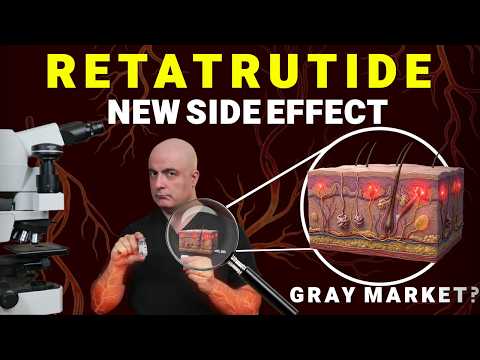
I’m a Pathologist. Retatrutide is NOT Ozempic. It’s Biological Overdrive.
A pathologist's solo lecture on how retatrutide's three receptor targets work, what he says the trial data show for liver fat, and the heart, muscle and mood costs he flags.
With Dr. Amin Hedayat (MD)
Key moments
Tap a moment to play the video from there.
- 0:00Framing and disclosuresHedayat introduces retatrutide as a triple agonist, states he has no industry ties, and says the talk covers published data and mechanisms, not treatment decisions.
- 2:25Not approved, gray market warningHe says retatrutide is still in phase three trials and warns that research-use-only vials carry unknown purity, sterility and potency.
- 3:56Why dieting failsHe argues that human biology evolved to store fat, so willpower is a software fix for a hormonal hardware problem.
- 5:19Hypothalamus and leptin resistanceHedayat describes the hypothalamus as a thermostat holding a body fat set point, with leptin resistance driving constant food noise.
- 6:23Three receptors and glucagonHe explains why glucagon is added to GLP-1 and GIP, saying it raises energy expenditure through heat production.
- 8:02Liver fat resultsHe cites MRI findings of liver fat dropping by over 80% at the high dose and normal liver fat in nine out of 10 participants who started with fatty liver disease.
- 9:40Heart rate increaseHedayat reports a dose-dependent rise in resting heart rate and attributes it to glucagon receptors in the heart's pacemaker.
- 10:49Muscle loss concernsHe says fast weight loss can cost muscle and lower metabolic rate, which he links to rebound risk if the drug is stopped.
- 11:51Anhedonia and nauseaHe mentions nausea in up to 60% of patients and describes a flattened mood he ties to dopamine and the brain's reward center.
- 12:24Risk mitigation approachesHe covers protein intake, resistance training and heart rate monitoring, framing each as something studied or managed with a medical team.
What the video says
Dr. Amin Hedayat, who describes himself as a board certified pathologist and assistant clinical professor, presents a mechanism-focused talk on retatrutide. He says it is still in phase three trials and not FDA approved. He draws on the TRIUMPH 1 and TRIUMPH 2 studies, states that he has no industry affiliations, and says the talk is education, not personal medical advice.
He opens with a warning about gray market sellers of vials labeled for research purposes only. Hedayat says buyers have no assurance of purity, sterility or potency, and he lists contamination and overly strong batches as risks. He then lays out his framing of weight regain as a hardware problem, not a willpower problem. In his account, the hypothalamus defends a body fat set point, and leptin resistance keeps the brain signaling starvation.
On mechanism, Hedayat contrasts retatrutide with Ozempic, which he describes as targeting GLP-1, and Mounjaro, which he describes as targeting GLP-1 and GIP. He says retatrutide adds glucagon, which he describes as acting like a furnace that raises energy burn. He cites an average weight loss of 24.2% from phase two trials. He also says MRI measures showed liver fat falling by over 80% at the high dose, and that nine out of 10 participants with fatty liver disease returned to a normal range.
The second half covers what he calls the price tag. He reports a dose-dependent rise in resting heart rate, 7 to 10 beats per minute at 12 mg, and says long-term data on cumulative cardiac strain are missing. He also raises muscle loss during rapid weight loss, nausea in up to 60% of patients, and anhedonia that he links to reward-center receptors. He closes with three mitigation ideas that he says are studied in research settings: higher protein intake, resistance training, and heart rate monitoring with dose adjustment under medical supervision.
On each compound
Retatrutide6:23
Hedayat describes retatrutide as a triple agonist of GLP-1, GIP and glucagon receptors, cites 24.2% average weight loss and large liver fat reductions in trials, and says it carries heart rate, muscle and mood costs. He stresses that it is not FDA approved.
See how your DNA reads Retatrutide“The tissue doesn't lie, but labels can.”
What this video doesn’t settle
- The 24.2% weight loss figure is attributed to phase two trials, and the video does not show the underlying data or the TRIUMPH results themselves.
- The link between retatrutide and anhedonia through reward-center receptors is asserted without any cited study or incidence figure.
- Hedayat says long-term data on cumulative heart strain from the raised resting heart rate do not yet exist.
Questions this video answers
Is retatrutide FDA approved?
Hedayat says it is not approved and is still in phase three clinical trials, so no official version is available at a pharmacy. He warns against gray market research-chemical sellers.
How does retatrutide differ from Ozempic and Mounjaro?
Hedayat says Ozempic targets GLP-1 and Mounjaro targets GLP-1 and GIP, while retatrutide also hits the glucagon receptor. He says glucagon adds a thermogenic effect that raises energy burn.
What does the video say about retatrutide and fatty liver?
He cites MRI data showing liver fat dropping by over 80% in the high-dose group. He says nine out of 10 participants who started with fatty liver disease reached a normal range by the end of the trial.
What side effects of retatrutide does the pathologist discuss?
Hedayat discusses a higher resting heart rate of 7 to 10 beats per minute at 12 mg, possible muscle loss, nausea in up to 60% of patients, and anhedonia. He says long-term cardiac data are lacking.
How does Hedayat say muscle loss on retatrutide could be limited?
He says research settings often evaluate higher protein intake, citing 1.2 to 1.5 g per kilogram for maintenance, plus leucine and resistance training. He says individual amounts should be set with a medical team.
Video by Dr. Amin Hedayat, MD on YouTube, embedded as published. The summary is written by PeptidesDNA from the video; every claim in it is the speaker’s. Not affiliated with or endorsed by the creator. Not medical advice.