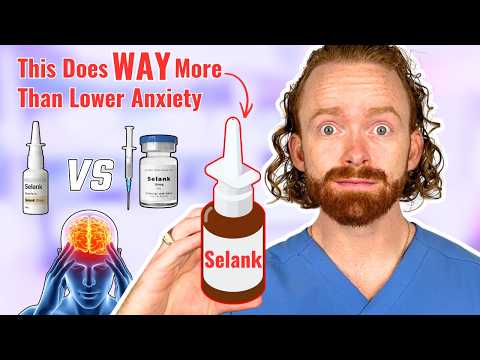
The Truth About Selank: Unveiling Its Nootropic Potential
A solo, ten-minute overview of Selank, covering its origin, proposed mechanisms, reported side effects, pros and cons, and the host's view that it is only approved in Russia and Ukraine.
With Host of The Anxious Resistance (name not stated)
Key moments
Tap a moment to play the video from there.
- 0:02Introducing Selank and its usesThe host presents Selank as a synthetic peptide derived from tuftsin, used in Russia for anxiety and considered a nootropic. They outline what the video will cover.
- 1:02Structure and deliveryThe host describes Selank as a seven amino acid peptide that is an analog of tuftsin. They say it is given as a nasal spray or an injection.
- 1:34Russian development historyAccording to the host, researchers in Moscow modified unstable tuftsin in the 1980s and tested analogs. They say Selank was approved in Russia as an anxiety medication in 2009.
- 2:35Proposed mechanisms in the brainThe host says Selank modulates serotonin, dopamine, norepinephrine and enkephalins, raises brain derived neurotrophic factor, and may affect cytokine balance.
- 3:05Evidence the host citesThe host lists findings on anxiety, memory, learning, depression-like behavior and alcohol withdrawal. They note that much of it is preclinical and that Western data is scarce.
- 4:35Side effects and cautionsThe host reports mild nasal or injection-site reactions, no sedation or addiction, and caution for people with bleeding disorders, on blood thinners, or with allergies.
- 6:07Pros the host listsThe host names the claimed benefits for anxiety, memory, learning and mood, the lack of sedative effects, fast onset, and easy administration.
- 6:37Cons and limited availabilityThe host says Selank is not widely approved outside Russia and Ukraine and is relatively expensive. They add that it can cause local irritation and may raise bleeding risk.
- 9:11The host's overall takeThe host says the peptide has potential but does not recommend seeking it out outside Russia and Ukraine. They compare their interest to their own use of SAM-e.
What the video says
The host of The Anxious Resistance gives a solo overview of Selank, which they describe as a synthetic peptide with reported benefits for the brain and mental health. They say it is used in Russia as a medication for anxiety disorder and is also treated as a nootropic, or cognitive enhancer, because of its claimed effects on memory, learning and mood.
The host describes Selank as a seven amino acid peptide derived from tuftsin, a shorter peptide made in the spleen. According to the host, Russian researchers in Moscow developed it in the 1980s because tuftsin broke down too quickly in the body, and they say it was approved as an anxiety medication in Russia in 2009. It is given as a nasal spray or an injection. The host says it influences neurotransmitters such as serotonin, dopamine, norepinephrine and enkephalins, raises brain derived neurotrophic factor, and may shift the balance of cytokines, which they link to anti-inflammatory and immune-modulating effects.
On evidence, the host lists findings they say come from preclinical studies and from healthy volunteers, including less anxiety, better memory and learning, less depression-like behavior, lower alcohol intake, and higher brain derived neurotrophic factor. They point to links in an article on their website and acknowledge that much of the work is preclinical, that there is little Western research, and that they do not know how reliable Russian trials are.
On safety, the host says it is generally well tolerated, with mild nasal irritation from the spray or local pain or redness from the injection. They say it is not sedating or addictive and has no known drug interactions, but that people with bleeding disorders or on blood thinners, or with allergies to its components, should be cautious. They list the cons as limited approval, relatively high cost, and these side effects. Their own take is that it has potential but that viewers outside Russia and Ukraine should not seek it out. They mention personally liking SAM-e for depression and anxiety as a point of comparison.
On each compound
Selank0:02
The host describes Selank as a synthetic heptapeptide derived from tuftsin, used in Russia for anxiety and considered a nootropic. They say it modulates neurotransmitters and raises brain derived neurotrophic factor, and that it is generally well tolerated. They do not recommend seeking it out outside Russia and Ukraine.
See how your DNA reads SelankWhat this video doesn’t settle
- The host says most of the cited findings are preclinical and does not show how well they carry over to people.
- No study names, sample sizes, doses or effect sizes are given in the video, since the host refers viewers to links in a written article.
- The host says they do not know how reliable Russian clinical trials are, so the human evidence is left unassessed.
Questions this video answers
What is Selank according to this video?
The host describes it as a synthetic seven amino acid peptide derived from tuftsin. They say it was developed in Russia in the 1980s and is used there as an anxiety medication, and that it is also called a nootropic. They say it is given as a nasal spray or an injection.
How does Selank work, according to the host?
The host says it mimics tuftsin and modulates serotonin, dopamine, norepinephrine and enkephalins. They also say it raises brain derived neurotrophic factor and may affect cytokine balance, giving anti-inflammatory and immune-modulating effects.
What side effects of Selank does the host mention?
The host reports mild nasal irritation or congestion from the spray and local pain or redness from the injection, usually short-lived. They say it is not sedating or addictive, but that people with bleeding disorders, on blood thinners, or with allergies to its components should be cautious.
Is Selank approved outside Russia, per this video?
The host says it is approved only in Russia and Ukraine and is not widely available elsewhere. They say they do not advise seeking it out in other countries and present the video as educational.
How strong is the evidence for Selank in this video?
The host lists findings on anxiety, memory, learning, depression-like behavior and alcohol withdrawal, mostly from preclinical studies plus some healthy volunteer work. They say there is little Western research and that they are unsure how valid Russian trials are.
Video by The Anxious Resistance on YouTube, embedded as published. The summary is written by PeptidesDNA from the video; every claim in it is the speaker’s. Not affiliated with or endorsed by the creator. Not medical advice.