

- The standard 250 to 500 mcg per day is convention, not a trial-derived number. There is no human dose-finding study.
- How fast your liver clears compounds is the biggest factor: slow processors need less, fast processors may need more.
- Always start with a low assessment dose (150-200 mcg) for the first week, no matter your target dose.
- Oral BPC-157 absorbs much less than injection, so oral doses run at roughly double.
- If you take prescription meds, get your liver enzyme status tested first to avoid dangerous drug interactions.
Search "BPC-157 dosage" and you'll find the same numbers repeated everywhere: 250-500 mcg per day, subcutaneous injection, 4-8 week cycles. These ranges come from animal study extrapolations and community consensus rather than from clinical trials with pharmacokinetic data.
That doesn't mean those ranges are wrong. It means they are averages, and averages hide a lot. Body composition, injury severity, and administration route all affect what dose actually works for you.
Imagine a shoe store that only sells size 10. It fits most people okay-ish, but it's not actually right for anyone with smaller or larger feet. Standard BPC-157 dosing is the size 10 shoe. Your CYP enzymes are your actual shoe size.
What is the standard BPC-157 dosage?
Before we get into genetics, here's what's commonly used in the peptide community and by practitioners:
| Route | Dose Range | Best For | Notes |
|---|---|---|---|
| SubQ (near injury) | 250-500 mcg/day | Localized tendon/joint repair | The most common route. You do not have to inject near the injury; see below. |
| SubQ (systemic) | 250-500 mcg/day | Gut healing, systemic inflammation | Abdominal injection when injury site not accessible. |
| Oral (capsules) | 500-1000 mcg/day | Gut conditions (ulcers, IBD, NSAID damage) | Lower bioavailability, so roughly twice the injection dose. |
Some practitioners scale to body weight: roughly 3-10 mcg/kg/day. For an 80 kg person, that is 240 to 800 mcg per day, which lands back inside the standard range. Most protocols recommend 4-8 week cycles with 2-4 weeks off.
Why the same dose does not land the same way for everyone
Every dosing guide gives you a flat number, and people still report very different experiences on it. Some of that is real variation between people. Some of it is that nobody has run a dose-finding trial in humans, so the number is convention.
Clear up one thing first: this is not a liver enzyme story
You will see it claimed, including in places that ought to know better, that BPC-157 is cleared by the CYP450 liver enzymes and that your CYP3A4 status therefore sets your dose. That is not how peptides work. Peptides are broken down by peptidases and proteases, enzymes that cut peptide bonds, not by the cytochrome P450 system that handles most small-molecule drugs.
Where CYP status genuinely matters is your other medications. If you take something routed through CYP3A4, a statin or certain immunosuppressants for instance, that is worth discussing with whoever prescribed it. But adding BPC-157 does not queue up behind them, because it is not using that pathway in the first place.
Worth adding: consumer DNA files cannot reliably resolve CYP3A4 or CYP2D6 anyway, so any service offering you a metabolizer readout for those from a 23andMe upload is overreaching. What array data can and cannot tell you goes through this properly, and the half-life page covers what actually governs how long it lasts.
What does vary
The more useful sources of difference are duller than a metabolizer phenotype.
The vascular one, which is real
BPC-157's mechanism runs substantially through nitric oxide signalling, and NOS3 variants (particularly rs1799983) are associated with differences in nitric oxide production. That association is the reason some people report lightheadedness, flushing or headaches at doses others tolerate without noticing.
It is an association rather than a prediction, and the practical response to it is the same one that applies to anybody: start at the low end and move up, rather than opening at 500 mcg to see what happens.
Start low because starting low is sensible, not because a test told you to. If you get flushing or lightheadedness, that is your signal to ease off, and it arrives faster than any genetic report would.
How much, for what
The dose does not vary as much by problem as people expect. What changes more is how long you run it and whether you split the day.
| What you are treating | Common dose | Typical length |
|---|---|---|
| Tendon or ligament injury | 250 mcg twice daily | 6 to 8 weeks |
| Muscle tear or strain | 250 mcg twice daily | 4 to 6 weeks |
| Gut problems | 250 to 500 mcg once daily | 4 to 6 weeks |
| Post-surgical recovery | 250 mcg twice daily | 4 to 8 weeks |
| Joint pain | 250 mcg twice daily | 6 to 8 weeks |
Long-standing problems sit at the longer end. A useful checkpoint: if three weeks of consistent use has produced nothing at all, that is worth treating as information rather than pushing on regardless.
Does body weight change the dose?
Less than you would think. Some practitioners scale at roughly 3 to 10 mcg per kg per day, which for most adults lands back inside the same 250 to 500 mcg range anyway. Unless you are at an extreme of body size, the standard dose is the standard dose.
You do not have to inject near the injury
This is the most repeated instruction in the category and the evidence does not require it. The animal studies behind BPC-157's reputation, the transected Achilles tendon, ligament and quadriceps work, dosed it into the abdomen or simply gave it in drinking water, and it worked from there.
So use ordinary subcutaneous sites and rotate between them. It is easier, it is kinder to your skin, and it is consistent with how the research was actually done.
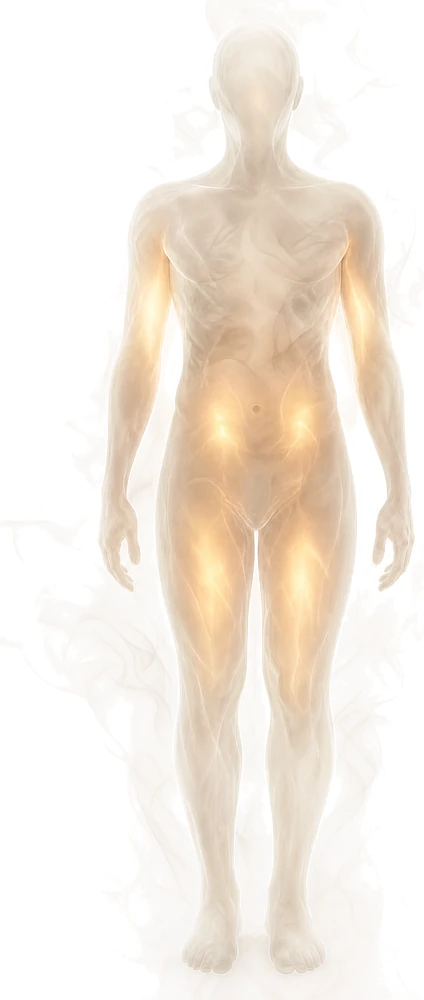
Subcutaneous sites
- AbdomenThe usual first choice. Stay roughly two finger-widths clear of the navel.
- Front or outer thighEasy to reach and easy to see what you are doing.
- Back of the upper armThe fleshy part at the back. Awkward to self-inject.
How should you approach BPC-157 dosing?
Instead of a flat "take 500 mcg," consider a phased approach:
Assessment: 150 to 200 mcg/day
Below the therapeutic range on purpose. You're testing tolerance: injection site reactions, vascular effects (lightheadedness, flushing), general response. If you're a poor CYP metabolizer or carry NOS3 variants, this conservative start is critical.
Titration: 250 to 300 mcg/day
If week 1 went smoothly, step up. Most people notice the first effects here: reduced pain, easier movement, or gut symptoms settling. Pay attention to what changes.
Therapeutic: 250 to 500 mcg/day
Settle into your dose based on response. Where you land depends on:
How you tolerate it: if the early doses caused flushing or lightheadedness, stay lower.
Injury severity: recent injuries generally settle at lower doses than long-standing ones.
Route: oral needs roughly twice the injected dose.
Stacking: no reduction is needed when combining with TB-500, since they do not compete for a shared clearance pathway.
What are the most common BPC-157 dosing mistakes?
Where a genetic report actually helps here
Worth being precise about this, because the category is full of overclaiming.
A DNA report will not tell you your BPC-157 dose. There is no dose-response study in humans to calibrate against, and the compound is not cleared by the pathways consumer arrays read well. Anyone selling you a peptide dose derived from a saliva test is selling you a number they invented.
What variant data can reasonably do is narrow a shortlist. Across our panel, the useful output is which compounds relate to pathways you carry variants in, so that when you are choosing between three plausible options you have something better than a forum thread. For BPC-157 specifically, NOS3 is the relevant one, because the mechanism runs through nitric oxide signalling, and it is a reason to be unhurried with titration rather than a dose instruction.
What it does not cover: CYP3A4 and CYP2D6 cannot be reliably resolved from consumer array data, so they are not reported, and they would not set a peptide dose even if they were.
Standard BPC-157 dosing is a starting point, not a protocol.
Where you land in the 200 to 500 mcg range comes down to what you are treating, how long you give it, and how you tolerate the early doses. Start at the low end, change one thing at a time, and give soft tissue the weeks it actually needs before deciding it did nothing.
Turning a dose into units on the syringe
This is where most people actually get stuck. The dose is in micrograms; your syringe is marked in units. What connects them is how much water you put in the vial, and getting that wrong is the most common way people take double or half what they intended.
5mg vial
| Water added | Concentration | 250 mcg dose | 500 mcg dose | Doses per vial |
|---|---|---|---|---|
| 2 mL | 2,500 mcg/mL | 10 units | 20 units | 20 at 250 mcg |
| 1 mL | 5,000 mcg/mL | 5 units | 10 units | 20 at 250 mcg |
10mg vial
| Water added | Concentration | 250 mcg dose | 500 mcg dose | Doses per vial |
|---|---|---|---|---|
| 2 mL | 5,000 mcg/mL | 5 units | 10 units | 40 at 250 mcg |
| 3 mL | 3,333 mcg/mL | 7.5 units | 15 units | 40 at 250 mcg |
Notice that the water never changes how many doses you get, only how many units each dose is. Two millilitres in a 5mg vial is the easiest combination to measure accurately, because 10 units is a clear mark rather than a squint.
Or skip the tables. This is the calculator, already set to a 5mg vial with 2mL of water and a 250 mcg dose. Change any box to match what you actually have and it draws the syringe for you.
How much is in the vial?
Printed on the label, in milligrams
How much water did you add?
Bacteriostatic water, in millilitres
What dose are you taking?
The dose you already intend to use
Which syringe?
Barrel size, printed on the wrapper
Draw to
10 units
on a 0.5 mL insulin syringe (0.1 mL)
- Strength once mixed
- 2.5 mg/mL
- Doses in the vial
- 20
5 mg in 2 mL makes 2.5 mg/mL. A 250 mcg dose is 0.1 mL of that, which is 10 units.
This is arithmetic, not advice. It converts a dose you already have into a mark on a syringe. It does not tell you what dose to take, and BPC-157 is not prescribed by us. Dosing belongs with a qualified clinician.
If you have ever wondered why two dosing charts disagree about the same vial, this explains it.
Write the concentration on the vial in marker as soon as you mix it. "5mg / 2mL = 10 units per 250mcg". You will not remember in a fortnight, and that is exactly when people double a dose.
What a 250 mcg dose looks like on a 0.5 mL insulin syringe once you have put 2 mL of water into a 5 mg vial. Change the water and this number changes; change nothing else and it does not.
The reason the convention is daily rather than weekly comes down to how fast it leaves. A 2025 systematic review in HSS Journal, covering 36 studies, put it plainly:
"BPC-157 is metabolized in the liver, with a half-life of less than 30 minutes."
Vasireddi et al., HSS Journal, 2025
Under half an hour in circulation, and yet the effects people report run over weeks. That gap is the whole reason this is dosed every day: you are topping up a signal rather than maintaining a blood level. The half-life page goes through it properly.
When to take it, and for how long
If you are splitting into two doses, roughly twelve hours apart is the convention, often morning and evening. Some people take it on an empty stomach on the theory that it absorbs more predictably; consistency matters more than precision here.
| Use | On | Off |
|---|---|---|
| Most injuries | 4 to 8 weeks | 2 to 4 weeks |
| Gut | 4 to 6 weeks | 2 to 4 weeks |
| Long-standing tendon or ligament | 8 to 12 weeks | 4 weeks |
The break is worth taking for a practical reason as much as a physiological one: it is the only way to find out whether the problem has resolved or is simply being held quiet.
What to expect and when
Dosing capsules instead
BPC-157 is one of the few peptides where oral is a genuine option rather than a marketing claim, because it derives from a protein found in gastric juice. Absorption is still lower than injecting, so oral doses are typically around double: roughly 500 mcg where you would inject 250.
It suits gut targets best, which is also where most of the older research sits. For a tendon, the injectable route is what the connective tissue studies used. The full comparison is here.
Related guides
- The reference page for citations, marker data and evidence tiers.
- How it works for the mechanism.
- The four hours after an injection.
- Running it with TB-500, if you are stacking.
- The beginners guide for supplies, sterility and vendor checks.
Buying it
The route that applies to each compound on this page, with what each one actually is.
Where to get it
BPC-157
The one people take for injuries that will not heal
Save 10% at checkout with code tcwisiiu
Frequently asked questions
What is the standard BPC-157 dosage?
The most commonly used range is 250-500 mcg per day via subcutaneous injection, typically in 4-8 week cycles. For oral administration (capsules), the range is 500-1000 mcg/day due to lower bioavailability. These are conventions rather than trial-derived figures, and where you land depends more on what you are treating and how you tolerate it than on anything a test will tell you. Injury severity, and whether you're stacking with other peptides.
Do CYP enzymes affect BPC-157 dosing?
Not directly. Peptides are broken down by peptidases and proteases rather than by the CYP450 system that handles most small-molecule drugs, so CYP3A4 or CYP2D6 status does not set your BPC-157 dose. CYP status matters for other medications you may be taking alongside it. Consumer DNA arrays also cannot reliably resolve CYP3A4 or CYP2D6, so a metabolizer readout for those from an uploaded 23andMe file is not something to rely on.
Should I start with a low dose of BPC-157?
Yes. Starting with an assessment dose of 150-200 mcg/day for the first week is recommended regardless of your target dose. This lets you evaluate tolerance, injection site reactions, and vascular effects before increasing. This is especially important if you're a poor CYP metabolizer or carry NOS3 gene variants affecting nitric oxide production.
Can I take BPC-157 orally instead of injection?
Yes, oral BPC-157 (capsules) is available and commonly used for gut-related conditions like ulcers, IBD, and NSAID-induced damage. Oral bioavailability is significantly lower than injection, so doses are typically doubled (500-1000 mcg/day vs 250-500 mcg for injection). For localized injury healing, injection near the injury site remains more effective.
How long should a BPC-157 cycle last?
Most protocols use 4-8 week cycles with 2-4 weeks off between cycles. Acute injuries often respond within 4 weeks. Chronic conditions or severe tissue damage may require the full 8 weeks. There's limited data on long-term continuous use, so cycling is the conservative approach.
This article is for informational and educational purposes only. It is not medical advice and does not diagnose, treat, cure, or prevent any disease. Consult a qualified healthcare professional before starting any peptide protocol. Individual results vary. Some outbound links are affiliate links, at no extra cost to you.