

- BPC-157 daily plus TB-500 twice weekly for four weeks, then TB-500 weekly. Six to eight weeks, then a break.
- You do not have to inject near the injury. The studies behind BPC-157 dosed the abdomen or drinking water, so ordinary sites and rotation are fine.
- Use two syringes rather than combining both in one barrel, so you can tell what caused what.
- How much water you add sets what a unit means. A 5mg vial in 2mL makes 250 mcg equal 10 units.
- Soft tissue is slow. Most reported change lands between weeks two and eight, so write down where you started.
The Wolverine stack is BPC-157 and TB-500 taken together, usually after an injury that is not settling on its own. It is the best known pairing in the peptide world, most vendors sell it pre-mixed in a single vial, and it is what people reach for after tendon and ligament trouble, joints that have not come right, and gut problems.
This is the practical version: what each one does, the protocol people actually run, how to mix it, where to put it, and what to expect and when.
If you want the whole thing in one line: BPC-157 every day, TB-500 twice a week for the first month and once a week after that, for six to eight weeks. The rest of this page is the detail that makes that go smoothly.
What you are actually taking
BPC-157 is a synthetic chain based on a protein found in stomach fluid. Most of its research concerns connective tissue and gut lining, and its mechanistic work runs largely through nitric oxide signalling and the growth of new blood vessels into healing tissue. Full detail, studies and dosing ranges live on the BPC-157 reference page.
TB-500 is a lab-made copy of the active fragment of thymosin beta-4, a protein your body already makes. It is involved in helping cells travel toward an injury and in the remodelling phase that follows. Same again: the TB-500 reference page has the detail.
The reason people pair them is that they act on different parts of the repair process rather than doubling up on the same one: broadly, one on the signalling that gets repair started, the other on the cell movement and remodelling that carries it through.
Here is the pairing as it is actually sold, with each component drawn at its real share of the vial rather than implying an even split.
What people use it for, and where it fits less well
The stack gets reached for across quite a range of problems, and it is worth being clear about which of those it is actually aimed at.
Where it is most commonly used
Tendon and ligament injuries that have stalled. This is the core use case and where most of the animal work sits: Achilles trouble, rotator cuff, tennis elbow, knee ligaments. Slow-healing tissue with poor blood supply is exactly the setting people reach for it.
Muscle strains and post-surgical recovery. Similar logic, usually with the expectation of shortening a recovery that was going to happen anyway rather than fixing something that was not.
Gut problems. This is BPC-157 territory specifically rather than the stack's. A good deal of the BPC-157 research is about gut lining, and people using it for that often do not need TB-500 in the picture at all.
Where it fits less well
A fresh acute injury in the first few days is usually a rest, ice and diagnosis problem rather than a peptide problem, and something that is getting worse rather than plateauing needs looking at by a person, not a protocol. Joint pain with no clear mechanical cause is worth diagnosing before treating. And if what you actually want is recovery between training sessions rather than repair of a specific injury, that is a different question, covered in peptides for muscle recovery.
Rule of thumb: this is aimed at a specific thing that is not healing, not at general wear and tear. If you cannot name the injury, the stack is not the answer to it.
Do you need both?
Not necessarily. If the problem is one specific spot and it is gut-related, BPC-157 alone is what most of the research is about. TB-500 earns its place more when the picture is broader: several areas, an older injury, or connective tissue that has been troublesome for a long time. Running one first also tells you far more than running both from day one.
What people actually run
These are the numbers repeated across vendors, clinics and forums, and they are what most people mean by "the Wolverine protocol".
A typical cycle is six to eight weeks, followed by a break of a few weeks. Recent injuries are generally reported as responding sooner than long-standing ones.
Why TB-500 loads and BPC-157 does not
It comes down to how long each one lingers. BPC-157 clears from the blood very quickly, which is the argument for taking it every day. TB-500 persists in tissue far longer, which is why twice a week does the job rather than daily, and why the front-loaded first month exists. We went through the actual numbers in how long each one stays in your system.
A sample four weeks
Written out, so there is nothing to work out at 7am:
From powder to a syringe you can actually use
Both arrive as powder and both need reconstituting with bacteriostatic water before use. Two rules do most of the work: run the water down the inside wall of the vial rather than firing it into the powder, and swirl the vial rather than shaking it.
Step by step, with the actual numbers
For a 5mg vial of either compound, which is the most common size sold:
The bit that trips everyone up
How much water you add does not change how much compound you have. It changes what a unit on your syringe means, and this is the single most common way people accidentally take double or half what they intended.
A 5mg vial with 2mL of water gives 2,500 mcg per mL. On a standard insulin syringe that makes a 250 mcg dose equal to 10 units. Put only 1mL in and those same 10 units would now be 500 mcg. Same vial, same syringe marking, twice the dose.
Our reconstitution calculator does this arithmetic and draws the syringe so you can see exactly where to fill to, and why two charts give different doses from the same vial explains the trap in more depth.
Use two syringes
Draw and inject them separately rather than combining both in one barrel. It costs you one extra needle and it means that if you get a reaction or an unexpected effect, you can tell which compound it came from. Keeping them separate also lets you stop or adjust one without touching the other, which matters when you are trying to work out what is doing what.
Injection sites, and the tip that makes this much easier
Both are subcutaneous injections, into the fat layer just under the skin.
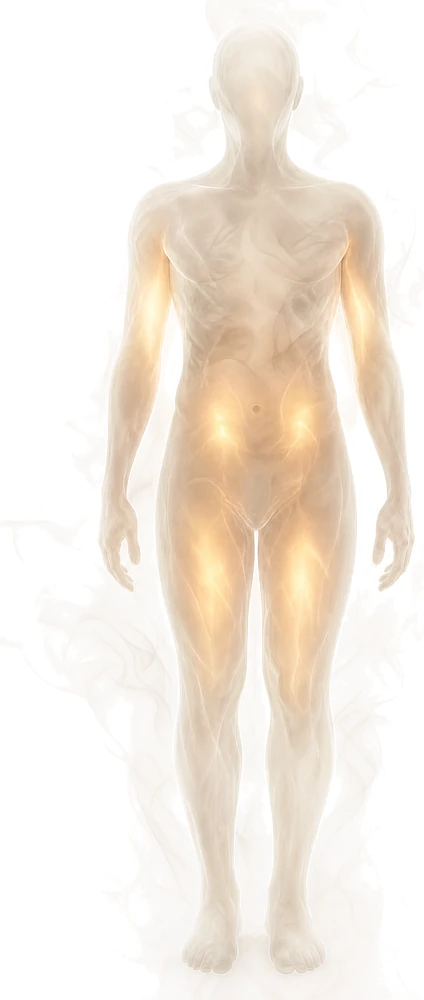
Subcutaneous sites
- AbdomenThe usual first choice. Stay roughly two finger-widths clear of the navel.
- Front or outer thighEasy to reach and easy to see what you are doing.
- Back of the upper armThe fleshy part at the back. Awkward to self-inject.
Here is the part worth knowing, because it saves a lot of awkwardness: you do not have to inject near the injury.
The animal studies behind BPC-157's healing reputation, including the transected Achilles tendon, knee ligament and quadriceps work, dosed it into the abdomen or simply gave it in drinking water, and it worked from there. Nothing published shows that injecting close to an injury outperforms injecting anywhere else.
So if you have been contorting yourself to get a needle into a shoulder or the side of a knee because a forum told you site-specific dosing matters, you can stop. Use the ordinary sites, rotate between them, and get on with your day. Rotating is also better for your skin than repeatedly injecting one patch.
Timelines, week by week
Tendon and soft tissue do not turn around in days, and the most common way people waste a cycle is quitting before it could have done anything.
One thing makes all of this far more useful: write down where you actually are on day one. Which movements hurt, how much, how far you can push. Injuries also improve with time and rest, and without a written starting point it is genuinely hard to tell at week eight what changed and why.
How long to stay on, and why people break
Six to eight weeks on, then three to four weeks off, is the pattern almost everyone runs. The reasoning given is usually about avoiding diminishing returns from continuous signalling, and it is convention rather than something derived from a trial of these compounds.
There is a more practical argument for the break, though: it is the only way you find out where you actually are. If you never stop, you cannot tell the difference between a problem that has resolved and a problem that is being held quiet. Coming off for a month and seeing whether the ache returns is genuinely informative.
For a defined injury, many people simply run one cycle and stop, because the compound was aimed at a specific thing rather than being something to stay on. That is its own kind of answer. There is a fuller treatment of on and off periods across categories in the peptide cycling guide.
What about oral BPC-157?
You will see capsules sold, and this is the one place in the peptide world where an oral version has a real argument behind it. BPC-157 is unusual in that it comes from a protein found in gastric juice, so the case made is that it is more stable in the gut than a typical peptide.
The practical position: if your target is the gut lining itself, oral has a coherent rationale. If your target is a tendon in your shoulder, the injectable route is the one the connective tissue research used, and it is what the protocol above assumes. We went through the trade-off in oral versus injectable BPC-157.
Stacking it with other things
The most common additions are the growth hormone secretagogues, on the theory that the overnight GH pulse supports repair generally. That is a different mechanism from either compound here and a different set of trade-offs; the stacks comparison lays them out side by side.
The advice worth taking is duller than the question deserves: get one thing working and understood before adding a third and fourth. Every compound you add makes the result harder to attribute and the side effects harder to trace.
The mistakes that cost people a cycle
Side effects and who should check first
Commonly reported effects are mild and local: irritation, redness or a small lump at the injection site, and sometimes nausea, headache or tiredness early on. A site that gets worse over a day rather than better, with spreading redness, warmth, swelling or fever, points to infection rather than irritation and is a reason to speak to a doctor.
Both are research compounds rather than approved medicines, and there is no long-term human safety data on either. Because the mechanisms involved include promoting new blood vessel growth, anyone with a cancer history should be having this conversation with an oncologist rather than with a web page. Both are prohibited in competitive sport under WADA.
What it costs
Research vials of each typically run from the high teens to the forties of dollars, and pre-mixed Wolverine vials sell in a similar range. On the protocol above, the daily BPC-157 is what drives your monthly cost; TB-500 at once or twice a week stretches a vial a long way. Add roughly $20 to $30 up front for bacteriostatic water, insulin syringes and a sharps container, most of which will last you several cycles.
Whatever you buy, ask for a certificate of analysis whose batch number matches your vial, HPLC purity at 98% or better, and endotoxin testing. The beginners guide covers how to read those and what the warning signs are.
Both components, with the route that applies to each.
Where to get it
BPC-157
The one people take for injuries that will not heal
Save 10% at checkout with code tcwisiiu
People who have run it
A doctor who ran the pairing on himself and reported back on what happened.
And for the compounds individually, a sports medicine physician going through the research on each one.
Why it is called the Wolverine stack
The name is traceable, which is unusual. In May 2016 Ben Greenfield published a guide to BPC-157 with a headline about healing the body like Wolverine. Readers in his own comment thread started pairing it with TB-500 and swapping doses. In October 2021 Jay Campbell wrote it up as the Wolverine Healing Stack, crediting Greenfield, and by 2023 it was on Reddit and in clinic marketing.
So the protocol at the top of this page is a community consensus that has been refined by a lot of people running it, rather than something handed down from a trial. That is worth knowing when you see two vendors quoting slightly different numbers: neither is more official than the other.
Going deeper
For the structured version, what is in the vial, the exact ratio, the studies behind each component and the conditions people use it for, see the Wolverine stack reference page. Other pairings are compared side by side across all stacks, and the healing peptides ranked covers what else is in this category.
Frequently asked questions
What is the Wolverine Stack?
BPC-157 and TB-500 taken together, usually after an injury that is not settling. It is named after the comic character who heals quickly. The two are paired because they act on different parts of the repair process: broadly, one on the signalling that starts repair and the other on the cell movement and remodelling that carries it through.
What is the standard Wolverine Stack protocol?
BPC-157 at 250 to 500 mcg daily throughout, and TB-500 at 2 to 2.5 mg twice weekly for the first four weeks, then once weekly. A cycle usually runs six to eight weeks followed by a break of a few weeks. These figures are the community consensus repeated across vendors and clinics rather than numbers from a human dose-finding trial.
Do I need to inject BPC-157 near the injury?
No. The animal studies behind BPC-157's reputation, including the transected Achilles tendon and knee ligament work, dosed it into the abdomen or gave it in drinking water and it still worked. Nothing published shows injecting near an injury outperforms injecting elsewhere, so ordinary subcutaneous sites and normal rotation are fine.
Can I mix BPC-157 and TB-500 in the same syringe?
Use two syringes. Keeping them separate means that if you get a reaction or an unexpected effect you can tell which compound caused it, and it lets you adjust or stop one without touching the other. It costs one extra needle.
How many units do I draw?
It depends entirely on how much water you added. A 5mg vial reconstituted with 2mL gives 2,500 mcg per mL, so 250 mcg is 10 units on a standard insulin syringe. The same 10 units from a vial mixed with 1mL would be 500 mcg. Work it out once with a calculator and write the numbers on the vial.
How long before I notice anything?
Most reported change lands between weeks two and eight, with long-standing problems at the slower end. Soft tissue is slow, and week one is usually quiet. Because injuries also improve with rest and time, writing down where you started makes it far easier to judge what actually changed.
This article is for informational and educational purposes only. It is not medical advice and does not diagnose, treat, cure, or prevent any disease. Consult a qualified healthcare professional before starting any peptide protocol. Individual results vary. Some outbound links are affiliate links, at no extra cost to you.