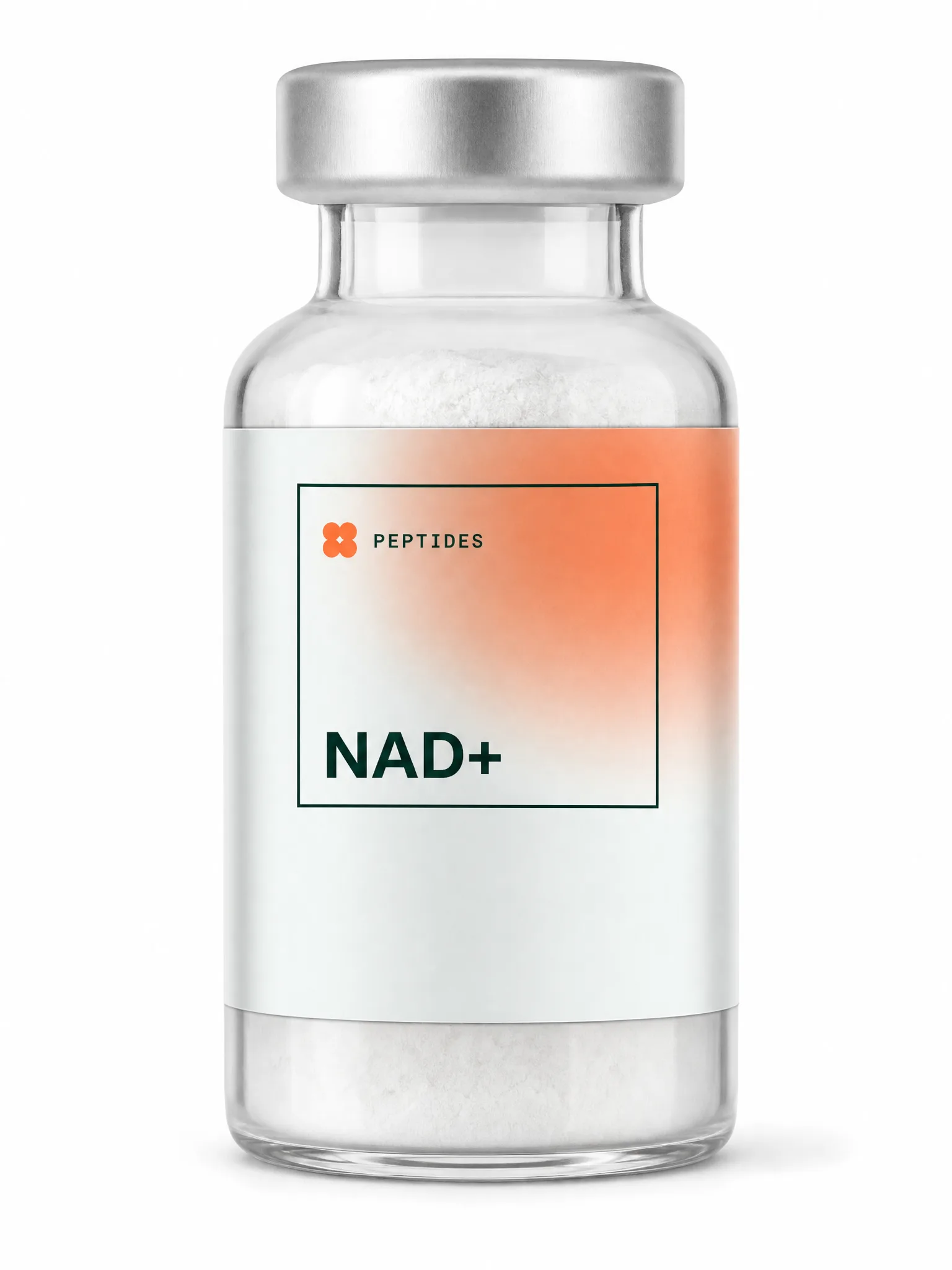
NAD+
Nicotinamide Adenine Dinucleotide
Also called nicotinamide adenine dinucleotide, NAD, NMN, nicotinamide mononucleotide, NR, nicotinamide riboside
The coenzyme that powers cellular energy and repair
NAD+ is a molecule every cell uses to turn food into energy, and levels fall with age. It is sold as an IV drip, an injection, and as oral precursors called NMN and NR. Almost all the human trial evidence is for the oral precursors, not for the drips and injections that clinics actually sell.
A molecule every cell spends constantly to turn food into energy, and that your DNA repair enzymes spend too. Levels fall with age, which is the whole reason anyone sells it. The catch is delivery: NAD+ itself does not cross into cells easily, so almost every trial tested smaller building blocks you swallow (NMN and NR) rather than the drip clinics sell.
- Route
- Subcutaneous / IV
- Typical dose
- Research-dependent
- Availability
- Research-only
Human trials published, with more underway
2,609 papers · 64 clinical trials
What people use NAD+ for
Reported uses, roughly in order of how often they are the reason someone goes looking. Whether it works for any of them is a separate question, answered under each one.
- Energy and fatigue
- The most common reason people try it, and the one with the least trial evidence behind it.
- Metabolic health
- The best single human result: improved muscle insulin sensitivity in prediabetic women.
- Ageing and cell health
- The whole rationale, since NAD+ falls with age and is required by repair enzymes.
- Cognition
- Tested in older adults with mild cognitive impairment, which is a real trial rather than a marketing claim.
Mechanism of Action
How NAD+ works
Nearly every reaction that turns food into usable energy inside your cells passes electrons around, and NAD+ is what carries them. It is less a nutrient than a currency: cells spend it constantly, all day, to keep the lights on.
Two other jobs draw on the same pot. The repair enzymes that fix damaged DNA spend NAD+ to work. So do the sirtuins, a family of enzymes tied to how cells handle stress and ageing. When NAD+ runs low, those jobs compete with basic energy production for what is left.
Levels fall as you get older. That single fact is the entire reason this category exists.
Why nobody sells you NAD+ itself, mostly
Here is the practical problem. NAD+ is a large, electrically charged molecule, and cells do not simply let it walk in. So the research went after its raw materials instead: NMN and NR, smaller molecules your body assembles into NAD+ once they are inside.
That is why nearly every trial you will find tested an oral capsule rather than the drip sold in clinics. It is the same reason: getting the finished molecule into a cell is the hard part, and swallowing a precursor sidesteps it.
What has actually been shown
The strongest result, published in Science, is narrow and worth reading precisely. Oral NMN improved how well muscle responded to insulin in prediabetic women. It did not change their weight, blood pressure or liver fat.
That is a specific finding, not a general rejuvenation, and the gap between the two is where most of the marketing lives.
NAD+ dosage calculator
Enter what is in your vial, how much water you added, and the dose you are using. It works out where to pull the plunger to.
How much is in the vial?
Printed on the label, in milligrams
How much water did you add?
Bacteriostatic water, in millilitres
What dose are you taking?
The dose you already intend to use
Which syringe?
Barrel size, printed on the wrapper
Draw to
10 units
on a 0.5 mL insulin syringe (0.1 mL)
- Strength once mixed
- 5 mg/mL
- Doses in the vial
- 20
10 mg in 2 mL makes 5 mg/mL. A 500 mcg dose is 0.1 mL of that, which is 10 units.
This is arithmetic, not advice. It converts a dose you already have into a mark on a syringe. It does not tell you what dose to take, and NAD+ is not prescribed by us. Dosing belongs with a qualified clinician.
NAD+ side effects: what people reported
NAD+ has one very distinctive side effect and it surprises people: pushed in too fast, it makes you feel genuinely awful for a few minutes. Chest tightness, cramping, a wave of nausea. It is not dangerous and it stops the moment the drip is slowed.
What most people notice
- Chest tightness or pressure during a fast infusion
- Stomach cramping and nausea while it runs
- Flushing and feeling hot
- Headache
- A wired feeling afterwards, which is why people avoid it late in the day
Worth keeping an eye on
- The unpleasant part is a speed problem. Ask for it slower rather than deciding you cannot tolerate it
- Injection-site reactions with the subcutaneous form, which is gentler but slower to act
- Infusions take hours, which is the practical cost people underestimate
Dose matters. This is about speed rather than dose. The same amount given slowly is uneventful.
Source: Clinic infusion practice and widely reported experience. This is a summary of published findings, not a complete safety profile and not medical advice. NAD+ should only be considered with a qualified clinician who knows your history.
Your Genetics & NAD+
The genes involved in how NAD+ works
NAD+ works through the receptors these genes build, and the genes vary from person to person. Researchers have linked some of that variation to differences in how people respond. A DNA report tells you which versions you carry.
NAMPT is the rate-limiting enzyme that recycles NAD+. Variants that lower NAMPT activity mean a less efficient salvage pathway — these individuals may start from lower NAD+ and respond differently to supplementation.
SIRT1 variants influence how effectively the sirtuin enzymes convert restored NAD+ into downstream longevity and metabolic benefits.
FOXO3 · ••
FOXO3 is one of the most replicated human longevity genes and acts downstream of sirtuin signaling. Favorable variants may amplify the benefit of restored NAD+.
SOD2 · ••
The Ala16Val variant sets how efficiently mitochondrial superoxide is cleared. It shapes the oxidative environment in which NAD+-driven energy metabolism operates.
The dots after each gene are where your own result goes. Your report fills them in with the two letters you carry at that position.
Which variants do you carry?
Upload your DNA data, or get tested through our partner, to find out.
Commonly combined with
What NAD+ is most often paired with, and why:
MOTS-c
Mitochondrial StackEmerging EvidenceMitochondrial Open Reading Frame of the 12S rRNA Type-c
A peptide written not in your own genome but in the tiny separate one your mitochondria carry, a leftover from when they were free-living bacteria. It behaves like an exercise signal: it switches on the same fuel-burning pathway a hard workout does. Levels fall with age, which is why it turns up in longevity conversations, and essentially all of the good data is in mice.
3
Gene variants
25+
Studies
Epithalon
Longevity StackEmerging EvidenceEpitalon (Ala-Glu-Asp-Gly)
A synthetic tetrapeptide based on the natural pineal gland peptide epithalamin. Epithalon activates telomerase, the enzyme that maintains telomere length, potentially slowing cellular aging. Discovered by Professor Vladimir Khavinson, it remains one of the most studied anti-aging peptides in gerontology.
3
Gene variants
20+
Studies
Sourcing & access
Where to buy NAD+
NAD+ is available through licensed telehealth and retail providers. We rank them by price, reviews and a credibility score — so you can find the cheapest source that's actually legitimate.
- Buy only from licensed providers that publish recent third-party purity tests (COAs).
- Compare the total cost — consultation, the compound, and shipping — not just the sticker price.
- Confirm the provider ships to your country and requires a genuine medical intake.
A research vial is also sold at Swiss Chems, without a prescription or a prescriber.
Before you buy: see whether your DNA actually responds to NAD+, and at what dose. Analyze my DNA — $99 →
Educational information only, not medical advice. Some outbound links are affiliate links (disclosed, at no extra cost to you). Most peptides are not FDA-approved — consult a qualified professional and check your local laws before purchasing.
Worth knowing before you consider NAD+
Interactions and situations where there is a specific reason to be careful. Where the honest answer is that nobody has studied something, it says so and says what that leaves open.
- The drip is not what was studied
- The trials below used oral NMN or NR. IV NAD+ has far thinner human evidence, and the infusions are widely reported to cause chest tightness, flushing and nausea if run quickly, which is why clinics drip them slowly over hours.
- Raising NAD+ is not the same as getting younger
- Trials reliably show blood NAD+ rising. Whether that produces the energy, ageing and cognitive benefits people buy it for is a separate question, and it is the question most of these studies were too short or too small to answer.
- Sold as a supplement, so quality varies
- NMN and NR are sold as supplements rather than medicines in most places, which means no one is required to verify that the bottle contains what the label says.
The evidence behind NAD+
Read the route before the results. Nearly every randomised trial here gave an oral precursor, NMN or NR, which the body converts to NAD+. What clinics sell is usually an IV drip or an injection, and that is not what was tested. The distinction matters because NAD+ is a large, charged molecule that does not simply cross into cells intact, which is why the research went after precursors in the first place. Treating the oral trial results as evidence for a drip is the single most common mistake made about this compound.
The literature, counted
Counted in PubMed on 3 August 2026 for nicotinamide riboside OR nicotinamide mononucleotide OR NAD+ precursor. Every figure links to the search that produced it, so you can re-run it. “Tagged human” is not the same as a human trial: that tag also covers work on human cells and reviews discussing people, which is why the trial count is given separately.
Studied in people
3 of 3The only kind that directly answers whether it works in humans.Science · 2021
HumanNicotinamide mononucleotide increases muscle insulin sensitivity in prediabetic women
Yoshino M, Yoshino J, Kayser BD, et al.
The strongest human result in this area, and published in Science. Oral NMN improved muscle insulin sensitivity in prediabetic women. Note what it did not show: no change in body weight, blood pressure, liver fat or most other measures, so it is a specific finding rather than a general rejuvenation.
Nicotinamide mononucleotide increases muscle insulin sensitivity in prediabetic women — source for NAD+ (opens in a new tab)Randomised controlled trial
Read the paperGeroScience · 2023
HumanThe efficacy and safety of β-nicotinamide mononucleotide (NMN) supplementation in healthy middle-aged adults: a randomized, multicenter, double-blind, placebo-controlled, parallel-group, dose-dependent clinical trial
Yi L, Maier AB, Tao R, et al.
A multicentre dose-response trial in healthy middle-aged adults, which is closer to who actually buys this than a patient population would be. It tested several oral doses against placebo for both effect and safety.
The efficacy and safety of β-nicotinamide mononucleotide (NMN) supplementation in healthy middle-aged adults: a randomized, multicenter, double-blind, placebo-controlled, parallel-group, dose-dependent clinical trial — source for NAD+ (opens in a new tab)Randomised controlled trial
Read the paperGeroScience · 2024
HumanA randomized placebo-controlled trial of nicotinamide riboside in older adults with mild cognitive impairment
Orr ME, Kotkowski E, Ramirez P, et al.
Tests the cognitive claim properly, in older adults who already have mild cognitive impairment, using oral nicotinamide riboside against placebo.
A randomized placebo-controlled trial of nicotinamide riboside in older adults with mild cognitive impairment — source for NAD+ (opens in a new tab)Randomised controlled trial
Read the paper
Every source behind this page74 more
- NAD(+) Intermediates: The Biology and Therapeutic Potential of NMN and NRYoshino J, Baur JA, Imai SI · Cell Metabolism · 2018Review
- Regulation of and challenges in targeting NAD(+) metabolismCovarrubias AJ, Perrone R, Grozio A, Verdin E · Nature Reviews Molecular Cell Biology · 2024Review
- Dietary Supplementation With NAD+-Boosting Compounds in Humans: Current Knowledge and Future DirectionsFreeberg KA, Udoh CE, Craighead DH, et al. · Journals of Gerontology: Series A · 2023Review
- Nicotinamide riboside and nicotinamide mononucleotide facilitate NAD(+) synthesis via enterohepatic circulationYang Y, Zhang N, Zhang G, et al. · Science Advances · 2025Animal
Everything we cite for NAD+, including animal work and early research. Each link goes to the source itself, so you can judge it rather than take our word for it.
Last updated · literature counts verified against PubMed on
Frequently Asked Questions
Why do NAD+ levels matter for aging?
NAD+ is the fuel for both mitochondrial energy production and the sirtuin and PARP enzymes that repair cells and DNA. Levels decline substantially with age, which is thought to contribute to falling energy and slower repair. Restoring NAD+ aims to give those systems their substrate back.
Why does NAD+ response vary between people?
Most NAD+ is recycled through the salvage pathway, gated by the enzyme NAMPT. People with less efficient NAMPT genetics recycle NAD+ more slowly and may start lower, while sirtuin and longevity-gene variants determine how much benefit restored NAD+ produces downstream.
Does genetics affect NAD+ response?
Yes. NAMPT sets salvage-pathway efficiency, SIRT1 determines how well NAD+ is translated into repair activity, FOXO3 shapes the longevity response, and SOD2 sets the oxidative background. A genetic peptide report profiles these for you.
Learn more about NAD+
Your next move
Two ways forward with NAD+.
Not sure it's for you?
How does NAD+ relate to your genes?
Your report scores NAD+ against your receptor, pharmacogene and pathway variants and shows the genetic markers relevant to it, with commonly cited dosing information to review with a clinician.
Analyze my DNA — $99Already decided?
Get NAD+ from a vetted provider.
We rank licensed telehealth providers by price, safety and reviews — no brand pays for placement. Find the cheapest one that's actually legit.
Compare providers →