

GHK-Cu works by carrying a single copper atom into skin, and copper is the atom that lysyl oxidase, the enzyme that welds collagen and elastin fibres to each other, cannot do its job without [[1]][[2]]. That mechanism is real, and it is much smaller than the claims on the bottle. The widely quoted figure that GHK-Cu modulates 4,048 human genes comes from a database query over cultured cancer cell lines, published by two authors listed at a company that sells copper peptide products [[6]][[12]]. The binding energy quoted for SIRT1, a gene whose protein is tied to cell repair, is a docking score: software estimating how well two shapes fit, generated inside a mouse study of chemically induced gut inflammation [[7]]. The one independent randomised trial on facial skin tested GHK-Cu after carbon dioxide laser resurfacing and found no difference between groups on any objective measure, because every patient improved and the copper peptide did not add to it [[8]].
The most-quoted fact about GHK-Cu is that it modulates 4,048 human genes, a figure usually relayed as about a third of the genome. The experiment people think they are citing counted 127, in lung tissue from smokers with chronic obstructive pulmonary disease 5. That gap is most of what this page is about, because what survives it is one sentence of chemistry: GHK-Cu carries a copper atom, and copper is the atom that lysyl oxidase, the enzyme that welds collagen and elastin fibres to each other, cannot do its job without 12. Every claim bigger than that sentence was measured somewhere other than human skin. If peptides in general are new to you, our peptides for beginners primer is the place to start.
What GHK-Cu does when it reaches living skin
GHK-Cu is a piece of collagen. It is three amino acids, glycine, histidine and lysine, taken from the middle of the collagen molecule your skin is built from and bound to one copper ion. Three amino acids makes it a tripeptide. Intact collagen releases nothing. Broken collagen releases that fragment, which is why the compound turns up in tissue at the moment tissue has been damaged.
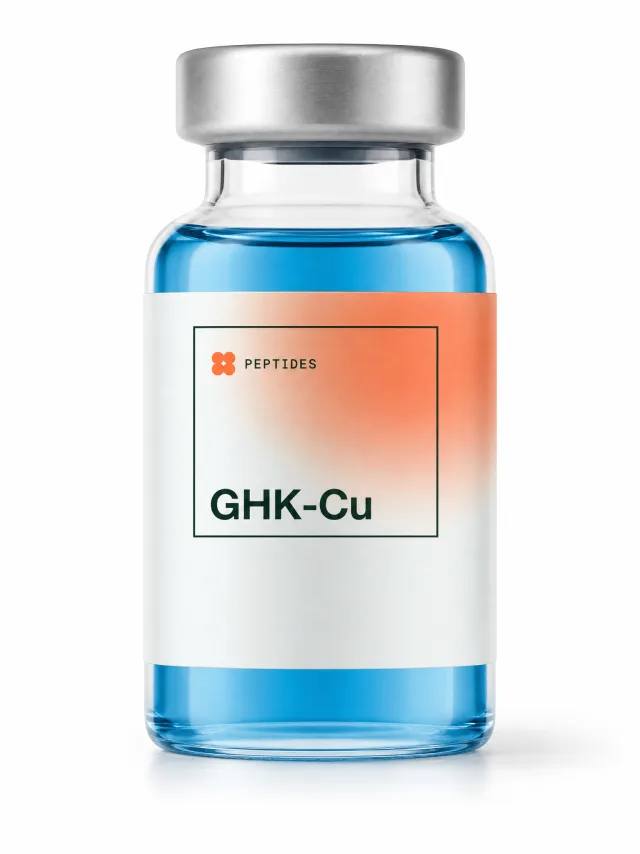
The grip on the copper is specific, and it was worked out in 1982. At the pH of living tissue, the peptide and the copper form a one-to-one pair held through two or three nitrogen atoms, one of them inside the ring at the centre of the histidine 1. The stacked, oxygen-bridged arrangement that shows up when the compound is crystallised does not exist in solution, so the form that matters in tissue is the simple pair. That grip is also why a correctly mixed vial is blue: the colour is copper, held rather than loose.
The grip matters, because loose copper drives the reactions that damage the tissue you are trying to repair, so the body moves copper around bound to carriers.
How the copper reaches the enzyme that needs it
Does a cream get the complex into skin? Yes, and the amount has been measured, in donated human skin in a laboratory rather than on a living person, under conditions far kinder than a pea of serum at bedtime. Applied as the copper tripeptide itself, glycyl-L-histidyl-L-lysine cuprate diacetate, at 0.68 percent copper in water under continuous supply, 136.2 plus or minus 17.5 micrograms of copper crossed each square centimetre over 48 hours, and another 82 plus or minus 8.1 micrograms stayed behind in the tissue as a reservoir 3. What the instrument measured was elemental copper rather than the intact complex, so the experiment establishes that copper crosses and that a meaningful share of it parks in the skin instead of washing straight back out. It does not establish that the pair arrives intact.
At 403 daltons the complex is small enough to cross, so size is not the limit. The limit is solubility. GHK dissolves readily in water and barely partitions into fat, which is what the outer layer of skin is made of, so the vehicle around the peptide decides more than the percentage printed on the label 4.
Where each famous GHK-Cu number was measured
Three numbers do most of the selling for copper peptide, and a fourth gets quoted as background. None of the four was measured in human skin.
| The claim as it is usually printed | What the study did | In what tissue | What the number really is |
|---|---|---|---|
| GHK-Cu modulates 4,048 human genes, about a third of the genome | Two authors applied a cutoff of their own choosing, 50 percent change, to public Connectivity Map expression profiles and counted the genes that cleared it 126 | Cultured cancer cell lines. No skin anywhere in it | A count from a database query, by two authors listed at a company selling GHK-Cu products. The third is 31.2 percent of the roughly 12,984 probes on the array, not of the genome; against the roughly 20,000 protein-coding genes a person has, 4,048 is nearer a fifth |
| GHK-Cu binds SIRT1 at minus 8.75 kcal per mole | A network database screen nominated SIRT1 as one of five hub targets from 17 overlapping compound and disease targets, then docking software scored how well the two shapes fit 7 | Mice with chemically induced colitis, plus cultured cells. Not people | A software score for shape fit, the best of 50 generated poses. No binding assay was run |
| GHK-Cu reduced wrinkle volume by 55.8 percent | Reported as the gap against a control serum rather than as the change measured on anyone's face | Human facial skin, in a small study using a nano-carrier formulation that has not been independently replicated | A relative difference between two products. Our comparison with retinol and vitamin C traces it to its source |
| Blood GHK-Cu falls about 60 percent between age 20 and 60 | Traced back through the 2018 review to an unpublished 1973 doctoral thesis by one of that review's authors 6 | Human blood, reportedly | A number with no published measurement behind it. Give it no weight |
Campbell and colleagues then used the Connectivity Map to ask what would flip that 127-gene signature. GHK came back as a candidate. They tested it in cultured human lung fibroblasts and got a concrete mechanistic result 5: GHK reproduced the gene expression pattern driven by TGF-beta, a growth signal that tells repair cells to build matrix, organised the internal scaffolding of the cells, raised a surface protein those cells use to grip matrix, and restored the ability of fibroblasts taken from damaged lungs to contract and remodel collagen. That is a cell-culture result and it reads as one. Nobody counted 4,048 genes and nobody looked at skin.
The 4,048 figure comes from a different kind of document. Reviews by Loren Pickart and Anna Margolina, both listed at R&D Skin Biology in Bellevue, Washington, a company that sells GHK-Cu products, queried the Connectivity Map for expression profiles built from cultured cancer cell lines, applied a 50 percent cutoff they chose, and counted what cleared it. The raw count, at least 4,000 human genes up- or downregulated, appears in their 2015 review 12. The 2018 review states the same finding as a percentage, 31.2 percent, and it is the document nearly every downstream citation on the internet traces back to 6. Two things go missing in transmission. The denominator is the roughly 12,984 probes the Connectivity Map array carries, not the human genome, so against the protein-coding genes a person actually has, 4,048 is closer to a fifth than a third. And the 2018 paper carries an explicit declaration of no conflict of interest despite both authors being listed at a company selling the compound. A count from a database query over cancer cells generates hypotheses; it does not measure what a serum does to skin.
The SIRT1 claim has the same shape. SIRT1 is a gene whose protein strips chemical tags off other proteins and has been linked to cell repair and ageing. The quoted figure, GHK-Cu binding it at minus 8.75 kcal per mole, comes from a 2025 study of chemically induced colitis in mice 7. SIRT1 arrived there as one of five hub targets from a network database screen of 17 overlapping compound and disease targets, and the binding energy is an AutoDock score, the best of 50 generated poses, which is software estimating how well two shapes fit.
molecular docking analysis was conducted to investigate whether GHK-Cu directly interacts with SIRT1Mao S, Huang J, Li J and colleagues, Frontiers in Pharmacology 2025, describing their own method
The authors report that SIRT1 protein levels rose after treatment, which is a genuine observation, and their own conclusion is hedged: their simulated results indicated that GHK-Cu can bind SIRT1. No binding assay was run to test it. What downstream copy drops is the hedge. Simulated becomes demonstrated, and a docking score becomes a measurement.
The 55.8 percent wrinkle figure that sells copper peptide comes from a single small study of a nano-carrier formulation, run over eight weeks, that has never been independently replicated. It gets quoted as though it settles the comparison against retinol, which has eight pooled randomised trials behind it.
What the human record on GHK-Cu contains
Two randomised trials have tested GHK-Cu on facial skin, and the independent one was negative on every objective measure. Thirteen patients completed it after carbon dioxide laser resurfacing of the skin around the mouth, so this was skin that had just been wounded rather than intact skin. Computer image analysis and blinded evaluators, meaning assessors who did not know which treatment each patient had received, found no difference between the copper peptide and the control in redness, wrinkles or overall skin quality at 12 weeks. Everyone improved; the copper peptide did not add to it. The only measure favouring it was the patients' own questionnaire, at P = .04, meaning the people using it rated themselves better by a margin unlikely to be chance, while nothing the evaluators or the imaging software measured had moved 8.
The second facial trial is the source of the 55.8 percent wrinkle volume figure. It is a small, unreplicated study of a nano-carrier formulation that reported its headline as the gap against a control serum rather than as a change from baseline, and our comparison of GHK-Cu with retinol and vitamin C traces it to its source. It belongs in the count. It is not the kind of evidence that settles anything.
The strongest human result for GHK-Cu comes from open wounds rather than from faces. In a multicentre, randomised, evaluator-blinded, placebo-controlled trial of a topical GHK-Cu gel on diabetic neuropathic foot ulcers (open sores on the feet caused by nerve damage from diabetes), median area closure was 98.5 percent against 60.8 percent for the inactive gel, and ulcer infection ran 7 percent against 34 percent. In ulcers larger than 100 square millimetres the medians were 89.2 percent against minus 10.3 percent, and that minus sign is not a typo: the large ulcers on the inactive gel typically grew rather than closed 9. Two conditions travel with those numbers. Every patient was on an aggressive standardised wound care protocol with sharp debridement at study entry and pressure-relieving footwear, so the gel was an addition to good care rather than a substitute for it, and the paper states that treatment must begin immediately after that debridement for the benefit to appear, with the infection figures reported for ulcers treated on that schedule. The product was an investigational gel, not something on sale. No GHK-Cu product is approved to treat a wound of any kind, a cosmetic copper peptide serum is not that gel, and a diabetic foot ulcer needs a clinician.
The wound evidence is not uniformly positive. An 86-patient prospective randomised evaluator-blinded trial on leg ulcers caused by poor vein drainage found a 0.4 percent copper tripeptide cream no better than the inactive cream it was compared against. Silver sulfadiazine, an ordinary antibacterial cream, beat both 10. The same compound on a different wound gave the opposite answer.
So, the verdict a buyer actually needs. For intact facial skin, a topical copper peptide is a plausible mechanism plus one independent randomised trial that found nothing objective: a reasonable thing to spend serum money on if you enjoy the routine and hold your expectations low, and an unreasonable thing to pay a premium for on the strength of the gene numbers, because the gene numbers are not about skin. For open wounds it has the best human evidence of its life, under medical supervision and alongside proper wound care, and almost nobody buys it for that. For injection it has none at all.
| Study | What was applied, and how | Who or what was studied | Result reported |
|---|---|---|---|
| Miller 2006 8 | Topical copper tripeptide complex on facial skin after carbon dioxide laser resurfacing | 13 people completed | No difference between groups in redness, wrinkles or skin quality at 12 weeks; all patients improved; only the self-report questionnaire favoured it (P = .04) |
| Mulder 1994 9 | Topical GHK-Cu gel on open diabetic foot ulcers, against an inactive gel, on top of a standardised wound care protocol | Multicentre, randomised, evaluator-blinded, placebo-controlled | Median closure 98.5 percent against 60.8 percent; infection 7 percent against 34 percent in ulcers treated immediately after debridement |
| Bishop 1992 10 | 0.4 percent copper tripeptide cream on leg ulcers from poor vein drainage, against an inactive cream and against silver sulfadiazine | 86 patients, prospective, evaluator-blinded | Copper tripeptide no better than the inactive cream; silver sulfadiazine beat both |
| Hostynek 2010 3 | Copper tripeptide at 0.68 percent copper in water, on donated human skin in flow-through diffusion cells | Laboratory skin, not a living person | 136.2 micrograms of copper crossed per square centimetre over 48 hours; 82 micrograms stayed in the tissue |
| Campbell 2012 5 | GHK added to cultured human lung fibroblasts, after profiling 64 lung tissue samples for regional emphysema severity | Cell culture and tissue from smokers with COPD, not a treatment trial | Restored collagen contraction and remodelling in fibroblasts taken from damaged lungs |
| Mao 2025 7 | GHK-Cu in mice with chemically induced colitis, plus docking software | Mice and cultured cells, not people | SIRT1 protein expression rose; the binding energy is a software score, not an assay |
A 2026 systematic review searched PubMed, Embase and Cochrane CENTRAL from inception through March 2026 and found 20 eligible studies of GHK-Cu as a standalone aesthetic treatment: 18 preclinical and 2 randomised controlled trials 11. Those two are the pair described above, which is why this page counts two facial trials rather than one. Its own verdict is that the biological rationale is reasonable while the findings are constrained by methodological variability and a limited number of well-designed clinical trials. Our GHK-Cu monograph counts 152 papers across every use, with the same thin clinical core, and has the full evidence table.
there is a surprising absence of clinical studies using themMortazavi, Mohammadi Vadoud and Moghimi, BioImpacts 2025, on GHK-Cu and Pal-GHK in anti-wrinkle products. The review declares no conflict of interest.
That review is not a hostile witness. The same abstract concludes that GHK-Cu and Pal-GHK are effective and relatively skin permeable, and that on the strength of cellular studies GHK can be considered an anti-wrinkle ingredient 4. What it declines to claim is clinical proof, and it names the vehicle rather than the biology as the practical problem: GHK dissolves readily in water, barely partitions into fat, and is unstable, so it needs a vehicle built for it. That is worth remembering when a serum lists copper peptide near the bottom of the ingredients and says nothing about how it is carried or stabilised, and it is why storage advice for copper peptide products tends to be specific: cool, dark, sealed, and used inside the window the maker states.
Rubbed on versus injected
Every human study of GHK-Cu on skin used a topical preparation. No published human trial has injected GHK-Cu by any protocol, which matters because injectable vials are the format most buyers are sold 11.
The two routes, and what the human record holds on each
The reported harms are mundane and worth stating plainly, because pages that sell this compound tend to skip them. On skin, copper peptides can irritate, and copper is a known contact allergen, so sensitisation is possible with repeated use. For injection there is no trial safety data at all; what gets reported anecdotally is local pain, redness and swelling at the injection site, plus the ordinary risks of any injection performed outside a clinic. None of it has been characterised systematically, which is itself the point.
The cosmetic side has one interaction worth planning around. Ascorbic acid, the active form of topical vitamin C, reduces copper and can pull the complex apart, which is ordinary chemistry rather than speculation. Formulators and dermatology sources generally separate the two, applying them at different times of day rather than layering them in a single pass.
Anything procedural about vials belongs elsewhere: how to reconstitute peptides and the peptide injection hygiene guide cover handling, and neither is a recommendation to inject this compound. There is no established human dose, concentration or schedule for injected GHK-Cu to reconstitute toward, because none has ever been tested. GHK-Cu is also the anchor of two blends sold ready-mixed, GLOW and KLOW, and no published trial has tested either combination. If the question is how GHK-Cu behaves alongside other compounds, our triple anti-ageing stack write-up and how to build a peptide stack cover the reasoning, and the individual compounds have their own pages: epithalon and SS-31.
Why two people get different results from the same serum
Most of the variation in what people see from a copper peptide serum has nothing to do with their genes. Ranked roughly by how much each one moves the outcome:
- How much of the complex reaches living skin. Penetration was measured under continuous supply on donated skin in a laboratory, and a pea of serum on a dry face at bedtime is a different situation 3.
- The vehicle. The measured penetration used a water-based preparation in continuous contact; a serum that lists copper peptide near the bottom of its ingredients and says nothing about how it is carried is not that 4.
- Concentration and how consistently it went on, since the laboratory measurement ran on 48 hours of uninterrupted contact.
- Duration. The facial trial ran 12 weeks before it measured anything 8.
- What else is on the face. Vitamin C breaks the complex apart, and acids and retinoids stack irritation on top of it.
- What the person is measuring with. A phone camera in changing light is not blinded evaluators plus computer image analysis.
Genetics sits below all of that here, for a plain reason: no trial has ever sorted responders from non-responders by genotype for GHK-Cu. A PubMed search for GHK-Cu with genotype returns no records, and GHK-Cu with polymorphism returns one record, a chemistry paper about the protein fragment that clumps in Alzheimer's disease, which is not a response study. Any page telling you that one variant means you need a 2 percent serum instead of a 1 percent one is describing a bridge someone built, not a measurement anyone made. That is a statement about GHK-Cu specifically, not about DNA data in general: for what a raw 23andMe or AncestryDNA file can and cannot legitimately say about peptides, see our 23andMe peptide guide. And for what a reader can genuinely watch on their own face week by week, our GHK-Cu before and after page covers that question.
Where GHK-Cu stands legally in the US
Route decides the answer. Topical copper tripeptide-1 is a cosmetic ingredient, and US cosmetic ingredients are not pre-approved by the FDA before they go on sale. Injectable GHK-Cu has never been approved for human use. It was placed in Category 2 of the FDA's 503A interim list of bulk ingredients that pharmacies may compound with, meaning mix into a preparation made up for an individual patient, in September 2023. On 22 April 2026 it came off Category 2, and the reason matters: the parties who had nominated it withdrew their nominations, which triggers automatic removal under the interim policy. The FDA did not assess it, and removal is not permission. It is not on Category 1, so compounding from bulk is still not authorised, and the Pharmacy Compounding Advisory Committee review of it is scheduled before 28 February 2027. A committee recommendation would not bind the FDA either. Our guide to peptide legality in the US keeps that account current and sources each step.
Sport is a separate system, and the honest answer there is that there is no clean one. GHK-Cu is not named on the World Anti-Doping Agency's 2026 Prohibited List, under S2, the class covering peptide hormones and growth factors, or under any other class. That is not the same as permitted: an injectable form with no regulatory approval for human use can fall under S0, the class covering non-approved substances. An athlete in tested sport should treat the status as unresolved and check with their anti-doping authority rather than assume either answer.
If the question is which compound to consider for a goal rather than how this one works, start with the skin ageing goal page or the cross-category skin ranking. The soft-tissue and wound comparison covers healing, GHK-Cu benefits goes through the claimed uses one at a time, and the hair loss and anti-ageing goal pages cover the two goals people most often arrive with.
No trial has tested GHK-Cu against anyone's genotype, so nobody can predict your response to it from DNA. Where the evidence does exist, we use it: upload the raw DNA data you already have and get all 39 peptides ranked against a 144-marker panel, reviewed by a person and delivered within 24 hours.
Get your DNA report- The impressive numbers were measured in the wrong room
The 4,048-gene figure is a count from a database query over cultured cancer cell lines, published by two authors listed at a company selling copper peptide, and the SIRT1 binding energy is a docking score generated inside a mouse study of colitis. Neither was measured in skin and neither was measured in a person, so neither answers the question of what a serum does to a face. What survives the traceback is one sentence of chemistry: GHK-Cu carries a copper atom, and copper is the atom the enzyme that welds collagen and elastin fibres together cannot work without. That is a far smaller claim than the bottle makes, and it is the claim with evidence behind it.
Sources12
- Freedman JH, Pickart L, Weinstein B, Mims WB, Peisach J. Structure of the Glycyl-L-histidyl-L-lysine-copper(II) complex in solution. Biochemistry 1982;21(19):4540-4544.
- Vallet SD, Ricard-Blum S. Lysyl oxidases: from enzyme activity to extracellular matrix cross-links. Essays Biochem 2019;63(3):349-364.
- Hostynek JJ, Dreher F, Maibach HI. Human skin retention and penetration of a copper tripeptide in vitro as function of skin layer towards anti-inflammatory therapy. Inflamm Res 2010;59(11):983-988. Applied as glycyl-L-histidyl-L-lysine cuprate diacetate; elemental copper was the species measured.
- Mortazavi SM, Mohammadi Vadoud SA, Moghimi HR. Topically applied GHK as an anti-wrinkle peptide: Advantages, problems and prospective. Bioimpacts 2025;15:30071. Source of the quoted line on the absence of clinical studies, and of the conclusion that GHK-Cu and Pal-GHK are effective and relatively skin permeable; declares no conflict of interest.
- Campbell JD, McDonough JE, Zeskind JE, et al. A gene expression signature of emphysema-related lung destruction and its reversal by the tripeptide GHK. Genome Med 2012;4(8):67. 64 lung tissue samples from smokers with COPD; 127 genes; GHK tested in cultured human lung fibroblasts.
- Pickart L, Margolina A. Regenerative and Protective Actions of the GHK-Cu Peptide in the Light of the New Gene Data. Int J Mol Sci 2018;19(7):1987. States the 31.2 percent figure and the age-related blood decline figure. Both authors are listed at R&D Skin Biology, Bellevue WA, a company selling GHK-Cu products, and the paper nonetheless carries an explicit declaration of no conflict of interest.
- Mao S, Huang J, Li J, et al. Exploring the beneficial effects of GHK-Cu on an experimental model of colitis and the underlying mechanisms. Front Pharmacol 2025;16:1551843. Mouse model of chemically induced colitis; source of the SIRT1 AutoDock score of minus 8.75 kcal per mole, best of 50 generated poses.
- Miller TR, Wagner JD, Baack BR, Eisbach KJ. Effects of topical copper tripeptide complex on CO2 laser-resurfaced skin. Arch Facial Plast Surg 2006;8(4):252-259. All patients improved in wrinkles and overall skin quality; no differences were found between groups.
- Mulder GD, Patt LM, Sanders L, et al. Enhanced healing of ulcers in patients with diabetes by topical treatment with glycyl-l-histidyl-l-lysine copper. Wound Repair Regen 1994;2(4):259-269. All patients were enrolled in an aggressive standardized wound care protocol including sharp debridement at study entry.
- Bishop JB, Phillips LG, Mustoe TA, et al. A prospective randomized evaluator-blinded trial of two potential wound healing agents for the treatment of venous stasis ulcers. J Vasc Surg 1992;16(2):251-257.
- Mokhtar J, Mohamad B, Haddad J, et al. The Regenerative Potential of GHK-Cu in Aesthetic Medicine. Aesthet Surg J 2026, online ahead of print, sjag169. Systematic review: 20 eligible studies, 18 preclinical, 2 randomised controlled trials.
- Pickart L, Vasquez-Soltero JM, Margolina A. GHK Peptide as a Natural Modulator of Multiple Cellular Pathways in Skin Regeneration. Biomed Res Int 2015;2015:648108. Source of the raw claim that GHK is capable of up- and downregulating at least 4,000 human genes; same R&D Skin Biology affiliation.
This article is for informational and educational purposes only. It is not medical advice and does not diagnose, treat, cure, or prevent any disease. Consult a qualified healthcare professional before starting any peptide protocol. Individual results vary. Some outbound links are affiliate links, at no extra cost to you.
Frequently asked questions
How does GHK-Cu work?
GHK-Cu is a three amino acid fragment of collagen bound to one copper ion, released when collagen breaks. It carries that copper into tissue, where lysyl oxidase and its relatives, the copper enzymes that weld collagen and elastin fibres to each other, cannot catalyse the first cross-link without it. At about 403 daltons the complex is small enough to cross skin, and measurement on donated human skin in a laboratory found copper both crossing and forming a reservoir in the tissue, though what the instrument measured was copper rather than the intact complex. That delivery step is the mechanism with chemistry behind it. The larger claims about gene expression and longevity signalling come from cultured cells, mice and docking software rather than from skin.
Does GHK-Cu really affect 4,000 genes?
Not in any way that was measured on skin, and the usual framing overstates it twice over. The figure comes from reviews by two authors listed at a company selling GHK-Cu products, who applied a cutoff of their own choosing to public Connectivity Map expression profiles built from cultured cancer cell lines and counted what cleared it. The share they report, 31.2 percent, is of the roughly 12,984 probes on that array rather than of the genome, so against the protein-coding genes a person has it is nearer a fifth than a third. The real Connectivity Map experiment on GHK profiled 64 lung tissue samples from smokers with COPD, identified 127 genes tracking regional lung destruction, and tested GHK in cultured lung fibroblasts. That study is worth reading. It says nothing about a third of your genome and nothing about a face.
Is GHK-Cu better than retinol?
Retinol has a far larger randomised human evidence base for cosmetic skin outcomes than GHK-Cu does, and the headline copper peptide numbers used to argue otherwise do not survive being traced to their sources. Our [comparison of GHK-Cu with retinol and vitamin C](/learn/ghk-cu-vs-retinol-vitamin-c) covers that question, including the traceback of the 55.8 percent wrinkle figure and what it measured. This page covers the mechanism rather than the head-to-head.
Can you inject GHK-Cu, and is injecting copper safe?
No published human trial has injected GHK-Cu by any protocol, and injectable GHK-Cu is not approved for human use by any regulator, so no dose, concentration or schedule has ever been established. The specific concern is copper delivery: GHK-Cu is about 15.8 percent copper by weight, as set out in the copper callout above, familiar daily copper limits are written for food where the gut decides how much to absorb, and an injection goes past that checkpoint entirely, with no limit set for copper given that way. Copper overload damages the liver and can destroy red blood cells. Anyone with Wilson's disease, another copper-handling disorder or copper hypersensitivity should avoid copper-carrying compounds, and no safety data exist for pregnancy or breastfeeding. Every human study of GHK-Cu on skin used a topical preparation, and the decision belongs with a clinician rather than a vendor.
This article is for informational and educational purposes only. It is not medical advice and does not diagnose, treat, cure, or prevent any disease. Consult a qualified healthcare professional before starting any peptide protocol. Individual results vary. Some outbound links are affiliate links, at no extra cost to you.