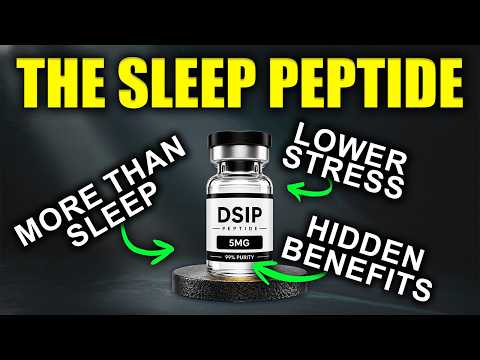
Delta Sleep Inducing Peptide A comprehensive guide by a sleep expert
A physician who calls himself a sleep expert explains delta sleep inducing peptide, cites older sleep studies and forum reports, and argues it is no substitute for fixing root causes.
With Dylan Petkus (MD, MPH, MS)
Key moments
Tap a moment to play the video from there.
- 0:27What DSIP is and its originPetkus lists the questions he will cover, then says the peptide was found in the 1970s during a search for new hormones in preclinical species.
- 5:15Rising and falling signalHe says it is the rhythmic rise and fall of DSIP that promotes sleep, and ties it to slow wave and REM sleep.
- 6:45Stress hormones and relaxationPetkus says DSIP reduces cortisol and the cellular response to stress hormones, which he links to relaxation.
- 7:45Preclinical and human sleep resultsHe cites preclinical figures for slow wave sleep, total sleep time and cortisol, and a human reduction in sleep latency of 22 minutes.
- 10:19Neuroprotection and pain claimsHe says DSIP protected against neurodegeneration in preclinical Alzheimer's and Parkinson's models, not yet shown in humans, and that it has a strong anti-pain response.
- 12:56Older human studies comparedPetkus reviews studies from 1981, 1987 and 1992, noting better sleep efficiency in some and non-significant results in the 1987 study.
- 15:16Forum reports from usersHe describes online reports of deeper sleep, calmer days and vivid dreams, and says about half of users feel nothing.
- 18:08Side effects and unknownsHe names nausea, headaches and sedation, and says interactions and long-term safety have not been established.
- 19:10Forms, doses and cyclingPetkus describes injectable, oral and transdermal forms, a starting dose of 100 to 200 micrograms, and cycling for one or two weeks.
- 20:46Root causes over quick fixesHe argues circadian rhythm and mitochondria are the real issues behind poor sleep, then promotes his master class and strategy call.
What the video says
Dylan Petkus, a physician who describes himself as a sleep expert, walks through delta sleep inducing peptide (DSIP), a compound he says he only learned about about a year before filming. He says it was found in the 1970s, when scientists looking for undiscovered hormones in preclinical species came across a small peptide tied to sleep. He describes it as a signaling molecule that triggers the release of GABA, resists breakdown by enzymes, is stable at room temperature, crosses the blood-brain barrier, and turns up in organs well beyond the brain.
On mechanism, Petkus says the rise and fall of DSIP, rather than a steady level, is the signal that promotes sleep, and he links it to slow wave and REM sleep. He also says it lowers cortisol and the cellular response to stress hormones. He cites preclinical studies reporting a 33 percent increase in slow wave sleep, a 72 percent increase in total sleep time and roughly 30 percent lower cortisol. He adds that neuroprotective effects have been shown only in preclinical Alzheimer's and Parkinson's models, not in humans, and says the peptide has a potent anti-pain response.
For humans, he points to double blind, placebo controlled studies from 1981, 1987 and 1992. He says one found people fell asleep 22 minutes faster on average, and others found better sleep efficiency and less daytime fatigue in people with insomnia, while the 1987 results were not statistically significant. He says recent research is thin and leans on forum posts, which he calls anecdotal: roughly half of users feel nothing, while others report deeper sleep, fewer awakenings, calmer days and vivid dreams. He lists nausea, headaches, sedation and drowsiness as side effects, and says interactions and long-term safety are unknown.
He describes the protocol people discuss: a powder mixed with bacteriostatic water and injected before bed, a starting dose of 100 to 200 micrograms, and some users working up to 400. He stresses he has never used it and advises talking with a health care provider. The last third argues that DSIP is not a silver bullet, that circadian rhythm and mitochondria are the root issues, and promotes his free master class and a paid strategy call.
On each compound
DSIP0:27
Petkus says DSIP is a small peptide found in the 1970s that triggers GABA release, shapes sleep through its rise and fall, and lowers cortisol. He cites older studies and forum reports, says a typical starting dose is 100 to 200 micrograms, and says he has never used it.
See how your DNA reads DSIPWhat this video doesn’t settle
- The human studies are mentioned only by year, with few details on size, design or dosing, and one is described as not statistically significant.
- Much of the benefit described comes from forum posts, which Petkus himself calls anecdotal and which have no control group.
- Claims about neuroprotection, pain relief and stress hormone effects rest on preclinical work, and the video does not show them in humans.
Questions this video answers
What is delta sleep inducing peptide (DSIP)?
Petkus describes it as a small peptide first found in the 1970s while scientists searched for new hormones in preclinical species. He says it acts as a signaling molecule that triggers GABA release, crosses the blood-brain barrier and is found in many organs.
What does the research say about DSIP and insomnia?
Petkus cites double blind, placebo controlled studies from 1981, 1987 and 1992. He says one showed people fell asleep 22 minutes faster on average and others showed better sleep efficiency and less daytime fatigue, while the 1987 results were not statistically significant. He also says recent clinical research is limited.
What side effects of DSIP does Dylan Petkus mention?
He says DSIP can cause nausea, headaches, sedation and drowsiness. He adds that it is not well researched at larger scale, and that interactions with other medications and long-term safety are unknown.
What DSIP dosage does the video describe?
Petkus says people discuss a starting dose of 100 to 200 micrograms, with some working up to 400 micrograms, taken once daily 30 to 60 minutes before bed. He also says smaller daytime doses are used for anxiety, and he tells viewers to talk with a health care provider first.
Does Petkus think DSIP fixes sleep problems long term?
No. He says it is not a silver bullet and that benefits may be temporary. He argues the underlying causes are disrupted circadian rhythm and poor mitochondrial function.
Video by Dylan Petkus, MD, MPH, MS | Not Licensed by Choice on YouTube, embedded as published. The summary is written by PeptidesDNA from the video; every claim in it is the speaker’s. Not affiliated with or endorsed by the creator. Not medical advice.