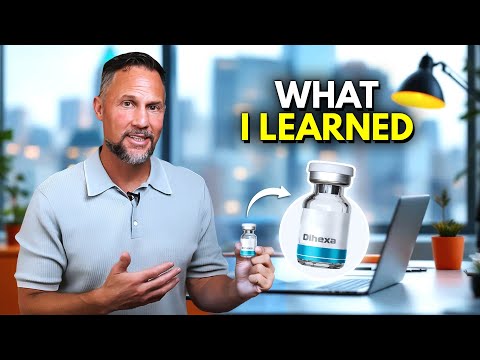
PEP Talk - Episode 103 - Dihexa
A solo episode in which a functional medicine physician explains why he uses dihexa, a brain-focused peptide, and what benefits he attributes to it.
With Dr. Eric Nepute (Physician (functional medicine and functional neurology), as he describes himself)
Key moments
Tap a moment to play the video from there.
- 1:19Peptides as cell signalsNepute gives his background on peptides, saying they are amino acid sequences that signal cells. He argues that weaker cell signaling is part of aging.
- 3:51Introducing dihexaHe presents dihexa as a neuroprotective and neuroregenerative peptide that he says crosses the blood-brain barrier. He mentions injectable, oral and topical forms.
- 4:55Neurodegenerative disease burdenHe cites figures on Alzheimer's cases and costs and argues that lifestyle and neuroprotective compounds deserve attention.
- 9:05How he says dihexa worksHe says he began using it about five years ago for concussion and brain injury patients. He describes it as acting on growth factor receptors and synaptic connectivity.
- 10:34Neuroplasticity and side effectsNepute says dihexa stimulates new synapses and strengthens existing connections. He says it has fewer potential side effects than another peptide and can be used with SSRIs.
- 12:07Inflammation, oxidative stress, blood flowHe says it lowers TNF alpha and interleukin 6, reduces oxidative stress, and promotes blood vessel growth. He mentions migraines and combining it with niacin or NAD.
- 13:31Cognitive and focus benefitsHe lists memory, learning, focus and mental clarity as benefits. He says he sees the most benefit in adults with ADHD and notes it is not approved for any disease.
- 16:15Brain injury, mood, tissue repairHe describes using it with post-concussion patients and says it has antidepressant-type properties without being an antidepressant. He also mentions muscle and tendon healing and pairing it with BPC-157.
- 17:47Vagus nerve and gut axisHe says dihexa improves vagus nerve signaling and cites heart rate variability changes he has seen in patients.
- 19:19Timeline and action stepsHe says nerve tissue heals slowly, often over 12 to 18 months. He closes by urging viewers to research dihexa and visit his website.
What the video says
This is episode 103 of The PepTalk Podcast, part of a series on peptides. Host Dr. Eric Nepute describes himself as a physician of more than 20 years in functional medicine and functional neurology. Before reaching the topic, he gives a short background on peptides, saying they are chains of amino acids that signal cells. He also recommends a DNA wellness kit as a way to personalize lifestyle choices. That promotional material and the closing call to action are the only parts not about dihexa.
Nepute introduces dihexa as a peptide for neuroprotection and neuroregeneration. He says it crosses the blood-brain barrier, works at low doses, and is available by prescription as an injectable, an oral form or a topical. He then spends several minutes on the burden of neurodegenerative disease, citing figures for Alzheimer's cases worldwide and annual costs in the US. He argues that lifestyle changes and neuroprotective compounds are worth considering.
On mechanism, he says he has used dihexa for about five years, mostly with patients who have concussions, traumatic brain injuries and neurodegenerative conditions. He says it binds hepatocyte growth factor receptors and supports synaptic connectivity and neuroplasticity. He also says it lowers inflammatory markers such as TNF alpha and interleukin 6, reduces oxidative stress, and promotes blood vessel growth. He prefers it to another neuro peptide (rendered "tesin" in the captions) because he says it has fewer potential side effects and can be taken alongside SSRI medications.
He lists benefits he attributes to it: memory and learning, focus in adults with ADHD, mood balance, tissue repair, and vagus nerve signaling. He says he has seen heart rate variability improve in patients and calls this clinical experience. He notes that dihexa is not FDA approved for any disease. He says nerve repair can take 12 to 18 months of consistent effort, and he suggests pairing dihexa with niacin, good gut health and lifestyle changes matched to a person's genetics.
On each compound
Dihexa3:51
Nepute calls dihexa one of his favorite peptides and says he has used it for about five years, mainly in concussion and neurodegenerative cases. He describes it as crossing the blood-brain barrier, supporting synaptic connectivity and neuroplasticity, and lowering inflammatory markers. He also says it is not FDA approved for any disease.
See how your DNA reads Dihexa“it's not an FDA approved drug for any disease”
“neurological tissue is the slowest healing tissue in the body”
What this video doesn’t settle
- Nepute does not cite any specific human trial, so the claimed effects on memory, focus and mood rest on his descriptions and clinical impressions.
- He does not give doses, dosing schedules or product sources, so how dihexa is actually used is left unclear.
- His observations of improved heart rate variability and brain scans are anecdotal and come without any control group.
Questions this video answers
What does Dr. Nepute say dihexa does in the brain?
He says dihexa binds hepatocyte growth factor receptors and supports synaptic connectivity and neuroplasticity. He also says it reduces neuroinflammation and oxidative stress and promotes blood flow. These are his descriptions, not findings he cites from specific studies.
Is dihexa FDA approved according to this video?
Nepute states that dihexa is not an FDA approved drug for any disease. He says it was first looked at in Alzheimer's and Parkinson's patients and that its use has since expanded.
Can dihexa be taken with SSRIs, according to Nepute?
He says you can take dihexa while on SSRI medications, unlike another neuro peptide he names (rendered "tesin" in the captions). He advises people on SSRIs to talk to their physician.
How long does Nepute say dihexa takes to work?
He says some people notice changes in about three to four days. He says repairing neurological damage takes a consistent 12 to 18 months.
What forms of dihexa does Nepute mention?
He says it is available by clinic prescription as an injectable, and that oral and topical versions are also on the market. He describes it as used at low doses and does not give specific doses.
Video by The PepTalk Podcast w/ Dr. Eric Nepute on YouTube, embedded as published. The summary is written by PeptidesDNA from the video; every claim in it is the speaker’s. Not affiliated with or endorsed by the creator. Not medical advice.