GHK-Cu
Glycyl-L-Histidyl-L-Lysine Copper Complex
Also called copper peptide, GHK, glycyl-L-histidyl-L-lysine, copper tripeptide-1, GHK Cu
The regeneration peptide
GHK-Cu is a small peptide that carries a copper atom, found naturally in human blood. It is used for skin, wound healing and hair, and it is the main ingredient in the GLOW and KLOW blends. Every human study of it on skin used a cream rather than an injection, which matters because it is mostly sold as an injection.
A naturally occurring copper-binding tripeptide, studied mainly for wound healing and skin. It carries copper into tissue, where copper is the cofactor the enzyme that cross-links collagen cannot work without. Most of the evidence is topical or in rats; the widely quoted gene-expression claims rest on far less than they appear to.
- Route
- Subcutaneous / Topical
- Typical dose
- 1–3 mg/day
- Availability
- Research-only
Studied in people, and well studied in animals
152 papers · 1 clinical trial
What people use GHK-Cu for
Reported uses, roughly in order of how often they are the reason someone goes looking. Whether it works for any of them is a separate question, answered under each one.
- Wound healing
- Its strongest evidence. A randomised trial of a topical gel improved healing of diabetic foot ulcers.
- Skin and collagen
- The reason it sells, though the one well-designed independent facial trial found no objective change.
- Hair
- Widely marketed for this, with far less published behind it than the skin claims.
- Delivering copper
- Copper is required by the enzyme that cross-links collagen and elastin, which is the clearest mechanism here.
Mechanism of Action
How GHK-Cu works
Here is the part most pages skip: GHK-Cu is a piece of collagen. Three amino acids, taken from the middle of the collagen molecule your skin is built out of.
That matters because of when it appears. Intact collagen does not release it. Damaged collagen does. So when skin is cut, burned or worn down, the breakage itself frees this fragment into the wound. It is not a foreign compound that happens to help skin. It is the signal skin already uses to say something broke here.
Why it drags a copper atom around
Your body welds collagen fibres to each other. Loose collagen strands are floppy; welded ones give skin its snap. The tool that does the welding is an enzyme, and that enzyme is useless without copper.
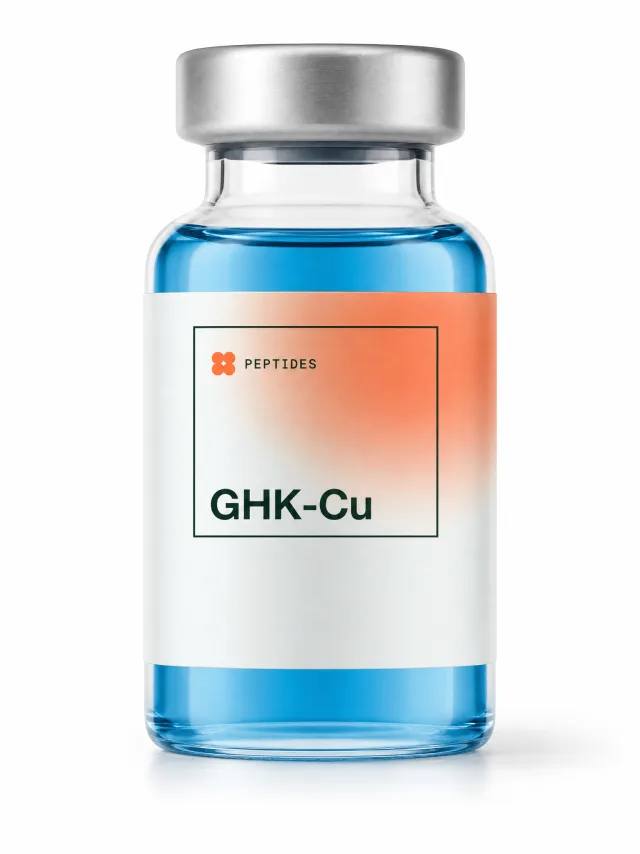
But copper cannot simply float around loose. Free copper is genuinely destructive: it drives the kind of reactions that damage the tissue you are trying to repair. So it travels held. GHK grips a single copper atom, partly with the ring in its middle amino acid, and carries it. That grip is also why a properly mixed vial is blue. The colour is the copper, held.
So the compound is a delivery van. It shows up exactly where collagen has broken, carrying the one ingredient the repair crew cannot work without.
The rat finding worth knowing
In rats it did something more interesting than "more collagen". It raised a protein called decorin and lowered one called biglycan.
Decorin's job is arranging collagen into neat parallel bundles. That arrangement is roughly the difference between a scar and normal skin: a scar is not short of collagen, it is collagen laid down in a mess. So the claim is not that you get more of the stuff, but that you get it stacked properly. The catch is that the researchers injected it straight into the wound.
The claim you should discount
You will read that GHK-Cu "resets 4,000 genes". That number comes from re-analysing a public database rather than running an experiment: three microarray profiles, from prostate and breast cancer cell lines, with a crude cut-off and no statistical test. No skin cells were involved anywhere in it. The authors' own conclusion was that there was not yet enough information to say what any of it does biologically.
It is a real number attached to a very small thing. The copper delivery story is far more modest and far better supported.
GHK-Cu dosage calculator
Opens at 1 mg, from the doses reported for GHK-Cu. Change any box to match your own vial. It works out where to pull the plunger to.
How much is in the vial?
Printed on the label, in milligrams
How much water did you add?
Bacteriostatic water, in millilitres
What dose are you taking?
The dose you already intend to use
Which syringe?
Barrel size, printed on the wrapper
Draw to
20 units
on a 0.5 mL insulin syringe (0.2 mL)
- Strength once mixed
- 5 mg/mL
- Doses in the vial
- 10
10 mg in 2 mL makes 5 mg/mL. A 1 mg dose is 0.2 mL of that, which is 20 units.
Want a rounder number? Adding 1 mL instead would put this dose at exactly 10 units, which is easier to draw accurately.
This is arithmetic, not advice. It converts a dose you already have into a mark on a syringe. It does not tell you what dose to take, and GHK-Cu is not prescribed by us. Dosing belongs with a qualified clinician.
GHK-Cu side effects: what people reported
Depends entirely on how you use it. On skin it is mild and local. Injected, it is a different conversation, and the evidence behind it is topical.
What people report using it on skin
- Redness, stinging or itching where applied, usually settling as skin adjusts
- Dryness or flaking early on
- A faint blue-green tint from the copper, which washes off
Worth keeping an eye on
- The copper uglies: some people report skin looking briefly worse, more textured or slack, in the first weeks. If it keeps getting worse rather than settling, stop
- Irritation stacking up if you layer it with retinoids or acids
- Injection-site reactions and a metallic taste reported by people injecting it
Reasons to check first
- Wilson's disease or any condition affecting how your body handles copper
- Applying into freshly needled skin is a sterility question, not a skincare one
Source: Cosmetic trial data plus widely reported use. This is a summary of published findings, not a complete safety profile and not medical advice. GHK-Cu should only be considered with a qualified clinician who knows your history.
Your Genetics & GHK-Cu
The genes involved in how GHK-Cu works
GHK-Cu works through the receptors these genes build, and the genes vary from person to person. Researchers have linked some of that variation to differences in how people respond. A DNA report tells you which versions you carry.
SOD2 · ••
The Ala16Val polymorphism reduces mitochondrial SOD2 efficiency by up to 40%. GHK-Cu upregulates SOD expression, potentially compensating for this genetic deficit in oxidative stress management.
COL1A1 · ••
The Sp1 binding site variant affects baseline collagen I production. Carriers with reduced collagen density may see more pronounced benefits from GHK-Cu's fibroblast-stimulating effects.
TGFB1 · ••
Affects TGF-beta1 expression levels, which regulate wound healing, fibrosis, and extracellular matrix remodeling. GHK-Cu modulates TGF-beta pathways — variant carriers may have altered healing response curves.
SIRT1 variants affect NAD+-dependent deacetylase activity linked to DNA repair and cellular stress resistance. GHK-Cu's gene expression reprogramming intersects with sirtuin-mediated longevity pathways.
The dots after each gene are where your own result goes. Your report fills them in with the two letters you carry at that position.
Which variants do you carry?
Upload your DNA data, or get tested through our partner, to find out.
Commonly combined with
What GHK-Cu is most often paired with, and why:
BPC-157
Repair StackModerate EvidenceBody Protection Compound 157
BPC-157 is the peptide people reach for when something will not heal. Tendons, ligaments, a gut that has been irritated by painkillers, an injury that has stalled. It is a short chain of amino acids copied from part of a protein your stomach already makes, and the animal research on it is unusually consistent for this category: across a lot of separate rat studies, injured tissue healed faster than it did without it. The gap is that this has largely not been repeated in people, and it is not an approved medicine, so nobody is checking what is in the vial you buy.
3
Gene variants
19+
Studies
TB-500
Full Regeneration StackEmerging EvidenceTB-500
TB-500 is a short seven-amino-acid fragment copied from the middle of a much larger protein your body makes called thymosin beta-4. That protein is 43 amino acids long and helps cells travel to the site of an injury; TB-500 is the small piece of it thought to do that job. Worth knowing before you buy: some suppliers sell the whole 43-amino-acid protein under the same TB-500 name, and the two are different molecules with different weights, so an identical label on two vials can mean quite different things.
3
Gene variants
50+
Studies
Epithalon
Longevity StackEmerging EvidenceEpitalon (Ala-Glu-Asp-Gly)
A synthetic tetrapeptide based on the natural pineal gland peptide epithalamin. Epithalon activates telomerase, the enzyme that maintains telomere length, potentially slowing cellular aging. Discovered by Professor Vladimir Khavinson, it remains one of the most studied anti-aging peptides in gerontology.
3
Gene variants
20+
Studies
Common Stacks
One of these pairings has a name people search for, and a page of its own.
Sourcing & access
Where to buy GHK-Cu
GHK-Cu is available through licensed telehealth and retail providers. We rank them by price, reviews and a credibility score — so you can find the cheapest source that's actually legitimate.
- Buy only from licensed providers that publish recent third-party purity tests (COAs).
- Compare the total cost — consultation, the compound, and shipping — not just the sticker price.
- Confirm the provider ships to your country and requires a genuine medical intake.
Before you buy: see whether your DNA actually responds to GHK-Cu, and at what dose. Analyze my DNA — $99 →
Educational information only, not medical advice. Some outbound links are affiliate links (disclosed, at no extra cost to you). Most peptides are not FDA-approved — consult a qualified professional and check your local laws before purchasing.
Worth knowing before you consider GHK-Cu
Interactions and situations where there is a specific reason to be careful. Where the honest answer is that nobody has studied something, it says so and says what that leaves open.
- You are injecting copper, and the usual limits do not apply
- GHK-Cu is about 15.8% copper by weight. The familiar daily copper limits are written for food, where your gut decides how much to absorb and refuses the rest. Injecting skips that control entirely, and no limit has been set for copper given that way. Per injection the amount is small, below the daily dietary requirement, so the concern is the missing checkpoint rather than the dose itself.
- Wilson's disease or any copper-handling disorder
- The same reasoning, sharpened. If your body already struggles to clear copper, a copper-carrying peptide is the wrong direction, and no safe dose has been established for that situation.
- Vitamin C at the same time
- Ascorbic acid reduces copper and can break the complex apart, which is a good reason to keep topical vitamin C and copper peptides at different times of day. This one is straightforward chemistry rather than speculation.
The evidence behind GHK-Cu
Read the counts below carefully, because they are the whole story. In fifty years there has been exactly one randomised controlled trial of GHK-Cu on facial skin, and it found no objective benefit. The positive human result is for a topical gel on diabetic foot ulcers, which is a different problem from cosmetic ageing. No published human trial has ever injected GHK-Cu, by any protocol, which is worth knowing since injectable vials are what most people buy. It is also worth knowing that most of the foundational literature comes from one researcher who founded two companies selling GHK-Cu products.
The literature, counted
Counted in PubMed on 3 August 2026 for GHK-Cu OR glycyl-L-histidyl-L-lysine. Every figure links to the search that produced it, so you can re-run it. “Tagged human” is not the same as a human trial: that tag also covers work on human cells and reviews discussing people, which is why the trial count is given separately.
Studied in people
2 of 2The only kind that directly answers whether it works in humans.Archives of Facial Plastic Surgery · 2006
HumanEffects of topical copper tripeptide complex on CO2 laser-resurfaced skin
Miller TR, Wagner JD, Baack BR, et al.
The only randomised controlled trial of GHK-Cu on facial skin, and it was negative. No significant difference in redness, wrinkles or skin quality by computer analysis or blinded assessors. Only the patients' own questionnaire favoured it. It is run by authors with no product interest, and it is absent from essentially every page selling copper peptides.
Effects of topical copper tripeptide complex on CO2 laser-resurfaced skin — source for GHK-Cu (opens in a new tab)Randomised controlled trial · n=13 · 12 weeks
Read the paperWound Repair and Regeneration · 1994
HumanEnhanced healing of ulcers in patients with diabetes by topical treatment with glycyl-l-histidyl-l-lysine copper
Mulder GD, Patt LM, Sanders L, et al.
The strongest positive human result: a randomised, placebo-controlled trial in diabetic foot ulcers reporting better closure and fewer infections. A topical gel on open wounds, which is a genuinely different situation from cosmetic use on intact skin.
Enhanced healing of ulcers in patients with diabetes by topical treatment with glycyl-l-histidyl-l-lysine copper — source for GHK-Cu (opens in a new tab)Read the paper
Studied in animals
1 of 3Results in animals do not automatically hold in people.Every source behind this page85 more
- In vivo stimulation of connective tissue accumulation by the tripeptide-copper complex glycyl-L-histidyl-L-lysine-Cu2+ in rat experimental woundsMaquart FX, Pickart L, Laurent M, et al. · Journal of Clinical Investigation · 1993Animal
- The tri-peptide GHK-Cu complex ameliorates lipopolysaccharide-induced acute lung injury in micePark JR, Lee H, Kim SI, Yang SR · Oncotarget · 2016Animal
- Human skin retention and penetration of a copper tripeptide in vitro as function of skin layer towards anti-inflammatory therapyHostynek JJ, Dreher F, Maibach HI · Inflammation Research · 2010Review
- Structure of the Glycyl-L-histidyl-L-lysine--copper(II) complex in solutionFreedman JH, Pickart L, Weinstein B, et al. · Biochemistry · 1982Review
- Regenerative and Protective Actions of the GHK-Cu Peptide in the Light of the New Gene DataPickart L, Margolina A · International Journal of Molecular Sciences · 2018Review
Everything we cite for GHK-Cu, including animal work and early research. Each link goes to the source itself, so you can judge it rather than take our word for it.
Last updated · literature counts verified against PubMed on
Frequently Asked Questions
What is GHK-Cu used for?
Skin, wound healing, hair and anti-ageing. The evidence is strongest for wound healing, where a randomised trial of a topical gel improved diabetic foot ulcers. For cosmetic skin use it is thinner than the marketing suggests: the one well-designed independent facial trial found no objective benefit. It is sold as injections, creams and serums, but every human study on skin used a cream.
Does genetics affect GHK-Cu response?
Yes. SOD2 variants affect how much you benefit from GHK-Cu's antioxidant upregulation. COL1A1 variants determine your baseline collagen production, influencing visible skin improvements. TGFB1 and SIRT1 variants shape your wound healing and cellular repair capacity. A DNA-based peptide report identifies these factors.
How does GHK-Cu differ from BPC-157?
BPC-157 is studied mostly for tendon and gut repair, and its research is almost entirely in rats. GHK-Cu is studied mostly for skin and wound healing, and unusually for this site it has some human data, though nearly all of it is topical. They are often sold together in blends such as GLOW and KLOW, which no study has tested as a combination.
Learn more about GHK-Cu
37 guides mention GHK-Cu→peptide guides
In depthGHK-Cu Benefits: What the Science Says About the Copper Peptide Everyone's Talking About
12 min read
peptide guides
In depthHow GHK-Cu Works: The Copper Peptide That Resets Your Skin's Gene Expression
14 min read
comparisons
In depthGHK-Cu vs Retinol vs Vitamin C: Which Skin Repair Compound Wins on Clinical Trials?
13 min read
peptide guides
In depthGHK-Cu Before and After: What Results Actually Look Like at 4, 8, and 12 Weeks
12 min read
stacking
In depthGHK-Cu, Epithalon, and SS-31: The Triple Anti-Aging Stack With One FDA-Approved Drug
13 min read
stacking
In depthPeptide Stacking for Women Over 40: GHK-Cu, Epithalon, and the Estrogen Protocol
13 min read
Your next move
Two ways forward with GHK-Cu.
Not sure it's for you?
How does GHK-Cu relate to your genes?
Your report scores GHK-Cu against your receptor, pharmacogene and pathway variants and shows the genetic markers relevant to it, with commonly cited dosing information to review with a clinician.
Analyze my DNA — $99Already decided?
Get GHK-Cu from a vetted provider.
We rank licensed telehealth providers by price, safety and reviews — no brand pays for placement. Find the cheapest one that's actually legit.
Compare providers →