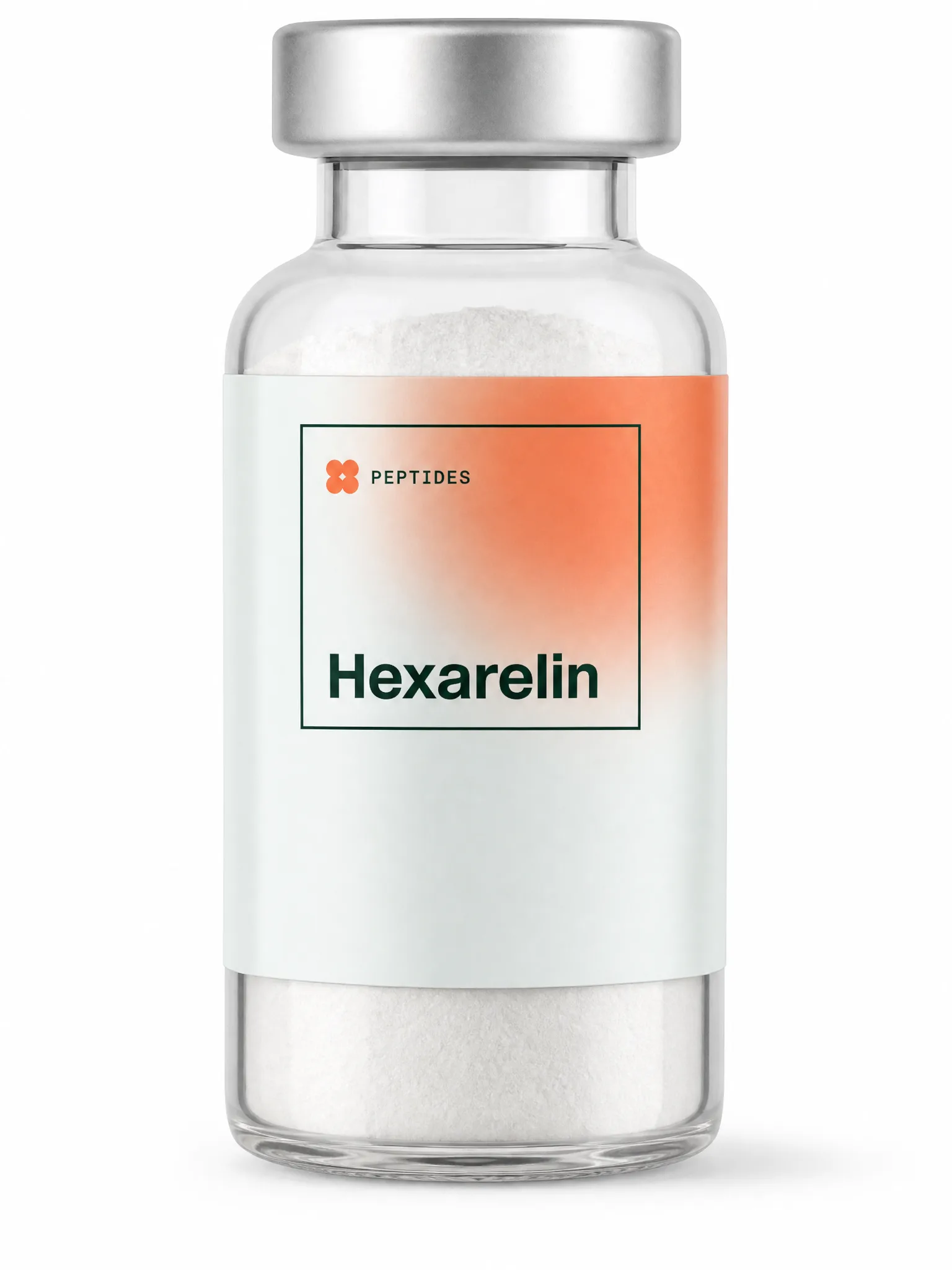
Hexarelin
Hexarelin (Examorelin)
Also called Hexarelin, Examorelin, EP-23905
A strong growth hormone releaser that also acts on heart tissue
Hexarelin is a growth hormone releaser from the GHRP family that produced large acute releases in human pharmacology studies, with a response that faded within weeks of repeated use. It also has an unusual second property: preclinical work describes it acting directly on heart tissue, independently of growth hormone. It is not approved.
A six-amino-acid growth hormone secretagogue from the GHRP family. In human pharmacology studies it produced a large acute growth hormone release, and the response faded with repeated use. It also binds the CD36 receptor in heart tissue, where preclinical work describes protective effects independent of growth hormone. It is not an approved medicine.
- Half-life
- About 20 to 70 minutes
- Route studied
- Intravenous, subcutaneous, intranasal (studies)
- Status
- Not FDA-approved
Studied in people, and well studied in preclinical models
What Hexarelin has been studied for
The reasons people look it up, roughly in order of how often, and what research exists for each. Interest in a use is not evidence that it works; the evidence is stated under each one.
- Raising growth hormone
- Human pharmacology studies measured large acute growth hormone releases, and a response that fell within weeks of continuous use. No trial has tested it for body composition or recovery.
- Heart tissue
- The genuinely interesting part. It binds a receptor in the heart directly, and preclinical work suggests protective effects on heart muscle that do not depend on growth hormone at all. Studied, not established in people.
Mechanism of Action
How Hexarelin works
Hexarelin acts through two receptors: the ghrelin receptor and CD36.
- Ghrelin receptor (GHS-R1a) activation. It strongly activates the growth-hormone-making cells of the pituitary, producing a large acute release.
- CD36 binding in the heart. It engages the CD36 scavenger receptor in heart and blood vessel tissue, the basis for the protective effects described in preclinical work, independent of growth hormone.
- Receptor desensitisation. Repeated activation turns the ghrelin receptor down faster than with milder secretagogues, which is why the response fades.
- Secondary hormones. It raises cortisol and prolactin, more at higher doses.
Hexarelin side effects: what studies reported
It is less selective than ipamorelin: in pharmacology studies it raised cortisol and prolactin alongside growth hormone.
Most commonly reported
- Strong hunger
- A head rush or flushing
- Tiredness
- Water retention and puffiness
- Injection-site redness
Worth keeping an eye on
- Desensitisation: in studies the growth hormone response dropped off within weeks of continuous use
- Raised cortisol
- Raised prolactin, which can affect libido and, in men, breast tissue
- Tingling hands from fluid retention
Dose-related findings. In pharmacology studies, the cortisol and prolactin rises were larger at higher doses.
Source: Clinical pharmacology studies and reports outside trials. This is a summary of published findings, not a complete safety profile and not medical advice. Questions about Hexarelin belong with a licensed clinician who knows your history.
Your Genetics & Hexarelin
The genes involved in how Hexarelin works
Hexarelin works through the receptors these genes build, and the genes vary from person to person. Researchers have linked some of that variation to differences in how people respond. A DNA report tells you which versions you carry.
GHSR · ••
Builds the ghrelin receptor hexarelin acts on. Variants have been studied for their association with appetite and body weight. No study has tested whether they change response to hexarelin.
CD36 is the receptor behind hexarelin's heart effects in preclinical work. Common CD36 variants have been associated with differences in receptor expression and fat handling in human studies. Any link to hexarelin is untested.
GHR · ••
The exon 3 deletion produces a shorter growth hormone receptor that some human studies, mostly of approved growth hormone in children, associated with greater sensitivity. It has not been studied with hexarelin.
Somatostatin is the body's brake on growth hormone release. Variants in its gene are studied for their association with growth and metabolic traits. Any link to hexarelin is untested.
The dots after each gene are where your own result goes. Your report fills them in with the two letters you carry at that position.
Which of these variants do you carry?
Your report reads the DNA file you already have against this research.
Often discussed alongside
Compounds that come up next to Hexarelin in research and discussion. Each has its own page. None of this is a suggestion to combine them.
Ipamorelin
a more selective ghrelin-receptor agonistModerate EvidenceIpamorelin Acetate
Presses the same switch the stomach uses to say it is empty, the one that also triggers a growth hormone release, but largely without the hunger. What set it apart in early pharmacology work is what it did not do: older peptides in its family also pushed up cortisol and prolactin, and this one mostly stopped at growth hormone. It is not an approved medicine.
4
Gene variants
40+
Studies
GHRP-6
same familyModerate EvidenceGrowth Hormone Releasing Peptide-6
A first-generation six-amino-acid ghrelin-receptor agonist that releases growth hormone and sharply raises appetite. It behaves much like ghrelin itself, and in pharmacology studies it raised cortisol and prolactin as well as growth hormone. It is not an approved medicine.
4
Gene variants
35+
Studies
Access
Access and legal status
Hexarelin is not an FDA-approved drug. Products sold online as “research chemicals” are labelled not for human use, and FDA treats them as unapproved drugs when they are marketed for people. We don't link to any seller, and nothing on this page is a recommendation to obtain or use it.
Your DNA and Hexarelin: see which of the variants studied alongside it you carry, and what that research does and does not show. Read my DNA, $99 →
Educational information only, not medical advice. Most peptides are not FDA-approved. Do not start, stop or change any medication or peptide because of this page; talk to a licensed clinician.
Worth knowing about Hexarelin
Interactions and situations where there is a specific reason to be careful. Where the honest answer is that nobody has studied something, it says so and says what that leaves open.
- The response fades with repeated use
- Not a rumour: in human studies the growth hormone response fell sharply within a few weeks of continuous use.
- Cortisol and prolactin rise with it
- It is less selective than ipamorelin, raising cortisol and prolactin alongside growth hormone. It is not an approved medicine and is prohibited in sport.
Last updated
Frequently Asked Questions
Why does hexarelin's effect fade?
Repeated strong activation turns the ghrelin receptor down. In human studies, the growth hormone response to hexarelin fell within a few weeks of continuous use, faster than with milder secretagogues.
What makes Hexarelin different from other GHRPs?
Besides its strong acute growth hormone release, hexarelin binds the CD36 receptor in heart and blood vessel tissue, and preclinical work describes protective effects on heart muscle that the other GHRPs do not share. These have not been established in people.
Do genes affect hexarelin response?
No study has tested whether any genotype changes response to hexarelin. GHSR, CD36, GHR and SST build the receptors and signals it works through, and some of their variants have been associated with related traits in human studies. A DNA report can show which versions you carry and what that research does and does not show.
Watch
What clinicians and researchers say about Hexarelin
 13 minDr. Explains Peptide Stacks Used for Muscle GrowthAshley Froese · EducatorSermorelinCJC-1295Tesamorelin
 1 hr 13 minCJC-1295, Ipamorelin, Tesamorelin & Sermorelin: Deep Dive on the Best GH PeptidesQuinn Stillson · ClinicianCJC-1295SermorelinTesamorelin
 17 minDoctor Explains Top Peptides: Tesamorelin, Sermorelin, Hexarelin, CJC-1295, Ipamorelin and more.Doctor Michael Mueller · CreatorSermorelinCJC-1295Ipamorelin
Learn more about Hexarelin
Your DNA and Hexarelin
What the research says about your variants.
The report
Which Hexarelin variants do you carry?
Your report reads the DNA file you already have against the published research on 31 peptides, marker by marker, and says what that research does and does not show.
Read my DNA, $99