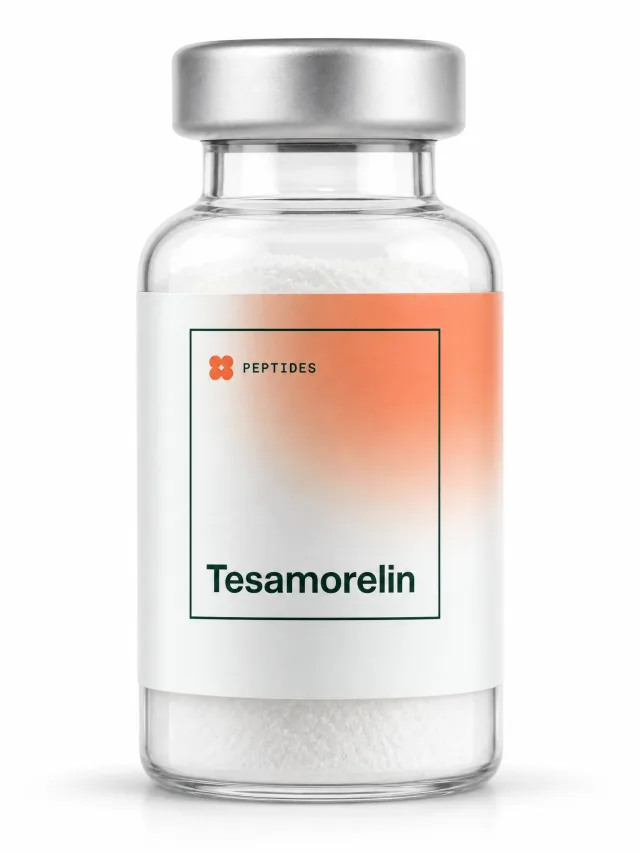
Tesamorelin
Tesamorelin (GHRH Analog)
Also called Tesamorelin, Egrifta, TH9507
The visceral-fat GHRH
Tesamorelin is the only compound in this catalogue approved specifically for shifting one kind of fat: the deep visceral fat that sits around your organs, not the fat you can pinch. It was developed for people on HIV medication who accumulate it, and it is a genuine prescription drug rather than a research vial.
A stabilized growth-hormone-releasing-hormone (GHRH) analog and the only GH-axis peptide with an FDA approval (Egrifta, for visceral fat in HIV-associated lipodystrophy). It stimulates your own pulsatile GH release, which drives IGF-1 and preferential breakdown of visceral (deep belly) fat — backed by real randomized trial data on VAT reduction. Off-label use for visceral fat is common. WADA-banned in sport.
- Half-life
- Around 25 to 40 minutes, which is why it is daily rather than weekly
- Route
- One injection under the skin of the stomach, every day
- Typical dose
- 2 mg daily, which is the approved dose
- Availability
- Research-only
Tested in several human trials
What people use Tesamorelin for
Reported uses, roughly in order of how often they are the reason someone goes looking. Whether it works for any of them is a separate question, answered under each one.
- Visceral fat specifically
- The approved use and the reason it is interesting. It reduces the fat packed around the organs, which is the kind that actually tracks with metabolic disease, while barely touching the subcutaneous fat under your skin. Most weight-loss drugs do not distinguish.
- Liver fat
- Follows from the same effect. It has been studied for fatty liver in people with HIV and reduced liver fat alongside the visceral fat.
- Growth hormone without injecting growth hormone
- It asks your pituitary to release its own rather than replacing it, which keeps your natural feedback loops in place. That is the argument for this whole family of compounds.
Mechanism of Action
How Tesamorelin works
Tesamorelin amplifies your natural GH axis with a specific bias toward visceral fat:
- GHRH receptor agonism — binds pituitary GHRH receptors to stimulate pulsatile growth-hormone release, preserving the natural feedback rhythm rather than overriding it
- IGF-1 elevation — sustained GH pulses raise hepatic IGF-1, the downstream driver of repair and body composition
- Visceral-fat lipolysis — its standout, trial-proven effect is preferential reduction of visceral adipose tissue (the metabolically dangerous deep fat), more than subcutaneous fat
- Glucose caution — GH is mildly counter-regulatory to insulin, so in people with heavy beta-cell genetic load, fasting glucose and IGF-1/IGFBP-3 should be monitored
Tesamorelin dosage calculator
Opens at 2 mg, from the doses reported for Tesamorelin. Change any box to match your own vial. It works out where to pull the plunger to.
How much is in the vial?
Printed on the label, in milligrams
How much water did you add?
Bacteriostatic water, in millilitres
What dose are you taking?
The dose you already intend to use
Which syringe?
Barrel size, printed on the wrapper
Draw to
40 units
on a 0.5 mL insulin syringe (0.4 mL)
- Strength once mixed
- 5 mg/mL
- Doses in the vial
- 5
10 mg in 2 mL makes 5 mg/mL. A 2 mg dose is 0.4 mL of that, which is 40 units.
Want a rounder number? Adding 0.5 mL instead would put this dose at exactly 10 units, which is easier to draw accurately.
This is arithmetic, not advice. It converts a dose you already have into a mark on a syringe. It does not tell you what dose to take, and Tesamorelin is not prescribed by us. Dosing belongs with a qualified clinician.
Tesamorelin side effects: what people reported
Two things dominate: the injection site, because this is a daily stomach injection and the skin gets tired of it, and fluid retention, because that is what happens when growth hormone rises.
What most people notice
- Injection-site redness, itching and lumps, which is the most reported effect and the reason rotating sites matters on a daily injection
- Joint aching and stiffness
- Muscle aching
- Puffy hands and ankles in the first weeks
- Pins and needles in the hands
Worth keeping an eye on
- Blood sugar drifting up, because growth hormone works against insulin. Prescribers monitor it and so should you
- Numbness at the wrist from fluid pressing on the nerve
- It stops working when you stop. The visceral fat comes back, which was clear in the trials
Reasons to check first
- An active cancer, since raising growth hormone raises IGF-1 and IGF-1 is a growth signal
- Diabetes that is not well controlled
Dose matters. Joint aching and swelling ease for most people after the first month or two rather than persisting.
Source: Phase 3 trials and prescribing experience with Egrifta. This is a summary of published findings, not a complete safety profile and not medical advice. Tesamorelin should only be considered with a qualified clinician who knows your history.
Your Genetics & Tesamorelin
The genes involved in how Tesamorelin works
Tesamorelin works through the receptors these genes build, and the genes vary from person to person. Researchers have linked some of that variation to differences in how people respond. A DNA report tells you which versions you carry.
GHRHR · ••
Variants in the GHRH receptor affect how many targets tesamorelin has on pituitary somatotrophs. Reduced receptor expression can mean a smaller GH response at a given dose.
IGFBP3 · ••
This variant sets baseline IGFBP-3, the main carrier of circulating IGF-1. Low-IGFBP-3 genotypes change how free IGF-1 should be interpreted — a reason to monitor IGF-1 and IGFBP-3 together rather than IGF-1 alone.
FTO · ••
FTO high-set-point genetics correlate with a visceral-fat-prone phenotype — the exact target tesamorelin's mechanism addresses, which strengthens the rationale for using it.
The dots after each gene are where your own result goes. Your report fills them in with the two letters you carry at that position.
Which variants do you carry?
Upload your DNA data, or get tested through our partner, to find out.
Commonly combined with
What Tesamorelin is most often paired with, and why:
Semaglutide
Visceral Fat StackStrong EvidenceSemaglutide (GLP-1 Receptor Agonist)
A weekly injection sold as Ozempic for diabetes and Wegovy for weight loss. It is a rebuilt copy of a hormone your gut releases after eating, the one that tells your brain you are full, engineered to last a week instead of minutes. It is also the only weight-loss drug shown to cut heart attacks and strokes rather than just weight.
CJC-1295
GH Axis StackModerate EvidenceCJC-1295 (Modified GRF 1-29)
A copy of the brain signal that tells the pituitary to release growth hormone, rewritten so the enzyme that normally destroys it in minutes cannot. Before you read any dose, check which version you have: with DAC it keeps growth hormone up for days, without DAC it produces a short pulse, and nearly every blend sold with ipamorelin contains the second one.
4
Gene variants
30+
Studies
Ipamorelin
GH Pulse StackModerate EvidenceIpamorelin Acetate
Presses the same switch your stomach uses to say it is empty, the one that also triggers a growth hormone release, but largely without the hunger. Its selling point is what it does not do: older peptides in its family also pushed up cortisol and prolactin, and this one mostly stops at growth hormone. It is almost always sold blended with CJC-1295.
4
Gene variants
40+
Studies
Common Stacks
One of these pairings has a name people search for, and a page of its own.

Sourcing & access
Where to buy Tesamorelin
Tesamorelin is sold as a research compound, not a licensed medicine, so quality and legal status vary widely by country and vendor. If you're sourcing it, treat independent purity testing as non-negotiable.
- Insist on a recent third-party Certificate of Analysis (COA) for the exact batch — labs like Janoshik verify purity and identity.
- Check the legal status where you live before ordering — it differs from country to country.
- Reconstitute correctly with bacteriostatic water and start at a conservative dose.
Before you buy: see whether your DNA actually responds to Tesamorelin, and at what dose. Analyze my DNA — $99 →
Educational information only, not medical advice. Some outbound links are affiliate links (disclosed, at no extra cost to you). Most peptides are not FDA-approved — consult a qualified professional and check your local laws before purchasing.
Worth knowing before you consider Tesamorelin
Interactions and situations where there is a specific reason to be careful. Where the honest answer is that nobody has studied something, it says so and says what that leaves open.
- The fat comes back
- This was measured, not speculated. In the trials visceral fat returned once treatment stopped. It is a treatment you stay on rather than a course you complete.
- A daily stomach injection is the real commitment
- Not weekly. Every day, into the abdomen, and the skin notices. This is the practical reason people give up on it rather than any dramatic side effect.
Last updated
Frequently Asked Questions
What is tesamorelin used for?
Tesamorelin is a GHRH analog FDA-approved (as Egrifta) to reduce visceral fat in HIV-associated lipodystrophy, and used off-label more broadly for visceral-fat reduction. It stimulates your own growth hormone and has trial data showing it preferentially shrinks deep abdominal fat.
Does genetics affect tesamorelin response?
Yes. GHRHR variants influence the size of the GH response, and IGFBP3 genotype changes how IGF-1 levels should be monitored. FTO/visceral-fat genetics help decide whether tesamorelin's visceral-fat target fits your phenotype in the first place.
Is tesamorelin legal?
Tesamorelin is FDA-approved by prescription for its HIV indication; other uses are off-label. It is also WADA-banned in sport. Availability and compounding access vary by country and by clinic.
Learn more about Tesamorelin
7 guides mention Tesamorelin→comparisons
In depthTesamorelin vs MK-677 vs CJC-1295: Which GH Peptide Actually Changes Body Composition?
12 min read
stacking
Semaglutide Muscle Loss: Why GH Secretagogues Work When Protein Alone Doesn't
12 min read
safety
When to Test Your IGF-1 on Peptides: Draw Timing, Fasting Rules, and Result Interpretation
12 min read
peptide guides
Sermorelin Dosage Chart by Body Weight: The Legal GHRH Peptide With 20 Years of Clinical Data
13 min read
how it works
7 Things to Know Before Your First Peptide Therapy Appointment
11 min read
safety
9 Signs Your IGF-1 Is Too High (And What to Do Before Your Next Injection)
11 min read
Your next move
Two ways forward with Tesamorelin.
Not sure it's for you?
How does Tesamorelin relate to your genes?
Your report scores Tesamorelin against your receptor, pharmacogene and pathway variants and shows the genetic markers relevant to it, with commonly cited dosing information to review with a clinician.
Analyze my DNA — $99Already decided?
Get Tesamorelin from Swiss Chems.
A US research-chemical supplier with third-party Certificates of Analysis. Sold for research use only — check your local laws before ordering.
Buy at Swiss Chems →Save 10% at checkout with code tcwisiiu