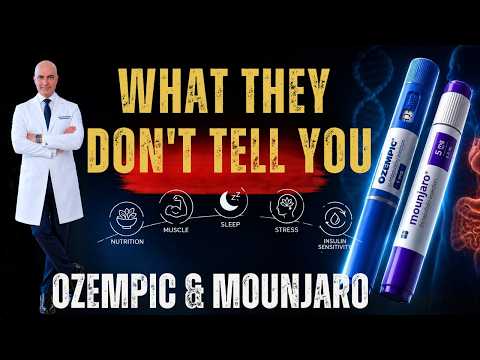
Cause for caution with weight loss drugs like Ozempic | Peter Attia, M.D.
A five-minute solo talk in which Peter Attia says semaglutide suppresses appetite effectively but, in his patients, often costs muscle, and explains the checks his practice requires.
Key moments
Tap a moment to play the video from there.
- 0:01Why everyone asks about OzempicAttia says he is asked about semaglutide constantly and describes it as a GLP-1 agonist and the prototype weight loss drug.
- 0:32Background and earlier AMAHe says the drug has been around a while, his practice began using it a little over two years earlier, and a deeper AMA episode exists.
- 1:03Purpose: a note of cautionAttia states he is making the video to warn people who treat the drug as a panacea, and says it works as a strong appetite suppressant.
- 1:33Appetite and glycemic effectsHe says it improves glycemic control, through weight loss and as a direct insulin sensitizer, and that early versions were used in type 2 diabetes.
- 2:34The muscle loss problemAttia says nearly every patient lost muscle at an alarming rate, and walks through a 200 to 180 pound example.
- 3:04DEXA scans and clinic guidelinesHe says his practice requires a DEXA scan before considering the drug and sets clear guidelines.
- 3:35Keep protein and training upAttia tells patients protein needs do not change and that heavy training should continue, which he says can shift loss toward fat.
- 4:06Criticism of FDA trial outcomesHe says the FDA will not accept DEXA as a primary outcome, so trials use body weight and disadvantage drugs that spare lean mass.
- 4:36Closing: body composition over weightAttia mentions a newer drug for a later episode and urges caution, saying body composition matters more than weight.
What the video says
Peter Attia, a physician, says he is asked about semaglutide (sold as Ozempic and Wegovy) almost daily by friends, acquaintances and patients. He describes it as a GLP-1 agonist and, in his words, the prototype weight loss drug. He says his practice began using it a little over two years before the video and points viewers to an earlier long-form Ask Me Anything episode for the detailed version. This clip has a narrower aim: to caution people who see the drug as a cure-all for weight loss.
Attia says the drug works. In his account it is a strong appetite suppressant that acts centrally and, unlike some earlier appetite drugs, does so without clear negative side effects. He adds that it improves glycemic control, partly through the weight loss itself and partly as a direct insulin sensitizer. He notes the first versions were used in people with type 2 diabetes, and that the weight loss version is dosed slightly differently.
The concern is body composition. Attia says that almost without exception, patients in his practice who took the drug lost muscle, at a rate that alarms him. He gives a worked example: a person going from 200 to 180 pounds by losing 10 pounds of muscle and 10 pounds of fat would end up fatter in proportion, unless they started above 50 percent body fat. His practice now asks for a DEXA scan before considering the drug, and only after other dietary options have been exhausted. He also tells patients that protein needs and training intensity stay the same, and says that with that approach fat mass can be lost disproportionately.
Attia also criticizes the FDA for not accepting DEXA as a primary outcome in weight loss trials, so studies track body weight. He argues this penalizes drugs that preserve lean mass, and that companies often do not report body composition. He mentions a newer drug he thinks is significantly better, saving that comparison for a later episode, and closes by saying body composition and health matter more than weight.
On each compound
Semaglutide0:01
Attia calls semaglutide a GLP-1 agonist and the prototype weight loss drug. He says it suppresses appetite and improves glycemic control, but that his patients almost always lost muscle mass, so his practice requires a DEXA scan first.
See how your DNA reads Semaglutide“it's not your weight so much that matters as your body composition”
What this video doesn’t settle
- The muscle loss claim comes from Attia's own patients, with no numbers, control group or published data shown in the video.
- He does not say how much muscle loss is typical or how much the protein and training approach reduces it.
- The newer drug he calls significantly better is named only in passing, and the comparison is deferred to a later episode.
Questions this video answers
What does Peter Attia say about muscle loss on Ozempic?
Attia says almost every patient in his practice who took it lost muscle mass, at a rate that alarms him. He argues this can leave a person proportionally fatter even as weight drops.
Why does Attia require a DEXA scan before semaglutide?
He says his practice wants a clear baseline of body composition so it can track what is being lost. He says this applies only after other dietary options have been exhausted.
What does Attia say about protein intake while taking semaglutide?
He says patients should understand that protein requirements do not change. His example is a 200 pound person still eating 200 grams of protein per day and training as heavily as before.
Why does Attia criticize the FDA over weight loss drug trials?
He says the FDA does not accept DEXA as a primary outcome and uses body weight instead. He argues this penalizes drugs that preserve lean mass and leaves companies with little reason to report body composition.
Video by Peter Attia MD on YouTube, embedded as published. The summary is written by PeptidesDNA from the video; every claim in it is the speaker’s. Not affiliated with or endorsed by the creator. Not medical advice.