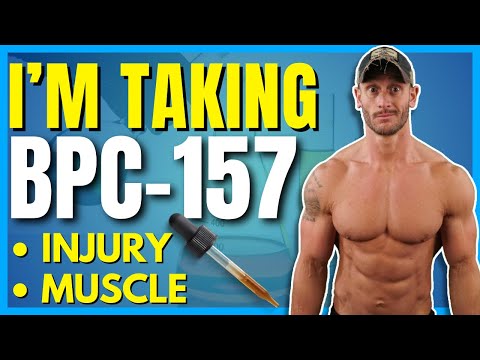
Should You Take BPC-157 Peptides?
A 10-minute evidence review of BPC-157 in which Brad Stanfield argues the research is almost entirely preclinical and explains why he advises against using it.
Key moments
Tap a moment to play the video from there.
- 0:00The claims around BPC-157Stanfield introduces the reported effects on injury recovery and performance, citing podcast hosts and clinics, and says he will check what the science supports.
- 0:32What the peptide isHe defines peptides, gives insulin and oxytocin as examples, and describes BPC-157 as a synthetic peptide derived from a protein in stomach fluid.
- 1:02Origins in early researchHe says it was isolated in the early 1990s by researchers in Croatia, who tested it in several kinds of animals and suggested it could be a new class of protective drug.
- 2:04Tendon and skin findingsStanfield describes preclinical studies on tendon injury and skin wounds, and explains why tendons are slow to recover.
- 2:34Proposed mechanisms of actionHe covers reduced inflammation, new blood vessel formation, and nitric oxide signaling, and explains why inflammation can be both useful and harmful.
- 4:36No human trials existHe states that all the research so far is preclinical and that no randomized trials in humans exist. He critiques the single 16-person knee pain study.
- 6:07Why anecdotes misleadUsing a tea and cold example, he explains placebo effects and why controlled trials are needed to separate what works from what does not.
- 7:08Three reasons for cautionStanfield lists unknown safety and dose, unregulated product quality, and the anti-doping ban as reasons not to try it.
- 8:39Better-studied alternativesHe contrasts BPC-157 with creatine monohydrate and trimethyl glycine, which he says have strong supporting data.
- 9:39Other peptides and GLP-1He says other popular peptides also lack human trials, then points to a follow-up video on GLP-1 medications.
What the video says
Brad Stanfield opens with the claims circulating about BPC-157, including podcast guests who say it resolved a tendon problem, and clinics that recommend it for strength and endurance. He then reviews what the research shows. He describes it as a synthetic peptide derived from a protein found in stomach fluid, first isolated in the early 1990s by researchers in Croatia.
Stanfield walks through the preclinical findings he considers most relevant: effects on the digestive tract, on tendon injury, and on skin wounds. He summarizes the proposed mechanisms as reduced inflammation, stimulation of new blood vessel formation, and an influence on the nitric oxide system. He pauses to explain why inflammation matters and why some control over it might be useful. He presents these results as interesting, but stresses that all of them come from preclinical work.
The central point of the video is the lack of human evidence. Stanfield says there are no randomized clinical trials of BPC-157 in people. He describes a single human study on knee pain and lists its limits: it was retrospective, it had no control group, and it involved only 16 people. He argues that anecdotes, however vivid, cannot separate a real effect from placebo or natural recovery.
He then answers the objection that trying it carries little downside. He gives three reasons for caution: safety and dose are unknown, the products sold online are unregulated and untested, and the US anti-doping agency has banned it in competition. He contrasts it with creatine monohydrate and trimethyl glycine, which he says have been studied extensively, and mentions that he takes the latter himself without recommending it to others. He closes by saying other popular peptides also lack human trials, and points to a separate video on GLP-1 medications.
On each compound
BPC-1571:02
Stanfield says BPC-157 shows promising results in preclinical studies of the stomach, tendon and skin, but that no randomized human trials exist. He advises against using it, citing unknown safety, unregulated products and its ban by the US anti-doping agency.
See how your DNA reads BPC-157“we don't have the human data yet”
What this video doesn’t settle
- The video does not establish whether BPC-157 is safe or effective in humans, since it covers no randomized trial.
- It does not identify any safe or effective dose, and Stanfield says the proper dose is unknown.
- The single human knee pain study is described only briefly, so its methods and results are not examined in detail.
Questions this video answers
Is there human evidence for BPC-157?
Stanfield says there are no randomized clinical trials in humans. He mentions one retrospective study of knee pain with 16 people and no control group, which he says does little to advance understanding.
Why does Brad Stanfield advise against BPC-157?
He gives three reasons: safety and proper dose are unknown without human trials, products sold online are not regulated or independently tested, and the US anti-doping agency has banned it in competition.
How does BPC-157 supposedly work?
Stanfield says preclinical studies point to reduced inflammation, stimulation of new blood vessel formation, and an influence on the nitric oxide system. He stresses these findings have not been confirmed in people.
Can personal stories show that BPC-157 works?
Stanfield argues they cannot, because placebo effects and natural recovery can look like benefit. He says only controlled trials with comparison groups can show whether a treatment makes a difference.
What supplements does Stanfield say have better evidence?
He names creatine monohydrate, which he says a sports nutrition society ranked as highly effective for athletes, and trimethyl glycine, which he says improves muscle performance. He says he takes the latter but does not tell viewers to do so.
Video by Dr Brad Stanfield on YouTube, embedded as published. The summary is written by PeptidesDNA from the video; every claim in it is the speaker’s. Not affiliated with or endorsed by the creator. Not medical advice.