

- In a head-to-head trial, Selank matched a benzodiazepine for anxiety relief with none of the sedation, tolerance, or withdrawal.
- Forty percent of patients hit sub-clinical anxiety scores within 3 days. The other 60% still reached significant improvement by day 14.
- Selank slows the breakdown of your own natural opioid peptides, a mechanism almost no Western article mentions.
- Your BDNF and GABRA2 variants predict whether you are a fast or slow responder before you take the first dose.
- As of April 2026, the FDA removed Selank from its restricted compounding list. A formal advisory committee ruling is expected in July 2026.
In a clinical trial comparing Selank to a benzodiazepine, 40 percent of patients moved from clinically significant anxiety to sub-clinical levels in three days. Not weeks. Three days. The benzodiazepine it was compared to, medazepam, achieved the same anxiolytic result. But medazepam caused sedation, cognitive dulling, and rebound anxiety on discontinuation. Selank produced none of these. Zero withdrawal reported across every trial that has tested it. That is the clinical record. Most people in the nootropic community know Selank exists but cannot name a single study behind it because the research was published primarily in Russian psychiatric journals, and a major placebo-controlled RCT in the Western trial register does not yet exist.
Proportion of GAD patients who reached sub-clinical Hamilton Anxiety Rating Scale scores within 3 days on Selank, from a 2012 study published in European Psychiatry. The rapid-responder group dropped from a baseline HARS of 20.3 to 7.0 in 72 hours. The slow-responder group reached a HARS of 6.2 by day 14. Both outcomes reached statistical significance (p less than 0.01).
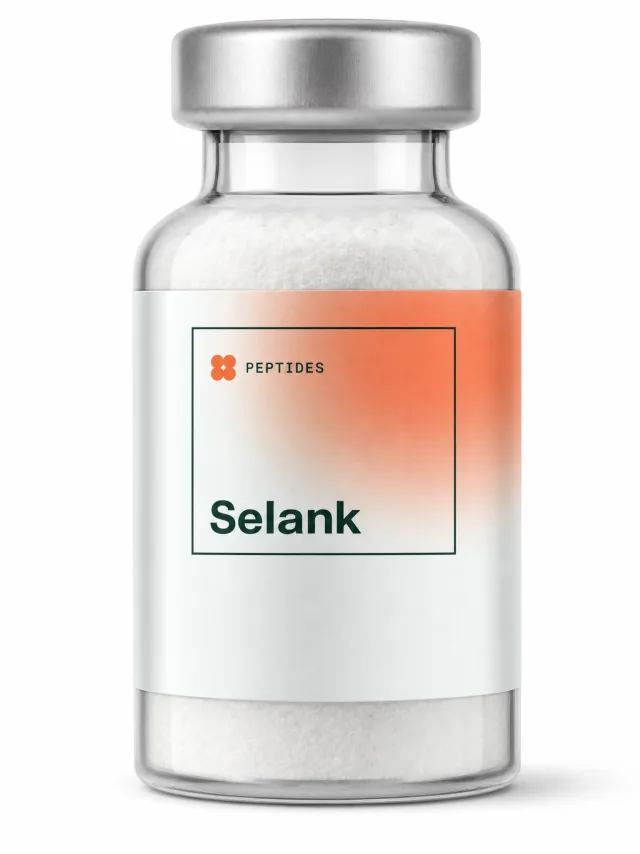
Selank (chemical name Thr-Lys-Pro-Arg-Pro-Gly-Pro) is a synthetic heptapeptide developed by Russia's Institute of Molecular Genetics as a derivative of tuftsin, an endogenous immunomodulatory peptide. It was approved by the Russian Ministry of Health for generalized anxiety disorder and neurasthenia and has been available as a prescription nasal spray in Russia since 2009. Over 800 patients have been enrolled across published Selank trials. For a nootropic peptide, that is a substantial evidence base. For an FDA approval dossier, it falls short. That gap is the entire story of Selank in the Western market.
The mechanism is where it gets interesting. Most articles classify Selank as a GABAergic peptide and stop there. A 2018 study by Vyunova et al. in Protein and Peptide Letters (PMID 30255741) confirmed that Selank acts as a subtype-selective allosteric modulator of GABA-A receptors: it binds at a different site than benzodiazepines and modulates receptor function rather than directly activating it. The Vyunova study showed Selank can actually block diazepam's modulatory activity at the same receptor. That is not how a typical GABA agonist behaves. It acts more like a tuner of your GABAergic system's sensitivity than a blunt amplifier.
Your GABA system is your brain's main anxiety brake. Benzodiazepines slam that brake as hard as possible, which works fast but leaves the brake worn down over time. Selank works more like a brake calibrator: it adjusts how sensitive the brake is without forcing it on at full strength. The result is calmer anxiety signaling without the crash when you stop.
What do the Russian clinical trials actually show?
The most cited head-to-head comparison enrolled 62 patients with generalized anxiety disorder or neurasthenic presentations and randomized them to either Selank or medazepam, a benzodiazepine used as the anxiolytic standard in Russian psychiatry. Both groups showed equivalent reductions in Hamilton Anxiety Rating Scale scores by the end of treatment. The Selank group showed none of the cognitive slowing or sedation seen in the medazepam group, and no withdrawal effects emerged on discontinuation. The finding is not that Selank works better than benzos. It is that Selank works as well, with a safety profile that excludes dependency.
The 2012 European Psychiatry study on response patterns is the most useful for understanding who benefits fastest. Researchers tracked how quickly patients responded and found a clear split: 40 percent were rapid responders whose HARS scores dropped from 20.3 to 7.0 (below the clinical anxiety threshold, approaching remission) within three days. The remaining 60 percent were slower responders who reached similar final HARS scores (6.2) by day 14. Both groups landed in the same place. The difference was timing. This rapid-versus-slow pattern maps closely onto genetic variants in BDNF and GABRA2, a connection the researchers noted but did not fully explain.
Selank demonstrated anxiolytic efficacy equivalent to medazepam in generalized anxiety disorder and neurasthenia, with additional psychostimulant and cognitive-enhancing properties not observed in the benzodiazepine comparator group. No sedative effect, no withdrawal syndrome, and no tolerance development were observed in the Selank group.
Seredenin et al., Efficacy and mechanisms of action of Selank in GAD and neurasthenia
The immunological dimension is one most Western nootropic coverage ignores entirely. A 2008 study by Uchakina et al. in Zh. Nevrol. Psikhiatr. (PMID 18577961) followed patients with anxiety-asthenic disorder and found that Selank completely suppressed IL-6 gene expression and rebalanced Th1/Th2 cytokine ratios. For patients whose anxiety is partly driven by chronic low-grade inflammation, this immune-modulating action may explain why Selank works when purely GABAergic interventions have not.
| Measure | Selank | Medazepam (benzo) |
|---|---|---|
| Anxiolytic effect | Equivalent | Equivalent |
| Cognitive effects | Improved focus and recall | Slowed and dulled |
| Sedation | None reported | Reported in most patients |
| Withdrawal on stop | None across all trials | Rebound anxiety common |
| Tolerance over 14 days | None observed | Common with daily use |
Why does Selank work differently from any GABA drug you have tried?
The GABAergic angle is only part of the story. Selank also inhibits enkephalinase, the enzyme that breaks down your endogenous enkephalins. Enkephalins are natural opioid peptides your brain produces to buffer emotional pain and anxiety. By slowing their degradation, Selank raises functional enkephalin availability without activating opioid receptors directly. That mechanism does not appear in any major Western article on Selank, and it explains why users often describe the calming quality as different from both benzos and SSRIs: less numbed, more of a natural settling.
The gene expression data behind the GABA effects is equally striking. A 2016 study by Volkova et al. published in Frontiers in Pharmacology (PMC4757669) tracked which genes changed expression after Selank administration. Within one hour, 45 out of 77 GABAergic genes showed altered expression. The pattern was biphasic: 20-fold decreases in certain receptor subunit genes at one hour reversed to 128-fold increases at three hours. That bidirectional, time-dependent regulation is not what you see with a blunt GABA agonist. It suggests Selank is recalibrating GABAergic signaling rather than simply amplifying it, which directly explains the absence of tolerance in trial data.
GABAergic genes whose expression was altered by Selank within one hour, out of 77 tracked in the Volkova et al. 2016 Frontiers in Pharmacology study. The changes were biphasic: 20-fold decreases at one hour reversed to 128-fold increases at three hours for key receptor subunits. This bidirectional regulation pattern is not seen with benzodiazepines.
Does your anxiety genotype are associated with how well Selank works?
The rapid-versus-slow responder split from the 2012 trial maps onto three genetic variants with unusual precision. These are not theoretical connections: Selank's documented mechanisms overlap directly with what these variants disrupt. If you have tested with 23andMe or AncestryDNA, your raw data almost certainly contains reliable calls for two of the three relevant genes.
Understanding your position on the genetic axes that predict peptide response is the clearest way to decide whether Selank or a different anxiolytic approach is the right starting point. Here is what each variant means for Selank specifically.
If you carry the COMT Met/Met variant, the genetic metabolism context matters for dose selection even though Selank is not metabolized by hepatic CYP enzymes. Selank is cleared like a normal dietary peptide. But your COMT status does affect how sensitive you are to the monoaminergic component of Selank's action, and starting conservatively avoids the overstimulation some Met/Met carriers experience with dopaminergic compounds.
Is Selank legal to use in the US right now?
As of April 2026, Selank's regulatory status in the US shifted materially. The FDA formally removed Selank from its 503A Category 2 "do not compound" bulk drug list on April 22, 2026, as part of a broader pullback covering 12 peptides including BPC-157, Semax, and Epitalon. This followed a February 2026 announcement by HHS Secretary Robert F. Kennedy Jr. that previous restrictions would be lifted. However, removal from Category 2 does not equal compounding approval. It clears the path for the FDA's Pharmacy Compounding Advisory Committee, scheduled to formally review these peptides on July 23 to 24, 2026. Until that committee rules, access through licensed US compounding pharmacies remains in regulatory limbo.
In Russia, Selank remains an approved prescription nasal spray available through licensed pharmacies at a standard intranasal dose. In EU countries, it is sold only as a research chemical, not a licensed pharmaceutical.
| Jurisdiction | Status | Access route |
|---|---|---|
| Russia | Approved prescription drug since 2009 | Licensed pharmacies, prescription required |
| United States | Category 2 removed April 2026, PCAC review July 2026 | Compounding pharmacy (uncertain), gray-market vendors |
| European Union | Not approved | Research chemical vendors only |
| United Kingdom | Not approved | Research chemical vendors only |
How is Selank dosed in clinical trials?
The dose used in Russian clinical trials is 2,700 mcg per day administered intranasally over 14 days. No published trial has tested doses above this level. No sedation, tolerance, or withdrawal were reported at any dose tested in published research. The self-administration community typically reports doses of 250 to 1,000 mcg per session intranasally, with frequency ranging from once to three times per day.
| Context | Dose | Frequency | Duration |
|---|---|---|---|
| Clinical trials (Russia) | 2,700 mcg/day | Multiple intranasal doses | 14 days |
| Community self-report (typical range) | 250 to 1,000 mcg | 1 to 3 times daily | 2 to 4 weeks typical |
| COMT Met/Met starting dose | 250 mcg | Once daily | 1 week titration, then reassess |
To understand how Selank fits into a broader protocol, the beginner's guide to peptide selection covers what to expect from your first nootropic peptide and how to structure a starting protocol. And the Selank peptide profile has a full summary of mechanism, stacking options, and sourcing considerations.
Verdict: Selank is the only anxiolytic peptide with a published head-to-head trial against a benzodiazepine, a clear genetic matching framework, and zero withdrawal across its entire clinical record.
It works best if you carry the BDNF Met allele, GABRA2 risk variants, or the COMT Met/Met profile. If you want to know which of those applies to you before starting a protocol, upload your existing DNA file or order a kit and get a full peptide genetics report covering all three anxiety-relevant axes.
Frequently asked questions
How long does Selank take to work for anxiety?
Clinical trial data shows two patterns. Forty percent of patients are rapid responders who reach sub-clinical anxiety scores within 3 days. The remaining 60% reach similar final outcomes by day 14. The difference is largely genetic, driven by BDNF and GABRA2 variants. Most users report noticing a calming effect within 30 to 60 minutes of intranasal dosing on each individual dose.
Is Selank addictive or does it cause withdrawal?
No withdrawal has been observed in any published Selank clinical trial, including trials running 14 consecutive days of daily dosing. This is the most clinically significant difference from benzodiazepines, which commonly produce tolerance and rebound anxiety on discontinuation. Selank's allosteric modulation of GABA-A receptors, rather than direct agonism, appears to explain the absence of tolerance development.
Is Selank legal in the United States in 2026?
As of April 2026, the FDA removed Selank from its restricted compounding list, reversing the 2023 prohibition on licensed pharmacies preparing it. A final advisory committee ruling is expected in July 2026. Until that ruling, access through licensed US compounding pharmacies remains uncertain. In Russia, Selank is an approved prescription nasal spray.
What is the right Selank dose for anxiety?
Russian clinical trials used 2,700 mcg per day intranasally over 14 days. The self-administration community typically uses 250 to 1,000 mcg per session, one to three times daily. If you carry the COMT Met/Met variant, start at the lower end of that range for the first week. Selank is cleared like a dietary peptide, so CYP3A4 metabolizer status does not affect how fast it clears.
How is Selank different from benzodiazepines?
Selank and benzodiazepines both interact with the GABA-A receptor, but through different mechanisms. Benzodiazepines directly potentiate GABA activity broadly, producing fast sedation and tolerance. Selank is a subtype-selective allosteric modulator that can block benzo activity at the same receptor. It also inhibits enkephalinase, raising natural opioid-peptide availability, and upregulates BDNF, improving cognition alongside anxiety reduction. The net result is anxiolytic efficacy without sedation, tolerance, or withdrawal.
Can Selank be stacked with other nootropic peptides?
Selank is often paired with Semax, another Russian nootropic peptide, with the combination targeting both GABAergic calming (Selank) and dopaminergic activation (Semax) pathways. This pairing is popular among people who find Semax alone too stimulating. If you carry COMT Met/Met, be cautious adding dopaminergic stimulants to the stack. The BDNF-upregulating effects of both peptides may be additive for neuroplasticity.
Does Selank help with social anxiety specifically?
Published trials enrolled patients with generalized anxiety disorder and neurasthenic presentations rather than social anxiety specifically. However, a 2020 PubMed-indexed study examined Selank in social stress models and found meaningful anxiolytic effects. Users frequently cite social anxiety as a primary use case. The GABRA2 genetic connection is particularly relevant here, as GABRA2 variants are associated with social threat sensitivity and anxiety-driven social avoidance.
This article is for informational and educational purposes only. It is not medical advice and does not diagnose, treat, cure, or prevent any disease. Consult a qualified healthcare professional before starting any peptide protocol. Individual results vary. Some outbound links are affiliate links, at no extra cost to you.