

- The standard 2.5mg twice-weekly loading protocol makes pharmacological sense but was never tested in a randomized trial. It comes from research vendor guidance, not clinical dosing studies.
- Loading phase (4-6 weeks at higher dose) builds tissue saturation. Maintenance (1.5-2mg weekly) sustains it. Most users skip maintenance and wonder why effects fade after 6 weeks.
- TB-500 distributes systemically. You do not need to inject near the injury. The abdomen works as well as the shoulder for a rotator cuff tear.
- The strongest controlled human data for thymosin beta-4 is in corneal repair, not tendons. The 2025 scoping review calls musculoskeletal evidence 'comparatively sparse.'
- WADA banned TB-500 in January 2026. The FDA removed it from the do-not-compound list in April 2026 and sent it to its compounding advisory committee, which met on July 23 to 24, 2026.
The 2.5mg twice-weekly loading protocol that fills every TB-500 forum has never been validated in a randomized clinical trial. The only published human study of how the body handles it (a 2021 Phase 1 trial in the Journal of Cellular and Molecular Medicine) confirmed that clearance rose in step with the dose up to 25 mcg/kg, with no serious adverse events. It was designed to test safety and handling, not to work out the best protocol. The loading schedule you have probably read a dozen times derives from research vendor guidance, not peer-reviewed dosing data.
That does not make it wrong. It makes it empirically derived. There is a meaningful difference. This guide explains the pharmacological rationale behind loading, covers maintenance dosing by body weight, maps three injury-specific protocols to the actual evidence, and answers the injection-site question that competitor articles leave unresolved.
Complete corneal healing at week 4 in the SEER-1 Phase 3 trial testing 0.1% thymosin beta-4 eye drops (RGN-259). The placebo group achieved 12.5%. This is the strongest controlled human outcome data for thymosin beta-4's therapeutic mechanism, and it involves tissue almost nobody using TB-500 is targeting.
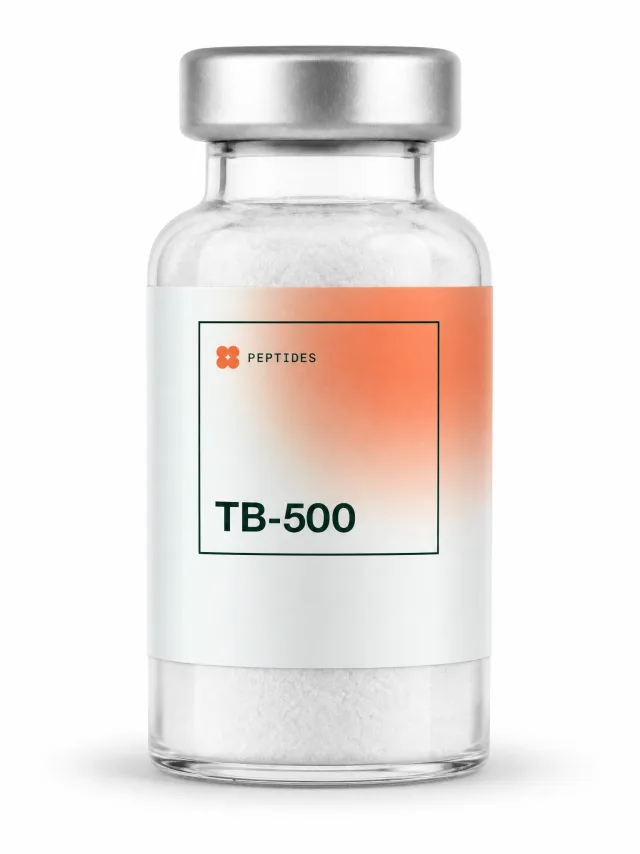
TB-500 is a synthetic fragment of thymosin beta-4, a protein that controls how cells assemble actin, the internal scaffolding that lets them hold shape and move. When tissue is injured, damaged cells spill loose actin everywhere. Thymosin beta-4 mops it up before it can set into the disordered tangles that become scar tissue. At the same time it draws in the immature cells that will become new tissue, promotes blood vessel growth and damps inflammation.
The practical result: faster clearance of inflammatory debris, new vascular growth into the healing zone, and less scarring as the tissue rebuilds. You get quicker maturation with better tissue quality. The 2025 scoping review in Applied Sciences, which mapped all TB-500 and thymosin beta-4 tissue-repair research through March 2026, confirmed this mechanism across multiple tissue types, while noting that musculoskeletal evidence in humans remains largely absent.
Think of a construction site after an earthquake. The debris (loose actin) is everywhere. TB-500 is the site manager who coordinates cleanup, calls in new workers, and makes sure rebuilding happens with proper materials instead of whatever is lying around. Without the site manager, cleanup happens eventually. With the site manager, it happens faster and the rebuilt structure is stronger.
What does the loading phase actually do, and why does it take 4 to 6 weeks?
TB-500 does not switch on a receptor and produce an immediate effect the way a drug like caffeine does. It works by saturating tissue with thymosin beta-4, which then modulates the local cellular environment over time. Loading builds tissue levels faster than a maintenance schedule alone would achieve.
The 2021 human Phase 1 study found no drug accumulation on repeat dosing at standard intervals, which is favourable. It means you can dose repeatedly without it piling up, and that clearance is predictable. What the study did not test: whether twice-weekly dosing builds meaningfully higher tissue concentrations than once-weekly dosing during a loading window. That question remains answered only by preclinical data and community experience.
The four-to-six-week loading window reflects collagen remodeling biology, not a dose-escalation study. Tendon and ligament collagen completes one full remodeling cycle in roughly four to six weeks. Running TB-500 for less than this window may saturate systemic tissue but may not complete a collagen remodeling cycle in the target tissue. Running longer than six weeks at loading dose adds cost without a clear benefit signal for most injury types.
| Phase | Standard dose | Frequency | Duration | Purpose |
|---|---|---|---|---|
| Loading | 2.0-2.5mg | Twice weekly | 4-6 weeks | Build tissue saturation |
| Maintenance | 1.5-2.0mg | Once weekly | Ongoing or 4-8 more weeks | Sustain tissue levels |
| Acute injury | 2.5-3.0mg | Twice weekly | Until resolved or 4 weeks | Accelerate acute repair |
| Preventive or performance | 1.0-2.0mg | Once weekly | Off-season or ongoing | Connective tissue resilience |
The maintenance phase is the most skipped step in TB-500 protocols. Most users run 4 to 6 weeks of loading, notice improvement, and stop entirely. Effects fade within four to eight weeks post-cycle because tissue levels drop below the threshold needed to sustain collagen remodeling activity. The loading phase gets tissue to a functional state. Maintenance keeps it there.
How to calculate your maintenance dose by body weight
Flat-dose protocols (2mg regardless of body size) dominate most guides. This is reasonable for most users, since the Phase 1 human study found clearance rose in step with the dose up to 25 mcg/kg, and 2mg falls within that range for anyone between 60 and 100kg. If you are outside that weight range, or if you have not responded to the standard protocol, a weight-adjusted dose gives you a more precise starting point.
| Body weight | Loading dose (25 mcg/kg) | Maintenance dose (15 mcg/kg) |
|---|---|---|
| 60 kg / 132 lb | 1.5mg | 0.9mg |
| 70 kg / 154 lb | 1.75mg | 1.05mg |
| 80 kg / 176 lb | 2.0mg | 1.2mg |
| 90 kg / 198 lb | 2.25mg | 1.35mg |
| 100 kg / 220 lb | 2.5mg | 1.5mg |
| 110 kg / 242 lb | 2.75mg | 1.65mg |
The 25 mcg/kg loading reference aligns with the upper dose range in the 2021 Phase 1 clinical trial. The 15 mcg/kg maintenance figure derives from preclinical tissue-saturation models and community experience, not from a controlled dosing study. Use it as a starting point, not a precision calculation.
Your genetics affect how long you stay in the loading phase, not just the starting dose. Carriers of certain versions of COL5A1, the gene for the collagen that sets tendon fibre thickness, take longer to recover from injury in endurance-athlete studies and may need six weeks of loading to achieve the tissue-level effect that typical responders see at four weeks. If you have checked your collagen gene variants, use that data to calibrate phase duration before defaulting to the four-week standard.
Which TB-500 protocol actually fits your injury type?
Every guide gives the same 2.5mg twice-weekly chart regardless of whether you have a partial Achilles tear, post-surgical recovery, or a chronically degenerated tendon that has not healed in 18 months. These are not the same injury. Here are three injury-specific protocols mapped to what the evidence actually supports.
Acute muscle tear or strain
Start at 2.5 to 3.0mg twice weekly as early as possible after injury. The first 72 hours is the highest-leverage window for reducing inflammatory debris and drawing the immature repair cells into the injury zone. Run at this dose for 4 weeks, then reassess. Most acute muscle injuries show measurable functional recovery between weeks 3 and 4. Transition to 2mg once weekly for 4 more weeks as maintenance. Total minimum cycle: 8 weeks. For a direct comparison of TB-500 vs BPC-157 in muscle injury, see the head-to-head evidence review.
A chronically painful tendon
A tendon that has hurt for months is degenerating, not inflamed. The mechanism is different: less about clearing inflammatory debris and more about laying down new collagen and growing vessels into the core of the tendon, which has almost no blood supply of its own. Start at 2mg twice weekly. Run for 6 weeks, not 4, because collagen maturation in degenerated tissue is slower than in acute injury. Transition to 2mg once weekly for an 8-week maintenance phase. Expect the response window to be weeks 6 to 10, not weeks 3 to 4. No response by week 8 suggests either a slower-healing genetic profile or that the injury calls for BPC-157 alongside it for the local nitric oxide signal it provides.
Post-surgical recovery
Wait until primary wound closure is confirmed before starting, typically 2 weeks after surgery. Then begin at 2mg twice weekly. The goal is accelerating secondary remodeling, not the initial healing phase where surgical repair must complete without disruption. Run the full 6-week loading phase. Post-surgical soft tissue remodeling continues for 12 to 18 months. Maintenance dosing at 1 to 2mg weekly during this active remodeling window is where the long-term benefit accumulates. Follow the injection hygiene guide carefully before starting any injectable protocol post-surgery.
For joint and cartilage repair, the evidence is thinner still. The 2025 Applied Sciences scoping review found that tendon, ligament, and cartilage evidence is "comparatively sparse" with no completed human musculoskeletal trials. If you are targeting joint cartilage, understanding how long each of TB-500 and BPC-157 lasts in the body matters before choosing a protocol. The half-life and tissue clearance guide covers that in depth.
Does TB-500 injection site actually matter? The answer most articles avoid
Here is the finding that most guides leave unresolved: TB-500 distributes systemically. Where you inject does not meaningfully change which tissue receives it.
This is a cleaner story than BPC-157 has. BPC-157 is conventionally injected near the target tissue, on the theory that a local concentration gradient helps, though the animal work that produced its tendon results dosed the abdomen or the drinking water rather than the injury. After subcutaneous injection, it enters systemic circulation and distributes broadly across tissues. Injecting into the abdomen, thigh, or glute produces the same systemic tissue exposure as injecting near a rotator cuff tear. The 2021 Phase 1 study confirmed predictable systemic distribution after subcutaneous administration in healthy volunteers across all dose cohorts.
Recombinant human thymosin beta-4 showed dose-proportional pharmacokinetics following both intravenous and subcutaneous administration, with predictable systemic distribution and no dose accumulation on repeat dosing across all cohorts.
Wang et al., Journal of Cellular and Molecular Medicine, 2021
In plain terms: doubling the dose doubled the exposure, the compound spread through the body the same way each time, and it did not build up from one injection to the next.
The practical implication: rotate injection sites for skin comfort and tissue health, not for effect. The abdomen is the most common choice because it is accessible and the fat layer is consistent there. If you are also running BPC-157 for the same injury, injecting it locally is the common convention rather than a requirement the studies establish.
| Peptide | Injection site strategy | Rationale |
|---|---|---|
| TB-500 | Abdomen (rotate sites) | Systemic distribution. Location does not affect target tissue delivery. |
| BPC-157 | Near injury site by convention | The local-gradient rationale is popular; the tendon studies dosed the abdomen. |
| Combined protocol | TB-500: abdomen. BPC-157: wherever you can rotate. | Neither compound has evidence that a specific site improves the outcome. |
Is TB-500 legal to source in the US in 2026?
The regulatory status of TB-500 shifted twice in the past 12 months. In October 2023, the FDA placed thymosin beta-4 on its 503A Category 2 list, prohibiting US compounding pharmacies from producing it. That remained in effect through early 2026. In April 2026, the FDA removed TB-500 from Category 2 and referred it to the Pharmacy Compounding Advisory Committee (PCAC), the outside panel that advises the agency on which substances pharmacies may use, which met on July 23 to 24, 2026.
The pre-meeting FDA briefing documents proposed that TB-500 not be added to the 503A Bulks List, which would keep it unavailable through licensed US compounding pharmacies. The committee met on schedule in July 2026. A final determination still depends on the FDA acting on that advice, since the committee advises rather than decides, and the rulemaking that would follow takes far longer than the meeting itself.
TB-500 is not a DEA Schedule I or II controlled substance. The legal question involves compounding and biologic classification (in 2020 the FDA moved it from the drug category into the biologic category, which is regulated differently), not the Controlled Substances Act. The issue is sourcing, not possession.
For competitive athletes: thymosin beta-4 and TB-500 are prohibited at all times under the 2026 WADA Prohibited List (effective January 1, 2026), listed under Section S2 as a growth factor modulator. VADA, the voluntary testing body used in combat sports, mirrors this prohibition. Any athlete subject to testing should treat TB-500 as a banned substance regardless of the US compounding ruling.
How do you know TB-500 is actually working? A week-by-week timeline
The most common complaint from first-time users: "Two weeks in and I feel nothing." That response is almost always premature. Here is what the data-backed and community-reported timeline looks like.
| Timeframe | What to expect |
|---|---|
| Weeks 1-2 | Usually no noticeable change. Systemic tissue saturation is building. Subtle anti-inflammatory effects may begin, occasionally noticed as reduced nighttime aching. |
| Weeks 2-4 | First reports of reduced resting ache, slightly improved range of motion, and better sleep quality in the injured area. Still modest. |
| Weeks 4-6 | Most users report the clearest functional improvement in this window: better load tolerance under activity, reduced pain during use, improved joint mobility. This is the primary response window. |
| Weeks 6-10 | Tissue remodeling continues during the maintenance phase and the off-cycle period. Collagen maturation finalizes here. Stopping at week 6 and skipping maintenance cuts this window short. |
No response by week 6 typically means one of two things. First, the injury involves mainly cartilage or bone, where TB-500's human evidence is weakest. Second, you may carry the connective tissue and blood vessel variants associated with slower healing generally, in which case the timeline stretches. Extending the loading phase to 8 weeks before concluding the protocol is not working is a more rational step than stopping early.
Worth being straight about the limits here: the COL5A1 and NOS3 links come from injury-risk and healing-rate research in athletes, not from any study of TB-500. Nobody has run a trial that sorts TB-500 responders by genotype. Treat these as reasons to give a protocol more time, not as a forecast.
How your connective tissue genes change the right TB-500 protocol
TB-500 works by mopping up loose actin and shaping how collagen is rebuilt. The genes behind both processes vary between people, which is one reason two people with the same injury can be on very different timelines.
Start with the gene that sets how tendon is built. COL5A1 makes Type V collagen, which controls how thick the main structural fibres in a tendon grow. One common version of it is associated with higher injury rates and slower tendon repair in athletes. If your report shows it, plan for a six-week minimum loading phase. Same destination, longer road. Nobody has tested whether this variant changes TB-500 response specifically.
Then the gene behind blood supply. NOS3 builds the enzyme that makes nitric oxide inside blood vessel walls, and the Glu298Asp version makes less of it. TB-500 leans partly on that pathway to grow new vessels into healing tissue. The argument for pairing TB-500 with BPC-157 in carriers is that BPC-157 pushes the same nitric oxide pathway harder. The Wolverine Stack review covers exactly this combination.
Last, the gene behind demolition. The MMP3 5A/5A genotype raises the activity of an enzyme that breaks down the scaffolding between cells so it can be rebuilt. Faster turnover can mean a quicker early response, and it also means the effect fades faster once you stop, which makes the maintenance phase matter more here.
Your DNA report from PeptidesDNA includes all three of these variants and ranks connective tissue peptides against your own profile. If you want to know whether thymosin beta-4 (TB-500) belongs at the top of your injury protocol, that is the place to start before committing to a 10-week cycle.
The verdict: TB-500 is one of the most pharmacologically coherent injury-repair peptides in use, with a confirmed mechanism, human data on how the body handles it, and a Phase 3 controlled human trial showing strong tissue-repair outcomes (in cornea, not tendons, but the mechanism is the same). The standard loading protocol is reasonable even without a randomised trial in tendons behind it. Run the full 6-week loading phase, do not skip maintenance, and inject in the abdomen since injection site does not change the outcome. If you have not checked your COL5A1 or NOS3 status, a DNA kit or genetic upload will tell you whether to extend your loading phase or pair TB-500 with BPC-157 for the best return on a long protocol cycle.
Frequently asked questions
How much TB-500 should I take per week?
The standard loading dose is 2.0 to 2.5mg twice weekly (4 to 5mg per week total) for 4 to 6 weeks. Maintenance is 1.5 to 2.0mg once weekly. If dosing by body weight, use 25 mcg/kg per dose as a loading reference: that translates to 2mg for an 80kg person. This aligns with the upper dose range in the only published human pharmacokinetics trial (Wang et al., Journal of Cellular and Molecular Medicine, 2021).
Do you need to inject TB-500 at the injury site?
No. TB-500 distributes systemically after subcutaneous injection, regardless of injection location. The abdomen is the standard site for convenience. Injecting near the injury does not meaningfully increase local tissue concentration compared to a standard subcutaneous site. BPC-157 is conventionally injected near the target tissue, but its own tendon research dosed the abdomen or the drinking water, so that convention is habit rather than a finding.
How long does a TB-500 cycle typically last?
A complete cycle is loading phase (4-6 weeks) plus maintenance phase (4-8 weeks), totaling 8 to 14 weeks. Most users stop after the loading phase. Effects begin fading within 4 to 8 weeks post-loading if maintenance is skipped, because tissue levels drop below the threshold needed to sustain collagen remodeling. The loading phase builds the result. Maintenance preserves it.
Can you take TB-500 without BPC-157?
Yes. TB-500 is effective as a standalone protocol, particularly for connective tissue repair across the body, chronically degenerated tendons and post-surgical recovery. Adding BPC-157 makes sense if you have one specific local injury, or if you carry the NOS3 variant that leaves you making less nitric oxide, since that is the pathway TB-500 leans on to grow new vessels.
What is the difference between TB-500 loading and maintenance dose?
Loading builds systemic tissue saturation quickly using a higher dose at twice-weekly frequency. Maintenance sustains those tissue levels at a lower cost using a reduced dose once weekly. Loading fills the tank. Maintenance prevents it from draining. Both phases are required for the complete protocol effect. Maintenance is the step most users skip, and its absence is the most common reason that initial gains reverse within weeks of stopping.
Is TB-500 legal to buy in the US in 2026?
The regulatory situation is actively evolving. The FDA removed TB-500 from its 503A Category 2 list in April 2026 and referred it to the Pharmacy Compounding Advisory Committee, which met on July 23 to 24, 2026. What the FDA does with that advice determines whether licensed US compounding pharmacies can resume producing it. TB-500 is not a DEA controlled substance. Athletes should note that WADA banned it effective January 1, 2026 under the S2 prohibited list.
How long does TB-500 take to work?
Most users notice the first meaningful effects (reduced resting ache, improved range of motion) between weeks 2 and 4. The clearest functional improvements typically appear between weeks 4 and 6. The full collagen remodeling cycle takes 6 to 10 weeks. If there is no response by week 6, consider extending the loading phase to 8 weeks or checking your COL5A1 and NOS3 genetic status, both of which are associated with slower connective tissue repair.
This article is for informational and educational purposes only. It is not medical advice and does not diagnose, treat, cure, or prevent any disease. Consult a qualified healthcare professional before starting any peptide protocol. Individual results vary. Some outbound links are affiliate links, at no extra cost to you.