Skin and appearance
GLOW
Also written GLOW peptide, GLOW blend, GLOW 70
GLOW is a pre-mixed vial containing three peptides: GHK-Cu, BPC-157 and TB-500, usually 50 mg, 10 mg and 10 mg in a 70 mg vial. People use it for skin quality, collagen and healing. It is a blend put together by suppliers rather than a protocol from any study.


GLOW is the best selling peptide blend aimed at skin. It is one vial holding three separate peptides, and the ratio is lopsided on purpose: the copper peptide GHK-Cu makes up most of it, with smaller amounts of the two repair peptides alongside. People take it for skin texture and firmness, for scars, and for general healing. It sells as an injection, and more recently as a nasal spray and dissolving oral strips.
What is in it
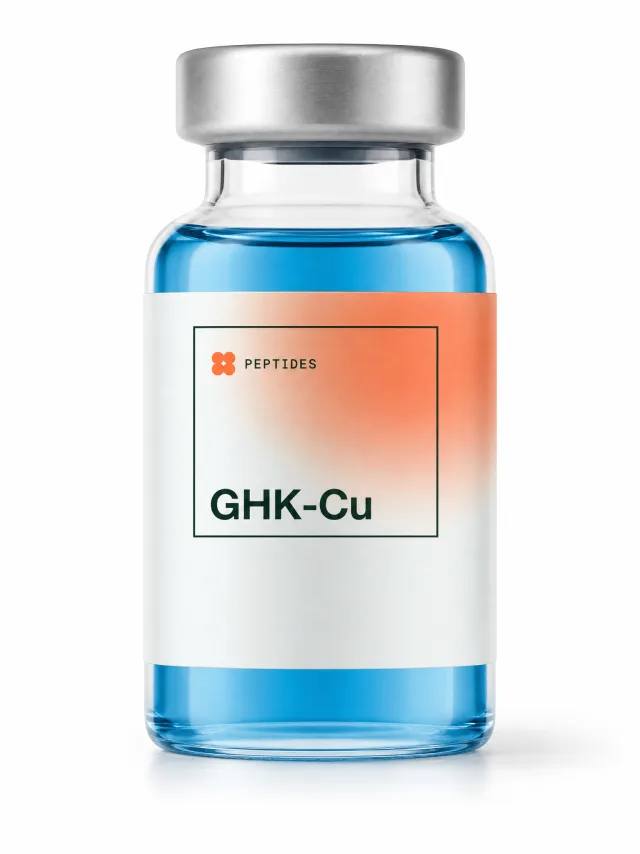
GHK-Cu
The regeneration peptide
The bulk of the vial and the reason it is aimed at skin. A small copper-carrying peptide your body makes less of as you age, studied for its part in building collagen and remodelling skin.
- Dose reported in research
- 1–3 mg/day
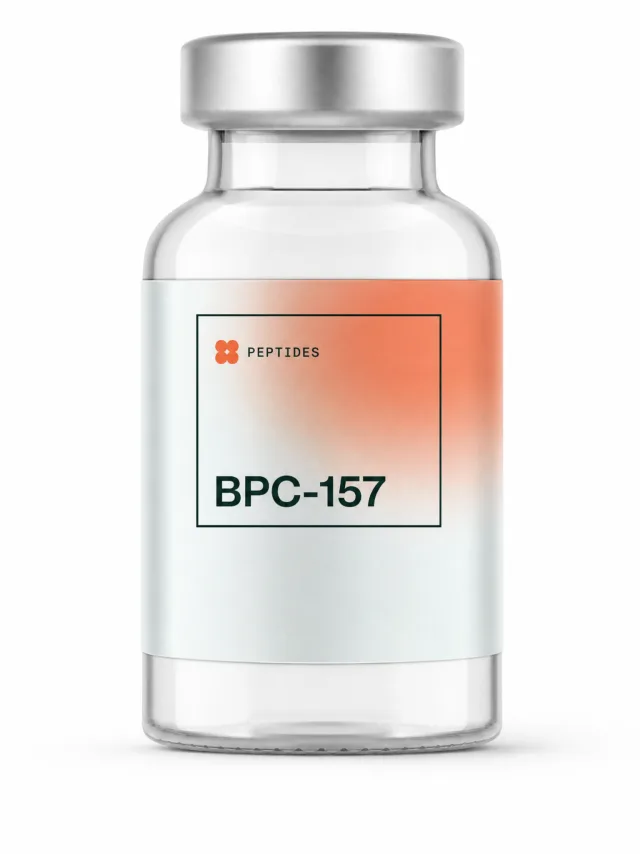
BPC-157
The one people take for injuries that will not heal
The repair component. Most of its research is about connective tissue and gut lining, and it is here for healing rather than for appearance.
- Dose reported in research
- 250–500 mcg per day
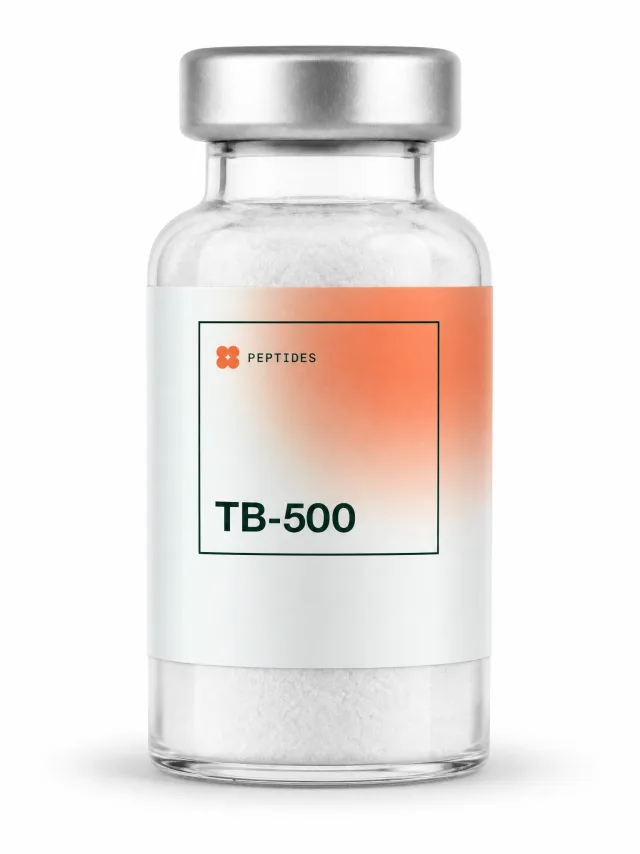
TB-500
The systemic healer
The second repair component, a short fragment linked to helping cells travel to damaged tissue.
- Dose reported in research
- 2–5 mg 2x/week
How it is thought to work
GHK-Cu is 50 of the 70 mg, so it is the part worth understanding.
What the copper peptide is thought to do
Skin is always being torn down and rebuilt. In animal studies GHK-Cu tips that cycle toward rebuilding, and appears to change the kind of tissue that results: it raised decorin, the molecule that organises collagen into neat parallel bundles, while lowering its counterpart. That organisation is roughly what separates scar tissue from normal skin, so the claim is better-arranged collagen rather than simply more of it.
The copper matters. Lysyl oxidase, the enzyme that cross-links collagen and elastin and gives skin its spring, cannot work without it, and loose copper in the blood causes damage. GHK holds copper in a stable grip and carries it, which is a sensible account of delivering a cofactor safely.
The limit worth knowing: every human study of GHK-Cu on skin used a cream, not an injection, and the animal work that showed remodelling injected it straight into a wound. Injecting the abdomen to reach facial skin is an assumption rather than a finding.
Why people pair them
The logic is straightforward and, unusually for this category, not really disputed: GHK-Cu is the one with the skin and collagen research behind it, and the other two are added because they are the most popular repair peptides going. It is less a designed formula than the skin peptide plus the two everybody already buys. The 50/10/10 ratio is consistent across most vendors, which suggests they are copying each other rather than each arriving at it independently.
Straight answer
GLOW is a product, not a protocol.
Nobody ran a study on this combination. It is a blend that suppliers mix and sell, and the reason the ratio is the same almost everywhere is that vendors copy each other's SKUs. That is worth knowing but it is not damning: GHK-Cu on its own has a genuine body of skin research behind it, and the other two are the most-used repair peptides in the category. What you cannot get from any page, including this one, is what the three do together, because that has not been looked at.
What people are usually trying to fix
Each of these has its own guide covering every peptide studied for it, not just these two.
Worth knowing first
- You are injecting copper, and the usual limits do not apply
- GHK-Cu is about 15.8% copper by weight, so a 70 mg GLOW vial holds roughly 7.9 mg of elemental copper. Daily copper limits are written for food, where your gut decides how much to take in. Injecting bypasses that, and no limit has been set for copper given this way.
- Wilson's disease or any copper-handling disorder
- If your body already struggles to clear copper, injecting a copper complex runs the wrong way, and no safe dose has been established for that situation.
- Ten units is not the same dose twice
- GLOW is sold as 35, 42 and 70 mg vials with different ratios, all under the same name, and reconstitution volumes vary. The same ten units off two vials can differ nearly twofold, so a dose copied from someone else tells you little.
The evidence behind GLOW
No study has tested GLOW, and none has tested any two of its three parts together. Everything below studies a single compound. The distinction that matters most on this page: every human study of GHK-Cu on skin applied it as a cream, and no published human trial has ever injected it, by any protocol.
Studied in people
2 of 2The only kind that directly answers whether it works in humans.Archives of Facial Plastic Surgery · 2006
HumanEffects of topical copper tripeptide complex on CO2 laser-resurfaced skin
Miller TR, Wagner JD, Baack BR, Eisbach KJ
The best-designed independent facial study of GHK-Cu, and it was negative. A randomised controlled trial found no significant difference in redness, wrinkles or skin quality by computer analysis or blinded assessors. Only the patients' own questionnaire favoured it. Pages selling copper peptides rarely mention this one.
Effects of topical copper tripeptide complex on CO2 laser-resurfaced skin — source for GLOW (opens in a new tab)n=13 · 12 weeks
Read the paperWound Repair and Regeneration · 1994
HumanEnhanced healing of ulcers in patients with diabetes by topical treatment with glycyl-L-histidyl-L-lysine copper
Mulder GD, Patt LM, Sanders L, et al.
The strongest positive human result for GHK-Cu: a randomised, placebo-controlled trial in diabetic foot ulcers reporting substantially better closure and a lower infection rate. It was a topical gel on open wounds, which is a long way from injecting a cosmetic blend into healthy skin.
Enhanced healing of ulcers in patients with diabetes by topical treatment with glycyl-L-histidyl-L-lysine copper — source for GLOW (opens in a new tab)Read the paper
Every source behind this page85 more
- In vivo stimulation of connective tissue accumulation by the tripeptide-copper complex glycyl-L-histidyl-L-lysine-Cu2+ in rat experimental woundsMaquart FX, Pickart L, Laurent M, et al. · Journal of Clinical Investigation · 1993Animal
- The promoting effect of pentadecapeptide BPC 157 on tendon healing involves tendon outgrowth, cell survival, and cell migrationChang C-H, Tsai W-C, Lin M-S, et al. · Journal of Applied Physiology · 2011Animal
- Human skin retention and penetration of a copper tripeptide in vitro as function of skin layer towards anti-inflammatory therapyHostynek JJ, Dreher F, Maibach HI · Inflammation Research · 2010Review
- Regenerative and Protective Actions of the GHK-Cu Peptide in the Light of the New Gene DataPickart L, Margolina A · International Journal of Molecular Sciences · 2018Review
- Structure of the glycyl-L-histidyl-L-lysine-copper(II) complex in solutionFreedman JH, Pickart L, Weinstein B, et al. · Biochemistry · 1982Review
Everything we cite for GLOW, including animal work and early research. Each link goes to the source itself, so you can judge it rather than take our word for it.
Questions people ask
What is in GLOW?
Three peptides in one vial: GHK-Cu, BPC-157 and TB-500. The usual split is 50 mg of GHK-Cu with 10 mg each of the other two, making a 70 mg vial. Some suppliers sell a nasal spray version at lower amounts, around 20/5/5.
What is the difference between GLOW and KLOW?
One ingredient. KLOW is GLOW plus 10 mg of KPV, an anti-inflammatory peptide, making an 80 mg vial instead of 70. Everything else is the same, including the 50 mg of GHK-Cu that does most of the work. If you see the two side by side at a similar price, the difference you are paying for is the KPV.
Is GLOW the same as a glow injection at a med spa?
No, and this catches people out. A “glow shot” or “glow drip” at a clinic is usually glutathione with vitamin C, which has nothing to do with these peptides. Same word, different product.
How is GLOW dosed?
There is no established dose, because it is not an approved medicine and no study has tested the blend. What suppliers and clinics quote generally works out to a small daily amount drawn from the vial. The safer way to think about it is per component: GHK-Cu is documented around 200 to 500 mcg a day, and you can work out what your vial delivers with a reconstitution calculator.
Is GLOW legal?
None of the three is an approved medicine, so the blend is not either. They are sold as research chemicals, and the rules vary by country. We do not sell them and cannot buy them for you.
Which of these suits you is a different question
A stack is a guess made on your behalf by someone who has never met you. The parts of it that are actually individual, how you process a compound and which of these your genes have anything to say about, are readable, and they do not change over your lifetime.
Upload data you already have from 23andMe or AncestryDNA and we score 39 peptides against your own variants, including which ones your results give no reason to bother with.