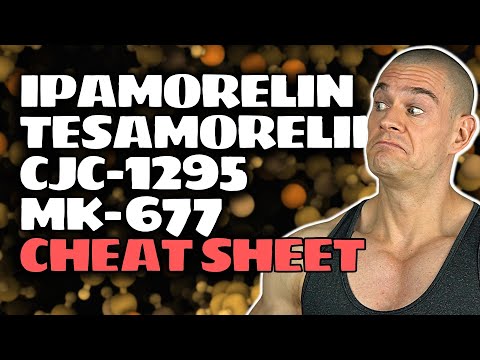
CJC-1295, Ipamorelin, Tesamorelin & Sermorelin: Deep Dive on the Best GH Peptides
A 73-minute talk in which Dr. Stillson compares GHRH analogs (sermorelin, tesamorelin, CJC-1295) and GHRPs (ipamorelin, MK-677) and lays out his framework for choosing among them.
Key moments
Tap a moment to play the video from there.
- 1:26Benefits of raising GH and IGF-1Stillson lists four groups of effects he attributes to growth hormone: tissue growth, recovery and repair, cognition, and metabolism.
- 4:17Downsides of raising GH and IGF-1He covers insulin resistance, what he describes as higher cancer risk in observational data, and a possible link to shorter lifespan.
- 10:18Normal growth hormone physiologyHe explains how GHRH, somatostatin and ghrelin create pulses, and why smaller pulse size drives the age-related decline.
- 19:59CJC-1295 with DAC versus the restStillson says the DAC version has a half-life of 5.8 to 8.1 days and raises trough growth hormone 7.5-fold, unlike the short-acting analogs.
- 28:11Sermorelin and tesamorelin human dataHe reviews the adult sermorelin studies and the larger tesamorelin trials, including its effects on visceral fat and insulin sensitivity.
- 38:15Choosing a GHRH analogHe describes signs that a larger growth hormone increase may help or hurt a person, and how that steers the choice among the three.
- 48:19GHRPs comparedStillson compares ghrelin, GHRP-6, GHRP-2, hexarelin, ipamorelin and MK-677, and explains why he favors ipamorelin.
- 57:53Why not a GHRP aloneHe cites a hexarelin study showing desensitization and explains why he uses a GHRP only alongside a GHRH.
- 1:04:42Who should use GH peptidesHe summarizes benefits and risks and ends with a short guide to choosing a GHRH analog and GHRP.
What the video says
Quinn Stillson MD opens by arguing that the usual question, which peptide raises growth hormone the most, is the wrong one. He says higher growth hormone and IGF-1 can bring benefits to muscle, fat distribution and recovery. He also says they carry downsides, and he describes the relationship with lifespan in humans as U-shaped. Before comparing compounds, he reviews how growth hormone is normally released: GHRH, somatostatin and ghrelin interact to produce pulses, and he says the drop with age comes mainly from smaller pulses.
The first half covers the GHRH analogs. Stillson explains how structure drives half-life and potency, and says sermorelin, tesamorelin and CJC-1295 without DAC all have short half-lives and act in pulses. He says CJC-1295 with DAC lasts days, raises baseline growth hormone 7.5-fold, and departs from normal physiology. He reviews the human data he knows of: sermorelin has a few small adult studies, tesamorelin has over a thousand patients (mostly in HIV-associated lipodystrophy), and CJC-1295 without DAC has none. He notes a terminated phase two CJC-1295 study with an unpublished result after a participant died, which the study's physician attributed to an unrelated cardiac event.
The second half covers the GHRPs. Stillson compares ghrelin, GHRP-6, GHRP-2, hexarelin, ipamorelin and MK-677 on half-life, potency, appetite and selectivity. He says he prefers ipamorelin for its selectivity despite very little human data. He says GHRPs should not be used alone because of desensitization, and that pairing one with a GHRH produced a synergistic response in a human study he cites.
He closes with a checklist for who might benefit and who might do poorly, covering IGF-1 level, visceral fat, insulin resistance, cancer history and fluid retention. He also lists risks, including those he describes as antibody formation and unknown long-term effects. He repeatedly says to decide with a doctor, and says a second video will cover monitoring, routes, doses and cycling.
On each compound
CJC-129516:40
Stillson explains that CJC-1295 properly means the version with DAC, which he says has a half-life of 5.8 to 8.1 days. He says he does not recommend it to people prioritizing health and longevity, and describes the version without DAC as potentially potent but unstudied.
See how your DNA reads CJC-1295Sermorelin25:51
Stillson describes sermorelin as the first 29 amino acids of GHRH, with the mildest effect and closest fit to normal physiology. He calls it a good starting option and cites small adult studies with about a 50% IGF-1 increase.
See how your DNA reads SermorelinTesamorelin28:28
Stillson calls tesamorelin the most studied GHRH analog, with over 1,000 patients, and says it reduced visceral fat in the studies. He also says it can worsen insulin sensitivity in people with little visceral fat and notes cost and antibody formation.
See how your DNA reads TesamorelinIpamorelin50:53
Stillson says he generally recommends ipamorelin as the GHRP because it is highly selective and has a mild effect on appetite. He adds that it has only two human studies, so the evidence is limited.
See how your DNA reads IpamorelinGHRP-648:48
Stillson says GHRP-6 has a half-life of up to 2.5 hours and the strongest appetite stimulation among the GHRPs. He says it also raises cortisol at high doses and has about 10 human studies.
See how your DNA reads GHRP-6GHRP-248:48
Stillson says GHRP-2 is more potent than GHRP-6 for growth hormone and has slightly less appetite effect. He mentions trials up to 2 years long in children with short stature.
See how your DNA reads GHRP-2Hexarelin48:48
Stillson says hexarelin is similarly potent to GHRP-2 and that a 16-week adult study showed desensitization, with IGF-1 never rising. He also mentions a cardiac surgery trial.
See how your DNA reads HexarelinWhat this video doesn’t settle
- Stillson says there are no head-to-head human studies comparing these peptides, so his comparisons are inferred from separate studies.
- CJC-1295 without DAC has no published studies, so its half-life and potency are his extrapolations from its structure.
- Ipamorelin has only two human studies, and neither measured growth hormone, IGF-1 or body composition outcomes over time.
Questions this video answers
What does Quinn Stillson say about CJC-1295 with DAC versus without DAC?
He says they are really different peptides. In his account, the DAC version lasts days and raises baseline growth hormone 7.5-fold, which he considers non-physiologic. The version without DAC acts in pulses but has no published studies.
Why does Stillson prefer ipamorelin among growth hormone releasing peptides?
He says it is the most selective, so it does not raise cortisol in the preclinical data he cites, and it has a milder effect on appetite. He acknowledges it has very little human data.
Why does he say a GHRP should not be used alone?
He says the receptor desensitizes with repeated use and cites a 16-week hexarelin study where IGF-1 never rose. He says a GHRH helps counter this and produced a synergistic response in a human study.
What risks of growth hormone peptides does Stillson list?
He lists insulin resistance, fluid retention, desensitization, antibody development to tesamorelin, and drug interactions. He also lists what he describes as faster progression of an existing cancer and a possible shorter lifespan, and stresses that long-term effects are unknown.
Video by Quinn Stillson MD on YouTube, embedded as published. The summary is written by PeptidesDNA from the video; every claim in it is the speaker’s. Not affiliated with or endorsed by the creator. Not medical advice.