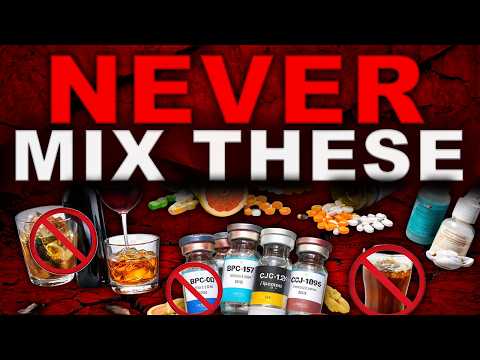
Peptides: The Most Overhyped Trend in Fitness?
A Renaissance Periodization host sorts peptides into five classes and argues none of them grow muscle, then covers storage, safety, sourcing and alternatives.
With Dr. Mike, Scott
Key moments
Tap a moment to play the video from there.
- 0:00No peptides grow muscleDr. Mike states his main claim that no peptide currently grows muscle, and warns about buying from gray market shops.
- 1:02What peptides areHe defines peptides as amino acid chains under about 50 units long that work as signaling molecules, and says insulin and GLP-1 are examples.
- 2:36Injection and other routesHe says most peptides are injected under the skin because digestion breaks them down, and that nasal, dermal and oral routes are rare.
- 3:38Storage and handlingHe says peptides degrade with heat, light, agitation and contamination, and that mixed vials last weeks, which he says affects vial size and travel.
- 6:13Five classes of peptidesHe lists weight loss drugs, recovery peptides, exercise mimetics, growth hormone secretagogues and IGF-1 modulators, with the effects he attributes to each.
- 11:00What each class is useful forHe goes through each class and says what he thinks it does and does not offer, including that secretagogues give small, marginal effects.
- 14:54Safety by classHe gives his view of safety for each class, saying the weight loss drugs are best studied and the recovery peptides have very limited human safety data.
- 18:07Should you take them?He uses a car analogy to argue readers should pick a desired effect first, and says he rarely recommends peptides outside the weight loss drugs.
- 20:10Sourcing and the futureHe says prescription is the route for vetted drugs, describes gray market risk, and predicts muscle-building peptides and oral small molecules are coming.
What the video says
Dr. Mike of Renaissance Periodization opens by saying that when people ask which peptide to take for muscle growth, his answer is that no peptide currently does that. He defines peptides as short amino acid chains that act as signaling molecules, notes that most are injected under the skin because the gut breaks them down, and says nasal, cream and oral forms are rare or inconsistent. He also covers handling: he says freeze-dried powder is refrigerated, mixed vials degrade over weeks, and shaking or repeated needle entry can ruin a vial.
He then groups peptides into five classes. These are the modern weight loss drugs (semaglutide, tirzepatide, retatrutide), recovery peptides (BPC-157, TB-500), exercise mimetics (MOTS-c), growth hormone secretagogues (sermorelin, CJC-1295, ipamorelin) and IGF-1 modulators. In his view none of them are primary muscle builders. He calls the secretagogues "permissive" and says the IGF-1 drugs have short half-lives, many side effects and poor tissue selectivity, which he says limits their use.
On safety, Dr. Mike says the weight loss drugs are well studied and, in his opinion, safer to take than not to take when dosed properly and prescribed by a doctor. He says the recovery peptides and exercise mimetics have little or no human safety or effectiveness data, and he raises a mechanistic concern about cancer that he says cannot yet be ruled out. He says IGF-1 type drugs are likely a poor trade-off for most people. These are his views, not established findings.
He closes with advice to decide what effect you want first, to talk to a doctor about tirzepatide, hormone replacement or growth hormone replacement, and to treat gray market online shops as a gamble. He predicts muscle-building peptides and oral small molecule drugs may arrive within a few years. The video also promotes the RP apps.
On each compound
Tirzepatide4:25
Dr. Mike says tirzepatide, with semaglutide and retatrutide, is the best-tested class, with no muscle-growth effect. He says it is worth discussing with a doctor for fat loss and metabolic health, and that mixed vials lose effect after a few weeks.
See how your DNA reads TirzepatideSemaglutide6:52
Dr. Mike groups semaglutide with the modern weight loss drugs and says they have no anabolic effect. He says multi-year data show lower all cause mortality in older people taking them.
See how your DNA reads SemaglutideRetatrutide6:52
Dr. Mike describes retatrutide as soon to be approved and groups it with the weight loss drugs. He says he would take it for weight loss and metabolic health when it comes out.
See how your DNA reads RetatrutideBPC-1577:14
Dr. Mike says BPC-157 is used for injury recovery with mixed results, very limited human safety data and no muscle growth effect. He raises a hypothetical cancer concern and says that if someone uses it, he would not run it year-round.
See how your DNA reads BPC-157TB-5007:14
Dr. Mike places TB-500 with the recovery peptides and says it has almost no human safety or effectiveness data. He says he would not recommend running it year-round.
See how your DNA reads TB-500MOTS-c7:44
Dr. Mike calls MOTS-c an exercise mimetic that may support energy and health but is too under-researched for him to state its risks or benefits. He says there are mechanistic reasons to suspect it is somewhat anti-anabolic.
See how your DNA reads MOTS-cSermorelin8:15
Dr. Mike lists sermorelin among the growth hormone secretagogues. He says they raise growth hormone to high normal levels but underperform growth hormone itself and give only small, permissive effects.
See how your DNA reads SermorelinCJC-12958:15
Dr. Mike lists CJC-1295 as a growth hormone secretagogue and says these drugs are under-vetted in human safety trials.
See how your DNA reads CJC-1295Ipamorelin8:15
Dr. Mike lists ipamorelin as a growth hormone secretagogue. He says it would enhance a fitness plan only at the margin and would not transform results.
See how your DNA reads IpamorelinIGF-1 LR38:58
Dr. Mike names IGF-1 LR3 among the IGF modulators. He says they have short half-lives, many side effects and poor tissue selectivity, and that he thinks they are likely a poor trade-off outside very advanced stacks.
See how your DNA reads IGF-1 LR3“there are no peptides that grow muscle”
“you're rolling the dice when you buy through online peptide shops”
What this video doesn’t settle
- Dr. Mike gives his own opinion and experience, and cites no specific trials, so his claims about effectiveness and safety are not backed by sources in the video.
- The video does not give doses, durations or study results for any peptide, so the comparisons between classes cannot be checked against data here.
- His five class grouping and the 90% figure are his own estimate, not an established classification.
Questions this video answers
Do peptides build muscle according to Dr. Mike?
Dr. Mike says no peptide currently grows muscle. He says growth hormone secretagogues are only permissive and IGF-1 modulators have small effects with many side effects, and that he knows of no real world evidence otherwise.
What are the main types of peptides in this video?
Dr. Mike describes five classes: weight loss drugs, recovery peptides, exercise mimetics, growth hormone secretagogues and IGF-1 modulators. He says these cover roughly 90% of peptides in circulation.
How does Dr. Mike say peptides should be stored?
He says freeze-dried powder keeps for months or years in the fridge. Once mixed with bacteriostatic water, he says they need refrigeration at 2 to 8° C and lose potency over weeks, and should not be shaken.
What does Dr. Mike say about buying peptides online?
He says vetted drugs like tirzepatide come with a prescription, while many others come from gray market shops. He says some are good and some are not, so buyers are rolling the dice.
What does Dr. Mike say about BPC-157 safety?
He says it has very limited human safety data and that he cannot rule out a cancer related concern, which he describes as hypothetical. He says he would not run it year-round.
Video by Renaissance Periodization on YouTube, embedded as published. The summary is written by PeptidesDNA from the video; every claim in it is the speaker’s. Not affiliated with or endorsed by the creator. Not medical advice.